Falling in Love

I have fallen in love with quilting. I started after learning about the fascinating history linking quilting to social justice. My first quilt was terrible. I didn’t start until my 50s—a time of life when many people might say it’s too late to take up a new hobby. I never subscribed to that point of view. I earned my doctorate in my late 40s.

When I interviewed my grandmother late in her life, she told me a bit about what sewing meant to her.

The part that gets me every time is how she says going into her sewing room was like a whole other world, and that she really missed doing it.

I always wanted to sew, but my results were so disappointing. I was scared of the machine. My seams were never straight. I once made a pair of shorts and put the pocket in backward. The shirt I made to match it didn’t fit because I’d messed up the seams. When I was in 6th grade, I took a home economics class—half cooking, half sewing—for only 6 weeks. Our sewing project was a door organizer with large pockets that you could hang over your door. I was having trouble with it, so I took it home to work on it. My grandmother asked if I was allowed to use a fusible bonding. (Looking back, I could have appliquéd the decorations on the door organizer, but my grandmother was not a quilter, and I’m not sure her machines had appliqué stitches.) My teacher said that was fine. I tried to do the project myself, but my grandmother was an impatient teacher. She took it over. She asked me later what grade she got on it. An A, of course. One of my classmates, a girl who, by turns, bullied me or acted like a friend when she needed something from me, loudly proclaimed to the whole class that my grandmother made it. I was embarrassed. She was right, but she didn’t know the whole story. I cannot blame my grandmother too much. I was probably a pain to teach because I was so inept. I concluded sewing, at least with a machine, was not something I’d ever be any good at, so I never tried to learn.

My only regret now is not starting to sew until my 50s, because it has brought me so much joy and become such an essential artistic outlet. I understand the feeling my grandmother described in our interview. It’s also offered me an opportunity to create art based on my reading.
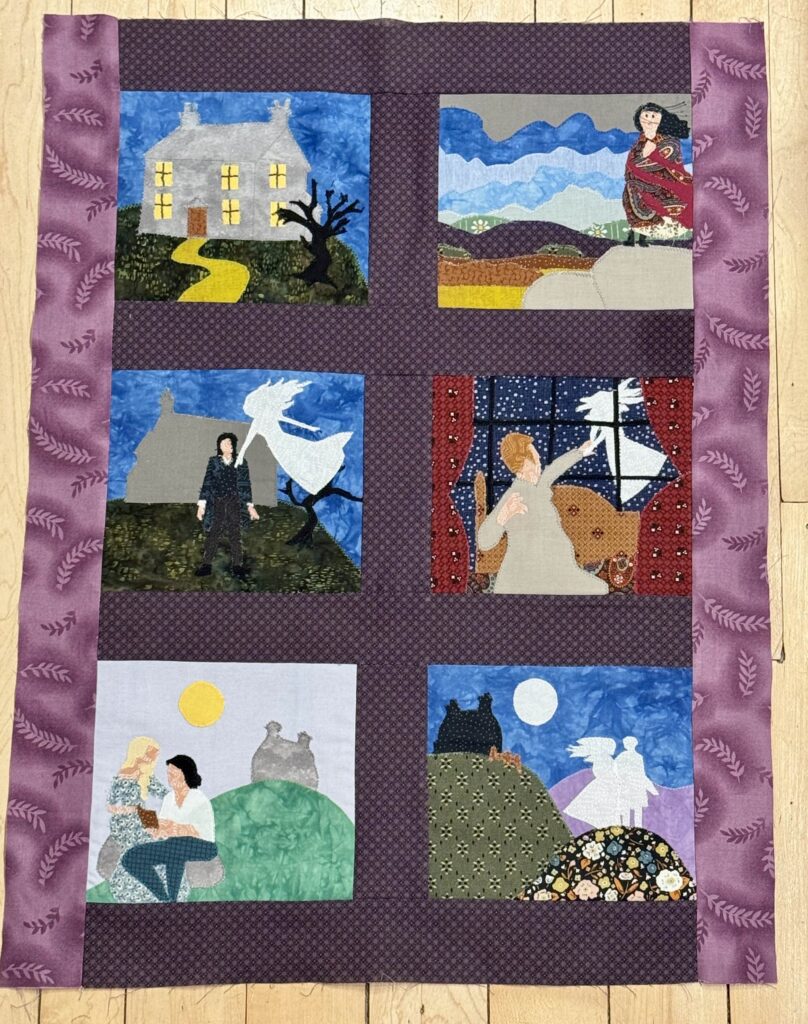
Pictorial quilt with six panels based on scenes from Wuthering Heights, including a picture of Wuthering Heights itself, Catherine on the moors, Heathcliff with the ghost of Catherine hovering overhead and touching his arm, Catherine's ghost grabbing Lockwood's arm and trying to pull him through the window of her bedroom, Hareton and Young Cathy reading with a sunny image of Wuthering Heights far in the background, and the ghosts of Catherine and Heathcliff with Wuthering Heights in the distance under the moonlight.
My quilt top based on Wuthering Heights

I also joined a block-of-the-month spanning the quilting history and techniques from the 1930s to the 2010s, and during the month we did a block based on the 1950s, I realized that my grandmother’s life spanned those decades, so I based my decades quilt on her life.
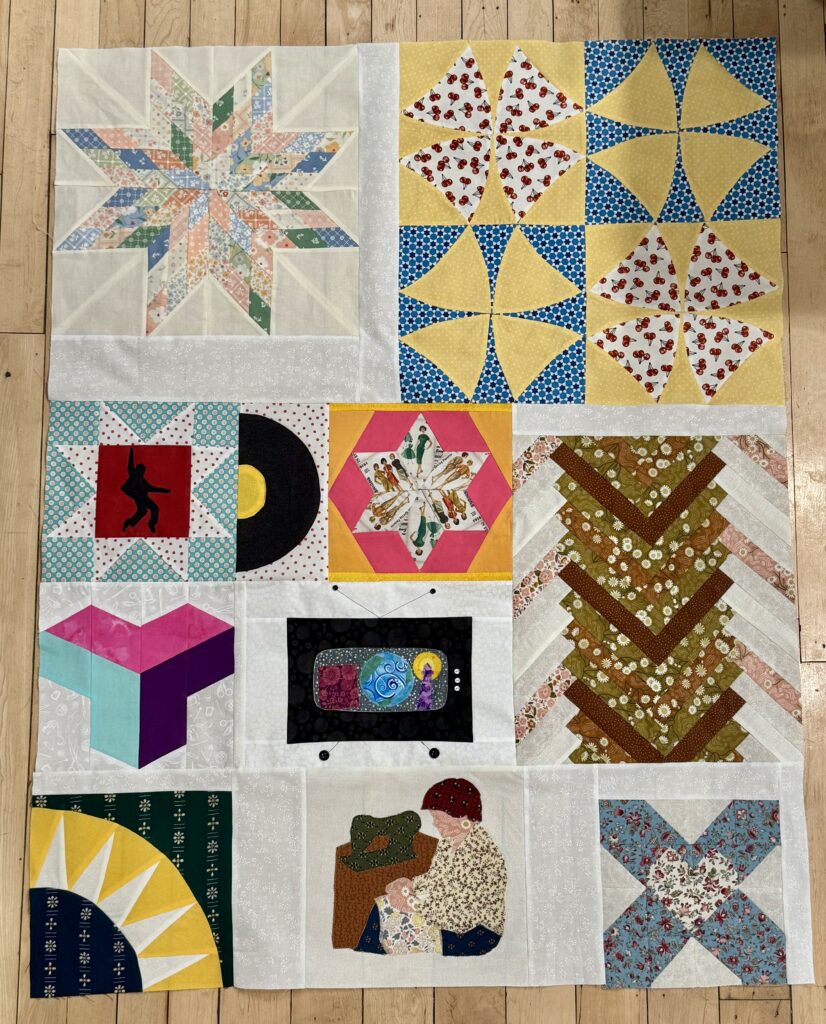
An eclectic quilt with blocks based on decades from the 1930s to the 2010s.
My quilt titled Granna

The first block in the Lone Star pattern is the 1930s block and is meant to evoke feed-sack prints, popular and economical for clothing and quilts during the Depression. I swear I remember my grandmother saying she wore dresses made of flour sacks. She lived in Oklahoma at the time, but by her early adulthood, she was living in Texas, the Lone Star State. The inspiration for the second block in the Winding Ways pattern was Rosie the Riveter. I wonder what Granna thought about women going to work during World War II. The third block with a Sawtooth Star and an appliqué image of Elvis evokes a funny family story my mom used to tell me about living across the street from her grandmother, my grandmother’s mother-in-law, who didn’t like it when Granna played her Elvis records too loud. The 1960’s block, a six-pointed star, was almost entirely hand-pieced. The images are meant to evoke the many dress patterns my grandmother had—some dating back to this era. The bright colors evoke the late 1960s color palette. The large block with the browns is a braid block, and it might be my favorite decade block. The 1970s color palette also serves as a symbol: the three brown strands represent my grandmother’s three children and their spouses, since all three married in the 1970s, and the flowered strands to the side represent her six grandchildren, all born in the 1970s. The 1980s block is more abstract. My instructors called it an “Inner-City Block.” The 1980s colors and style represent the height of my grandmother’s sewing business. It is hard to see in the image, but the block’s background features a sewing motif. The TV block displays images representing the three soap operas she watched: All My Children (red book), As the World Turns (globe), and Guiding Light (lighthouse). The 2000s block is a New York Beauty quarter, and the colors are highly symbolic. My grandparents celebrated their 50th wedding anniversary in 2000, and the dark blue fabric is my grandmother’s birthstone, while the dark green is my grandfather’s. The white rays and gold in the middle represent the Golden Anniversary. The next block is an appliquéd image of my grandmother at her sewing machine. I based it on my favorite photograph of her. I was really proud of how it came out because it really looks just like her. The last block, the 2010s block, has a bit of unintended symbolism. I read an Emily Dickinson poem at my grandmother’s funeral, and one line I emphasized was “Life steps almost straight” because I was trying to say that we would always miss my grandmother, and even if we grew accustomed to the darkness of her absence, things wouldn’t ever be the same again. You probably can’t tell from the picture, but the seams in that block are pretty straight, except for the upper-right corner of the “kiss” (X-shape). Life… and sewing… almost straight. It was like a little wave from Granna.

Not only did I enjoy making both of these quilts, but I’m also proud of the work I did, and I believe my grandmother would be as well. In fact, I know she is.
Related posts:

Penny Black, Penny Red

My grandfather passed away in April, two weeks before his 95th birthday. He was my last living grandparent, and we were close. When I was about nine, he got me started on a stamp collection. He took me to the hobby shop in the shopping center about a quarter of a mile from his house, and he selected a starter stamp album for me. He bought a package of hinges to fasten stamps into the album. He probably also bought me a grab bag of loose used stamps, some of them still stuck to a corner of an envelope. He showed me how to use the album, which had tiny pictures of the stamps. These albums are helpful for beginners because once you find the picture of my stamp, you just affix the stamp to the image using a hinge. Papa showed me how I could put a used stamp that was still stuck to the envelope in a small bowl of warm water, and it would separate from the paper without tearing. Then I could dry the stamp on a paper towel and affix it to my album with a hinge.

He donated stamps from his own collection to help me get started. He collected stamps from all over the world. I remember being confused about the country of origin of one of the stamps, and he helped figure out where to put it, explaining that there were “two Chinas.” I didn’t understand what he meant, but I realized later it must have been a generational difference—I had only ever known the country he called the “second China” as Taiwan. I learned a lot about history and geography from collecting stamps.

My own collection was never large. I took up the hobby again in my 20s, but unfortunately, I couldn’t really afford it at the time, so I set aside the collecting for a while. I inherited my grandfather’s collection, which might not be considered large in philatelic circles, but it’s much larger than mine ever was. He appears to have stopped collecting stamps himself around the time I was born, or at least his albums don’t appear to date past the early 1970s. He has albums dedicated to the countries of France, Germany, Japan, Great Britain (the United Kingdom), and the U.S.A. He also has many stock albums and a few handmade albums with carefully drawn templates and typed on what I recognize as his old Royal typewriter.

The stamps in his U.S. album are mounted, while the other stamps all appear to be affixed to their albums with hinges. I think a long time ago, hinges were considered relatively harmless, but these days, many collectors prefer mounts. Mounts are affixed to the album, but they do no damage to the stamps themselves, unlike hinges, which sometimes disturb the gum or the paper on the back of the stamp.

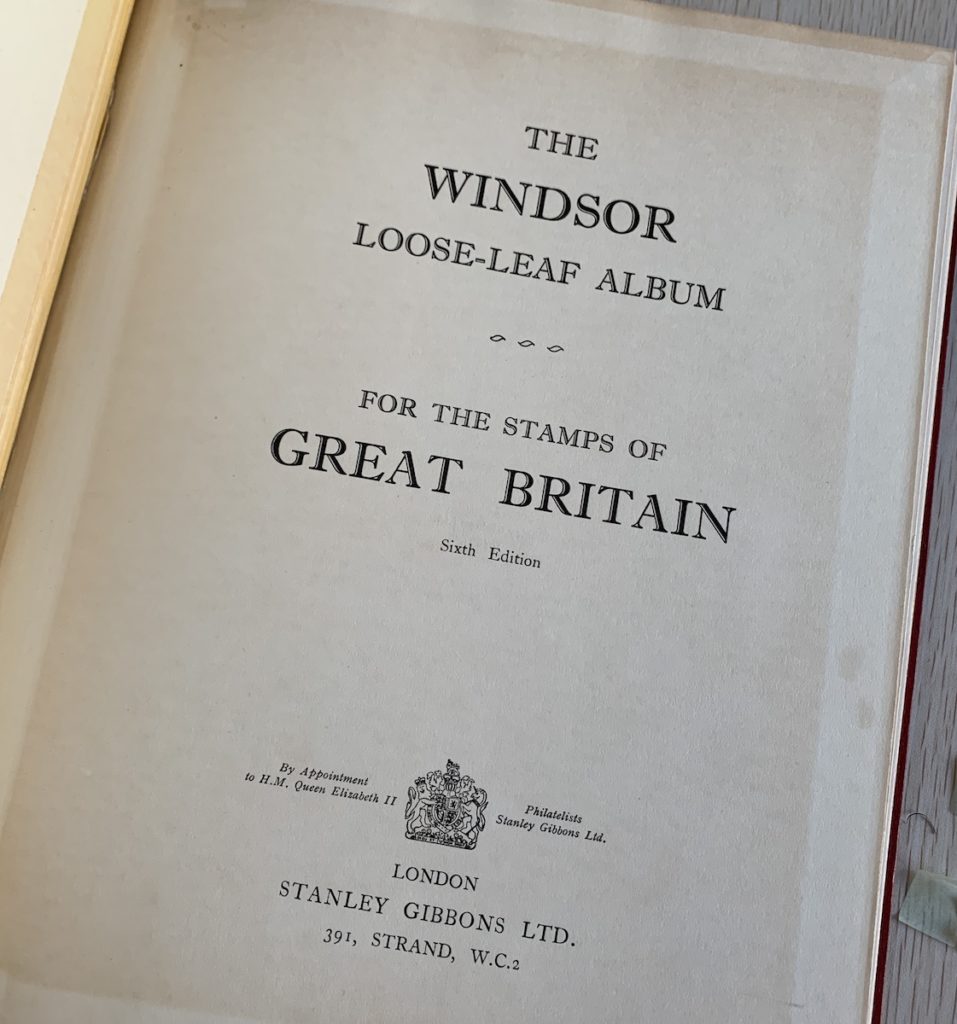
Stamp albums are really expensive, and I wouldn’t be able to find some of the albums Papa used anymore—maybe on eBay, but certainly not easily. I plan to preserve his collection and perhaps add to it, but I wanted to replace all his hinges with mounts.  This is the title page of his British stamp album.

Stamp Album Title Page

Its copyright date is 1959. I don’t have much to compare it to, but I suspect it might be a more comprehensive British stamp album than one made in the U.S. Stanley Gibbons is a stamp merchant in the U.K. The edges of the page are lighter. I am not sure what caused the discoloration, but I suspect maybe the paper on the part of the cover touching the title page is not acid-free. The pages in the rest of the album seem fine, but all the more reason to mount the stamps. I wouldn’t want them to become discolored, too.

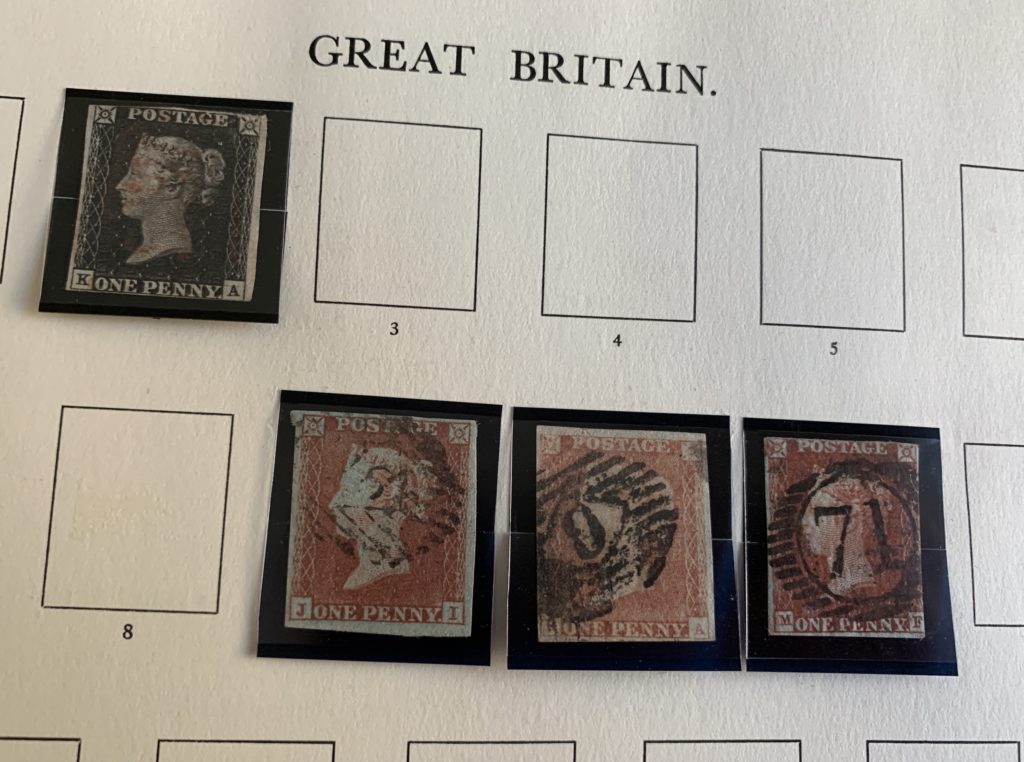
I discovered the pre-cut mounts I ordered were a bit too big, so I ordered some mount strips and a little craft guillotine so I could cut the mounts to the correct size. My last supply order arrived today, so I started working on Papa’s Great Britain album. This is the first page.

The stamp in the upper left is known as a “Penny Black.” Penny Blacks were the first postage stamps. They’re not exceedingly rare, but I think just about every collector wants one. If you are collecting stamps, you want to have the first postage stamp in your collection. The Penny Black was issued for less than a year—May 1840 to February 1841. The reddish cancelation you can see on the stamp was apparently easy to remove, and people reused the stamps, so the British postal service decided to change the stamp’s color to red and use black cancelation, which would be harder to remove. This stamp was called a “Penny Red.” I don’t know if you can tell, but the first stamp with the letters J and I in the corner is actually on blue paper. The three stamps in the second row date from about 1841.

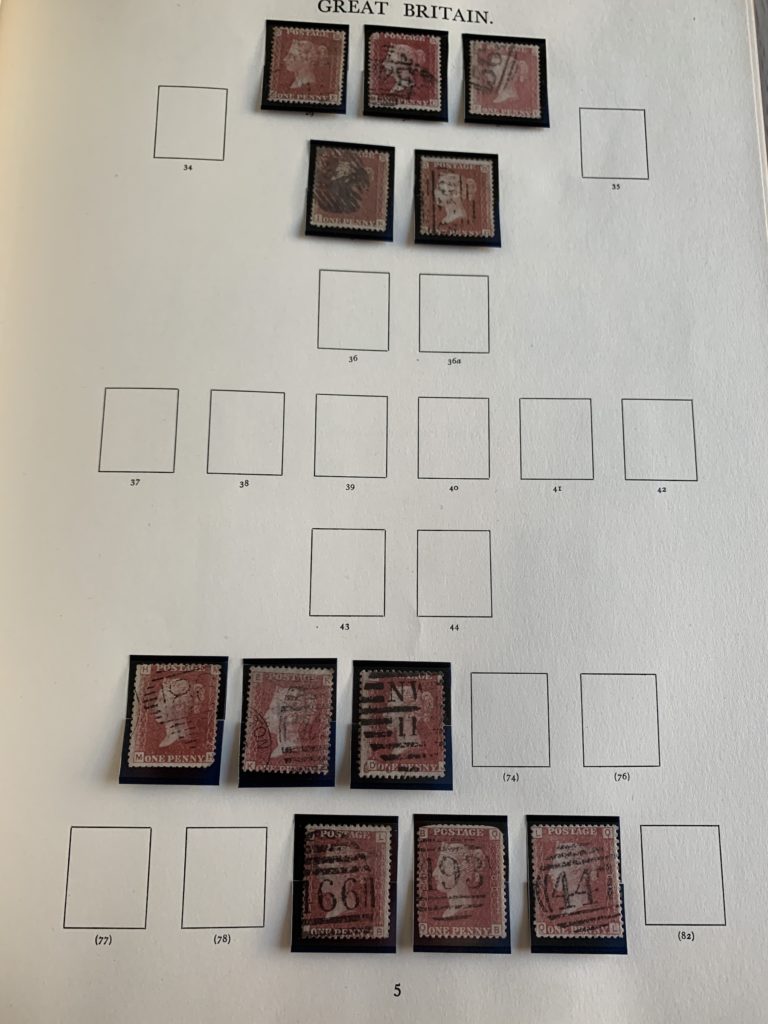
This next page includes stamps with a similar design, but they were issued later. The stamps at the top date from 1854-1857. The ones on the bottom date from 1858-1879. You probably can’t see this because I can only barely detect it with a magnifying glass, but the stamps on the bottom row have plate numbers in their frames on each side. The plate number is what it sounds like: the number given to the plate used to print the stamps. Plate numbers started appearing on Penny Reds in 1864.

Papa doesn’t have a complete collection of Penny Reds with each plate number, but it’s clear the album was designed for a serious collector who might want to have a copy of a Penny Red from each plate.

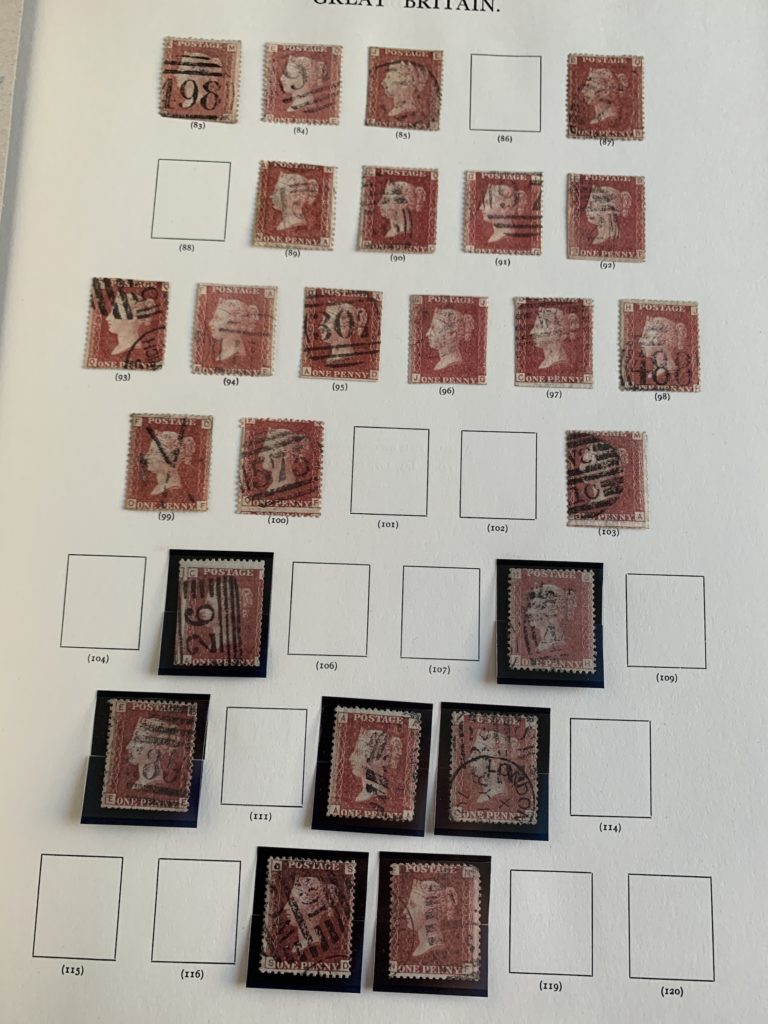
Here is another page of Penny Reds with plate numbers. I took a picture of this page in the middle of replacing the hinges with mounts. You can see the mounted stamps on the bottom and the hinged stamps on the top. While I admit I love the way the hinged stamps look in the album, the stamps will be better preserved in mounts. Papa placed the stamps into the album so carefully.

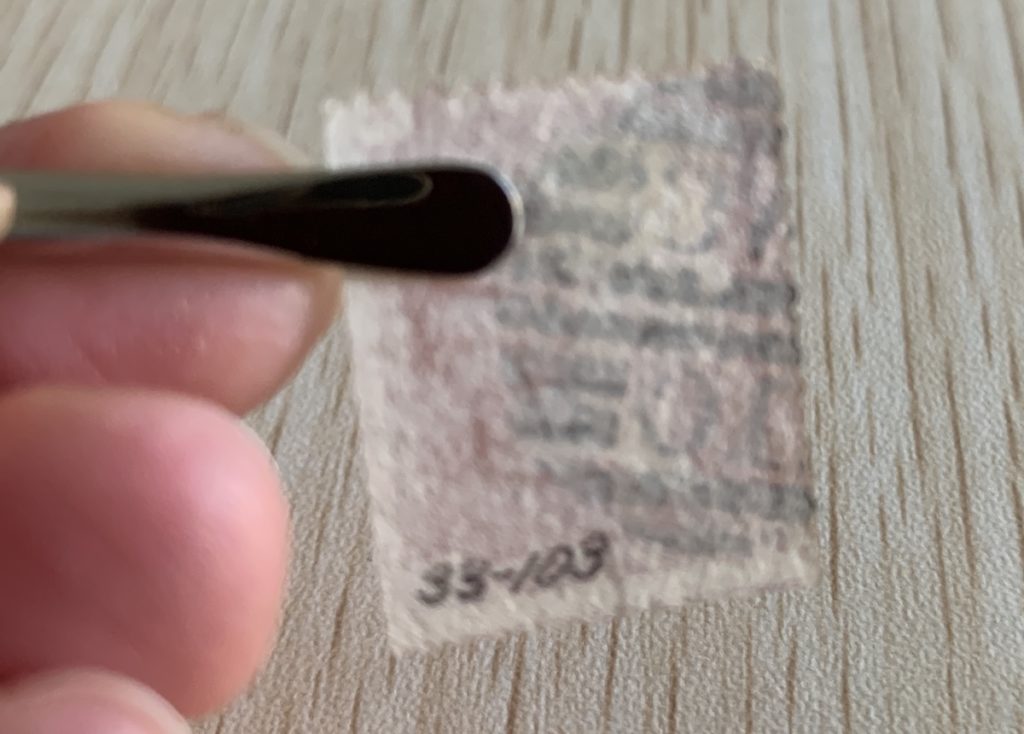
Partway through this project, I realized that someone had written the stamp’s Scott Number and plate number on the back of the stamps.

The Scott Number is the individual number given to each stamp by the Scott Catalogue, a comprehensive list of every stamp produced. Most collectors use Scott Numbers to refer to stamps. The Scott Catalogue also sets the basic value for a stamp, though the value is generally fluid and something that the buyer and seller agree on rather than anything fixed. The Scott Number for this stamp is 33, which was produced from 1864-1879. The plate number for this stamp is 103. The stamps vary in value depending on the plate number. This is not my grandfather’s handwriting. I am not sure who wrote the Scott and plate numbers on the backs of his stamps, but most of his Penny Reds have this information penciled on the back of the stamp. I suspect Papa may have bought or traded for another philatelist’s collection, and perhaps a previous owner penciled these numbers on the stamps. It was a fascinating find, though I suspect it would decrease the value of the stamps. The handwriting is extremely small. Even if I wanted to erase the numbers, I might damage the stamps in doing so.

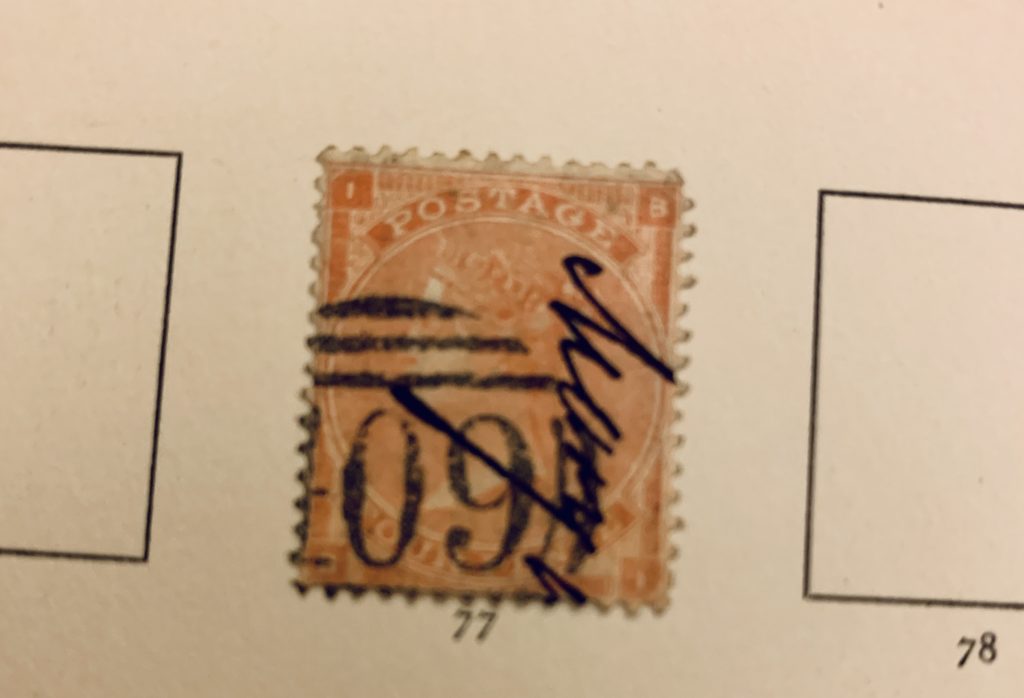
Further on into the collection, I found this stamp with what might be a partially handwritten cancelation. In any case, there is some black handwriting on the stamp.

I think Papa thought this stamp was a Scott 34, but I think it’s probably a Scott 43 based on the color and the way the letters in the corners of the frame look. I don’t know the corresponding Stanley Gibbons Windsor Number for the stamp. I guess I’ll need to get a copy of the Stanley Gibbons catalogue so I can compare. To be fair to Papa, the previous collector who penciled numbers on the backs of the stamps wrote the number “34” on the back, and the two designs are pretty similar.

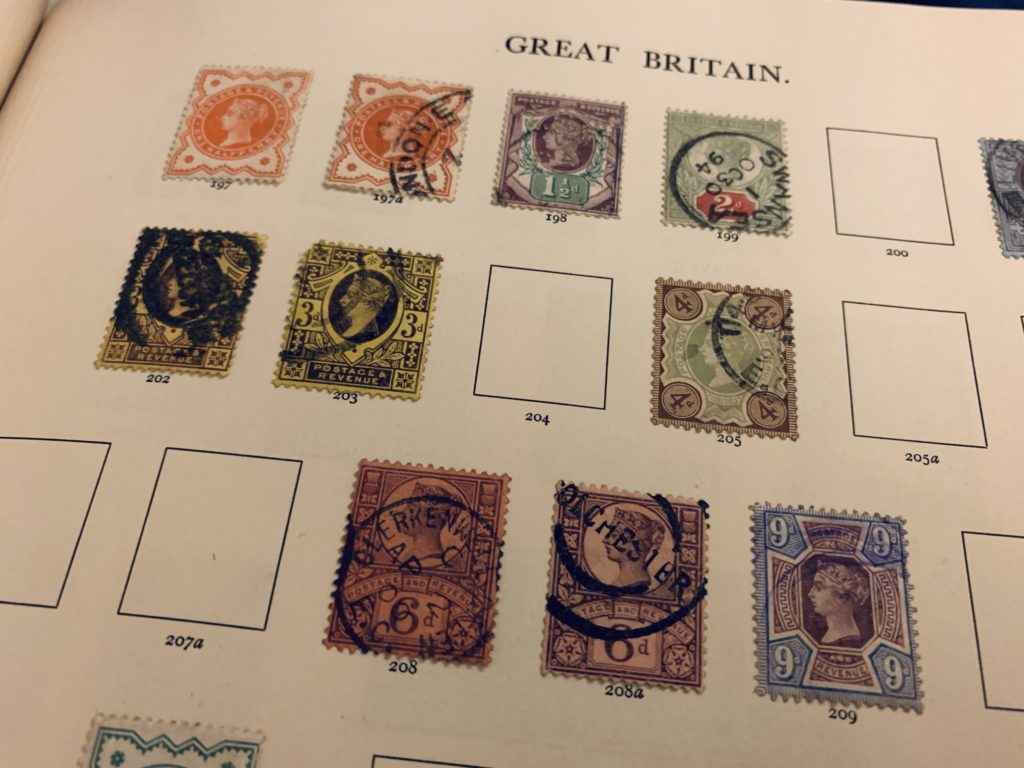
I found Papa’s first mint (not used) stamps dating from about 1887 (the stamp in the upper left).

While this stamp is beautiful and is in great condition, it’s not worth very much (less than $2.00). I also think Papa has the order of the stamps 197 and 197a reversed. The one labeled 197 should be vermilion and the 197a is orange vermilion. I think the one above the label 197 looks more orange.

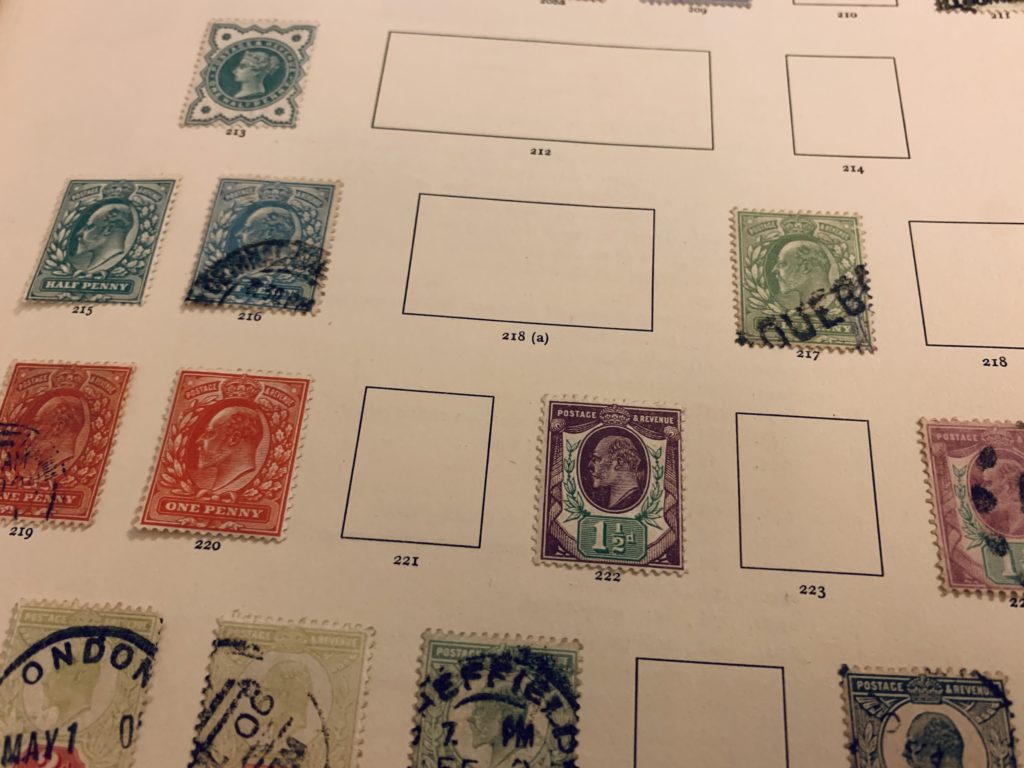
These stamps are on the bottom half of that same page. You can see a few more mint stamps: in the top row, a blue half-penny stamp featuring Queen Victoria, then in the next row a blue-green half-penny featuring Edward VII. In the third row are a scarlet one-penny and a 1½-pence in two colors. Stamps that are unused or mint and centered nicely with gum on the back (if any) intact, are more valuable than used stamps and/or stamps that are poorly centered or missing the gum.

It’s interesting how quickly all of this came back to me as I examined Papa’s stamps. It definitely made me want to build on his collection. It’s strange that I still think of it as his rather than mine. I am starting to think of them as my stamps, but not completely. It made me feel close to him again, to spend some time caring for his stamps and remember him sitting next to me at the coffee table in his house, showing me how to place my stamps into my album.

I don’t think I ever saw these stamps while Papa was alive. I know I would have wanted to spend hours flipping through the albums. I’m not sure why Papa stopped collecting stamps. As far as I can tell, based on what I see in the collection and based on what my Uncle Wayne told me, he collected stamps during the 1950s and 1960s. When my mother and Wayne were little, Papa worked in the post office, and I think he must have picked up the hobby at that time. Papa was something of a serial collector. He would spend a great deal of time on a collecting hobby and then move on to a new one. Wayne looked and looked for this stamp collection, and I think he had just about given up hope of finding it. When he finally found it, he called me and told me he’d bring it to me in person, as he and his girlfriend were going to stay in his girlfriend’s sister’s cottage on Cape Cod. We spent the day together. I was really moved that Wayne went to all that trouble to make sure I could have these stamps. I will treasure this collection. This is us at Cape Cod when we connected a couple of weeks back. (Don’t worry, we kept our masks on indoors, and I have had two negative COVID tests since—I wouldn’t risk his health, nor he mine).

Wayne looks so much like Papa. He told me all about how he used to go to stamp shows with Papa and collected a bit himself when he was young. He said that if not for those stamp shows, he might have started playing drums, which he’s done for 50 years. He said the stamp shows had live music, and he remembered being enthralled by the bands.

As soon as we arrived at the cottage, Wayne pulled out Papa’s stamps to show me. He had an old apple box full of albums. I don’t know that I can bear to toss out the box, even if I put the albums on a bookshelf at some point because Papa wrote “Automobile Quarterly” in his clear print on the top. At one time, he must have kept his issues of the magazine in that box. It was a publication devoted to collectible cars—another of Papa’s hobbies. Wayne will keep that particular collection. It isn’t that I don’t have anything in Papa’s handwriting. Once he sent me the longest letter I’ll probably ever receive, written on tablets, because I asked him to write down some of his stories.

I thought about Papa and my grandmother, who passed in 2016, this week as the 27th would have been their 70th wedding anniversary. I feel really blessed to have had them in my life and to have some of their things—a pair of Granna’s Gingher scissors and some spools of thread, a sewing machine foot, some thimbles, a packet of needles dating from the 1950s, an old package of stale Freedent gum, a tape measure, a business card… and Papa’s stamps.

Related posts: