I have fallen in love with quilting. I started after learning about the fascinating history linking quilting to social justice. My first quilt was terrible. I didn’t start until my 50s—a time of life when many people might say it’s too late to take up a new hobby. I never subscribed to that point of view. I earned my doctorate in my late 40s.
When I interviewed my grandmother late in her life, she told me a bit about what sewing meant to her.
The part that gets me every time is how she says going into her sewing room was like a whole other world, and that she really missed doing it.
I always wanted to sew, but my results were so disappointing. I was scared of the machine. My seams were never straight. I once made a pair of shorts and put the pocket in backward. The shirt I made to match it didn’t fit because I’d messed up the seams. When I was in 6th grade, I took a home economics class—half cooking, half sewing—for only 6 weeks. Our sewing project was a door organizer with large pockets that you could hang over your door. I was having trouble with it, so I took it home to work on it. My grandmother asked if I was allowed to use a fusible bonding. (Looking back, I could have appliquéd the decorations on the door organizer, but my grandmother was not a quilter, and I’m not sure her machines had appliqué stitches.) My teacher said that was fine. I tried to do the project myself, but my grandmother was an impatient teacher. She took it over. She asked me later what grade she got on it. An A, of course. One of my classmates, a girl who, by turns, bullied me or acted like a friend when she needed something from me, loudly proclaimed to the whole class that my grandmother made it. I was embarrassed. She was right, but she didn’t know the whole story. I cannot blame my grandmother too much. I was probably a pain to teach because I was so inept. I concluded sewing, at least with a machine, was not something I’d ever be any good at, so I never tried to learn.
My only regret now is not starting to sew until my 50s, because it has brought me so much joy and become such an essential artistic outlet. I understand the feeling my grandmother described in our interview. It’s also offered me an opportunity to create art based on my reading.
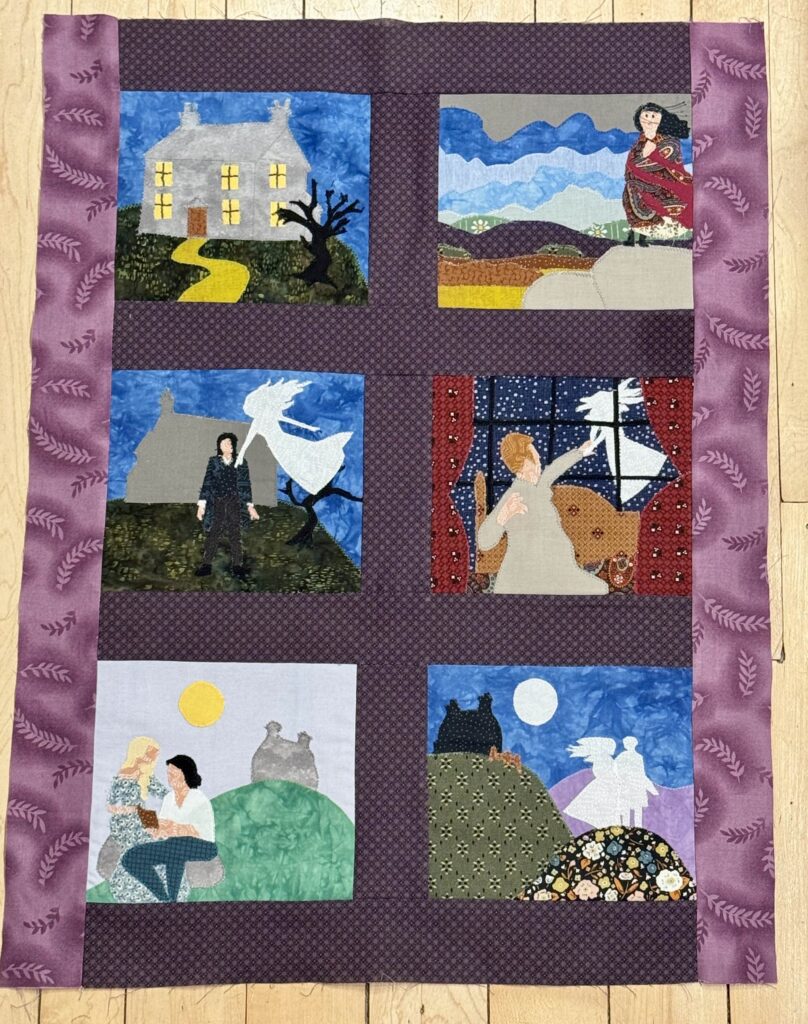
I also joined a block-of-the-month spanning the quilting history and techniques from the 1930s to the 2010s, and during the month we did a block based on the 1950s, I realized that my grandmother’s life spanned those decades, so I based my decades quilt on her life.
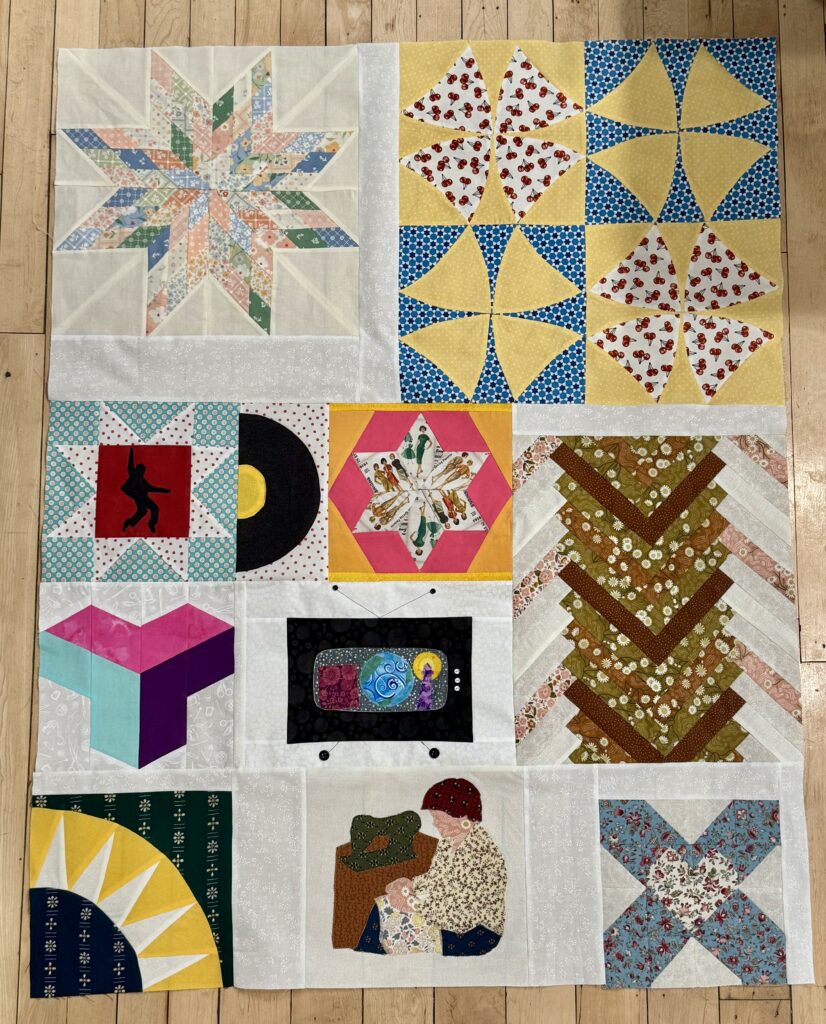
The first block in the Lone Star pattern is the 1930s block and is meant to evoke feed-sack prints, popular and economical for clothing and quilts during the Depression. I swear I remember my grandmother saying she wore dresses made of flour sacks. She lived in Oklahoma at the time, but by her early adulthood, she was living in Texas, the Lone Star State. The inspiration for the second block in the Winding Ways pattern was Rosie the Riveter. I wonder what Granna thought about women going to work during World War II. The third block with a Sawtooth Star and an appliqué image of Elvis evokes a funny family story my mom used to tell me about living across the street from her grandmother, my grandmother’s mother-in-law, who didn’t like it when Granna played her Elvis records too loud. The 1960’s block, a six-pointed star, was almost entirely hand-pieced. The images are meant to evoke the many dress patterns my grandmother had—some dating back to this era. The bright colors evoke the late 1960s color palette. The large block with the browns is a braid block, and it might be my favorite decade block. The 1970s color palette also serves as a symbol: the three brown strands represent my grandmother’s three children and their spouses, since all three married in the 1970s, and the flowered strands to the side represent her six grandchildren, all born in the 1970s. The 1980s block is more abstract. My instructors called it an “Inner-City Block.” The 1980s colors and style represent the height of my grandmother’s sewing business. It is hard to see in the image, but the block’s background features a sewing motif. The TV block displays images representing the three soap operas she watched: All My Children (red book), As the World Turns (globe), and Guiding Light (lighthouse). The 2000s block is a New York Beauty quarter, and the colors are highly symbolic. My grandparents celebrated their 50th wedding anniversary in 2000, and the dark blue fabric is my grandmother’s birthstone, while the dark green is my grandfather’s. The white rays and gold in the middle represent the Golden Anniversary. The next block is an appliquéd image of my grandmother at her sewing machine. I based it on my favorite photograph of her. I was really proud of how it came out because it really looks just like her. The last block, the 2010s block, has a bit of unintended symbolism. I read an Emily Dickinson poem at my grandmother’s funeral, and one line I emphasized was “Life steps almost straight” because I was trying to say that we would always miss my grandmother, and even if we grew accustomed to the darkness of her absence, things wouldn’t ever be the same again. You probably can’t tell from the picture, but the seams in that block are pretty straight, except for the upper-right corner of the “kiss” (X-shape). Life… and sewing… almost straight. It was like a little wave from Granna.
Not only did I enjoy making both of these quilts, but I’m also proud of the work I did, and I believe my grandmother would be as well. In fact, I know she is.