Cron Jobs and MT

Learning Movable Type has an interesting post about scheduled postings and cron jobs. A cron job is an automated task set to run in the future. If you have MT 3.1x, you have probably noticed you can save a post as “draft,” “publish,” or “future.” In order to make use of the “future” post status, you need to create a cron job.

Elise and Arvind do a wonderful job explaining how to do this, and their tutorial works very well, although I noticed my post did not occur *exactly* when I set it to occur; however, it posted soon after that. It was probably my server and nothing to do with their instructions.

When might you want to save a post for a future date?

  • When you want to commemorate a special event, like a birthday, holiday, anniversary, etc.
  • When you are going out of town, but want to continue to post to your blog, because daily posting (or something close to it) is important to you.

I did not find, as Elise and Arvind indicated, that the cron job needed to be set to run every fifteen minutes of every hour, day, week, and month, but my server’s cron job configuration may be different. That just seemed a little excessive to me.

How will you know if it works? Well, I set this to post on Friday morning. If it works, then you’re reading this. I promise not to cheat and change the draft status to “publish” if it doesn’t.

Update: It appears to have worked! By the way, I figured out the issue with cron job not running as scheduled. The folks who host PlanetHuff are located in the Pacific time zone. The cron job I set to run at 8:00 actually ran at 8:00 PDT, which was 11:00 EDT. You may want to find out if you would have the same problem. Also, make sure the permissions to your file “run scheduled tasks” located in your “tools” folder under wherever you have MT installed, are set to 755. I tried to run a cron job on my other web site and received a permission denied error, because I forgot to change the permissions.

Related posts:

Lord Byron

Lord ByronOn this day in 1824 Byron’s body arrived in London, returned home for burial from Missolonghi, Greece, where the poet had died ten weeks earlier.

Lord Byron, the sexiest Romantic poet. Kay Redfield Jamison profiled Byron in Touched With Fire. Her contention is that Byron most likely was bipolar, which fits very well with everything I’ve read about him.

His last poem, “On This Day I Complete My Thirty-Sixth Year” in some way explains why he was in Greece.

I also found it it interesting that on this day in 1821, Byron was apparently ruminating over the passions of poets:

I can never get people to understand that poetry is the expression of excited passion, and that there is no such thing as a life of passion any more than a continuous earthquake, or an eternal fever. Besides, who would ever shave themselves in such a state?
Lord Byron, in a letter to Thomas Moore, 5 July 1821

You can read more Byron at this site, which has a large collection of links.

Related posts:

How the WWW is Changing the Way We Read

The Web is changing how people read.

Take “Hamlet.” A decade ago, a student of the Shakespeare play would read the play, probably all the way through, and then search out separate commentaries and analyses.

Enter hamletworks.org.

When completed, the site will help visitors comb through several editions of the play, along with 300 years of commentaries by a slew of scholars. Readers can click to commentaries linked to each line of text in the nearly 3,500-line play. The idea is that some day, anyone wanting to study “Hamlet” will find nearly all the known scholarship brought together in a cohesive way that printed books cannot.

I have to admit this sounds exciting to me, as an English teacher. Having so much knowledge at our fingertips could really enhance our knowledge. I know many people believe that books are on the way out, set to be replaced by all the online reading we do. No matter how much time I spend each day, curled up in my computer chair, in front of the computer screen, and checking the RSS feed tracker I use to see which blogs I read have updated, I still can’t see books being replaced. I just can’t read longer works online. There is something about the feel of books in your hand, about the way they smell, that can’t be replaced by a computer screen.

Barnes and Noble and Borders are crowded every time I go there.

Related posts:

Ernest Hemingway

On this day in 1961, Ernest Hemingway committed suicide. Suicide runs in his family. One glance at his family history must be a textbook example of a genetic link to mental illness. Hemingway’s own father Clarence, his brother Leicester and sister Ursula, and his granddaughter Margaux all also committed suicide. While his death cannot be termed a suicide, Hemingway’s youngest son Gregory died a transsexual who called herself Gloria in a women’s jail cell in 2001 after having been arrested for indecent exposure. Gregory’s daughter Lorian Hemingway blamed his substance abuse problems for the revocation of his medical license. One can only imagine what Papa himself might have made of “Gloria.” You can read more about Gregory Hemingway at The Strange Saga of Gregory Hemingway.

My favorite Hemingway work is The Sun Also Rises. This is probably my favorite passage:

I lay awake thinking and my mind jumping around. Then I couldn’t keep away from it, and I started to think about Brett and all the rest of it went away. I was thinking about Brett and my mind stopped jumping around and started to go in sort of smooth waves. Then all of a sudden I started to cry. Then after a while it was better and I lay in bed and listened to the heavy trams go by and way down the street, and then I went to sleep.

Which is followed at the end of the same chapter by a related passage:

This was Brett, that I had felt like crying about. Then I thought of her walking up the street and stepping into the car, as I had last seen her, and of course in a little while I felt like hell again. It is awfully easy to be hard-boiled about everything in the daytime, but at night it is another thing.

Somehow, I felt like those two passages defined something about human nature, or at least my nature. I just thought those passages were so pretty.

Hemingway links:

Related posts:

George Sand

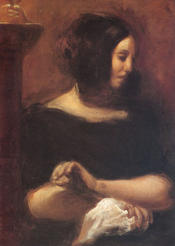
Portrait of George Sand by Eugene DelacroixHave you ever heard of George Sand? George Sand was the pen name of Amandine-Aurore-Lucile Dupin, Baroness Dudevant, a novelist and proto-feminist who lived in 19th century France. She wore men’s clothing, which was considered shocking for the time. I can’t remember anymore how I first heard of her, but I remember when. I was a freshman in college, and I had come across some writings from her journal after her parting from Alfred de Musset. I remember being so affected by what I read. This was a woman in pain — so in love and so forlorn. Clearly, I thought, she would never love another. Then I discovered she was Chopin’s lover until shortly before his death.

Right after I became aware of George Sand, it seems, a movie called Impromptu starring Judy Davis and Hugh Grant as Sand and Chopin, respectively, was released. It was OK. I ran out and bought a bunch of Sand novels, but I only ever read one: Indiana. Maybe it was the translation (probably not the translation linked, as I couldn’t find it on Amazon), but I thought it was awful, and I wondered if the author’s unconventional life might not be the only reason it’s even still available.

If you can read French, several of her works are available from Project Gutenberg. Her letters and journals are well worth checking out. In a letter to Frederic Girerd, she wrote:

People think it very natural and pardonable to trifle with what is most sacred when dealing with women: women do not count in the social or moral order. I solemnly vow — and this is the first glimmer of courage and ambition in my life! — that I shall raise woman from her abject position, both through my self and my writing, God will help me!…let female slavery also have its Spartacus. That shall I be, or perish in the attempt.

Honore de Balzac wondered, “What will become of the world when all women are like George Sand?”

Update: A weird bit of serendipity… July 1, when I posted this entry, was George Sand’s birthday.

Related posts: