Sherlock Holmes: The Adventure of the Red Circle, Sir Arthur Conan Doyle

Brock Red Circle
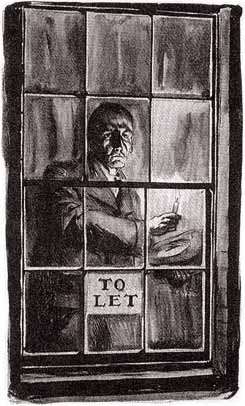
Illustration by H. M. Brock for The Strand

This week’s story in the Chronological Sherlock Holmes Challenge is “The Adventure of the Red Circle,” which is one of many stories that seems to follow a similar patter for Doyle: a mysterious “foreigner” shows up in London bringing intrigue from their country of origin with them, and Holmes must get to the bottom of it. In the case of this mystery, Holmes is initially uninterested, but he is moved to investigate by the pleas of a landlady, Mrs. Warren, who is increasingly suspicious of her new boarder. In spite of himself, Holmes finds himself interested Mrs. Warren’s story and agrees to help.

Holmes and Watson discover several suspicious anomalies as they begin investigating the case: first, the lodger’s notes are printed rather than written in cursive, and Holmes can somehow tell from the cigarette butts the lodger leaves behind that he does not have a mustache, while Mrs. Warren insisted he did have one. Holmes discovers that the landlady has no contact with the lodger aside from these written requests and a ringing bell for meals, which she leaves outside the lodger’s rooms. Breakfast includes copy of the The Daily Gazette. Holmes begins searching the Daily Gazette‘s extracts for messages and believes he is onto something when he finds a series of messages signed “G.”

This one didn’t grab me, though I did enjoy the fact that Holmes didn’t figure out all the pieces of the mystery before everyone else did. Gregson from Scotland Yard was a bit ahead of him on who the mysterious occupant boarding with Mrs. Warren is connected to, and he has a Pinkerton agent with him who is after the same man. I enjoyed Holmes’s comment to Watson, who questions why he is taking on this case when there doesn’t seem to be much substance to it: “Education never ends, Watson. It is a series of lessons with the greatest for the last.” That said, it was long on exposition at the end when the mysterious lodger is revealed, and Holmes doesn’t play much of a role in his deduction, except for a few wild leaps that don’t make as much sense (to me) as his deductions typically do, as well as some substantial lack of resolution in the end. If you want to know what the Red Circle is all about, you’ll be disappointed. The villain is easily dispatched, given he is such a threat, and the man who obtained the lodgings from Mrs. Warren disappears, his fate unknown, though Doyle alludes to an escape.

This story originally appeared in His Last Bow and was 44th in composition. Those who have ordered the stories chronologically must have their reasons for ordering this story number 6, but I’m not sure how they figured it out, as there did not seem to me to be any timeline indicators, but I admit I’m not a Sherlock Holmes scholar. I didn’t notice any connections to the Sherlock TV series, possibly because as Sherlock Holmes stories go, this is not one of the more memorable.

Rating: ★★★☆☆

The Chronological Sherlock Holmes ChallengeI read this story as part of the Chronological Sherlock Holmes Challenge. It is the sixth story in the chronology (time setting rather than composition). Next up is “The Beryl Coronet.”

Related posts:

Review: Vietnamerica, GB Tran

As I mentioned in my review of Tim O’Brien’s The Things They Carried, I am interested in the Vietnam War for very personal reasons. My dad was in Vietnam when I was born and missed the first six months of my life. I can’t remember that, of course, but I can remember the looming presence that war had on my childhood. In the last couple of years, I have been wanting to learn as much about it as I can. I think one reason is that I became very close to a few of my students from Vietnam.
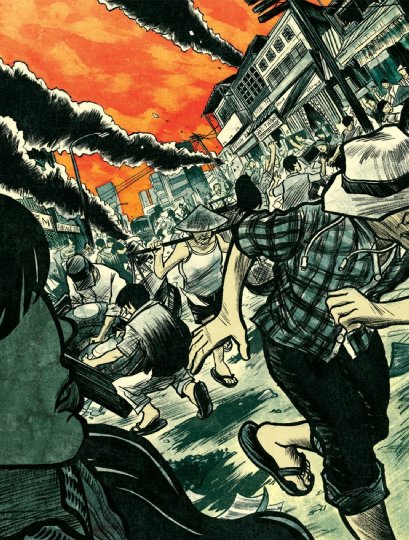
GB Tran’s graphic memoir Vietnamerica caught my attention through a post on Literary Hub about Vietnamese and Vietnamese-American literature. The list was compiled by Viet Thanh Nguyen, whose book The Sympathizer made such a splash in literary circles last year. I found the cover arresting, and I am trying to read more graphic novels, mainly because my students like them, and I want to be able to recommend good ones to them. Tran’s memoir is about his family, who left Vietnam five days before the fall of Saigon. He was born the following year. He felt, in many ways, separated entirely from his Vietnamese heritage and culture, and this book explores that feeling of being the first generation American in a family of immigrants. Tran initially has no interest in his family’s history, but as he notes in the book, quoting Confucius, “A man without history is a tree without roots.” This book is Tran’s journey of discovering his family’s history. As he says in his afterword, “Making this book broke my heart.”

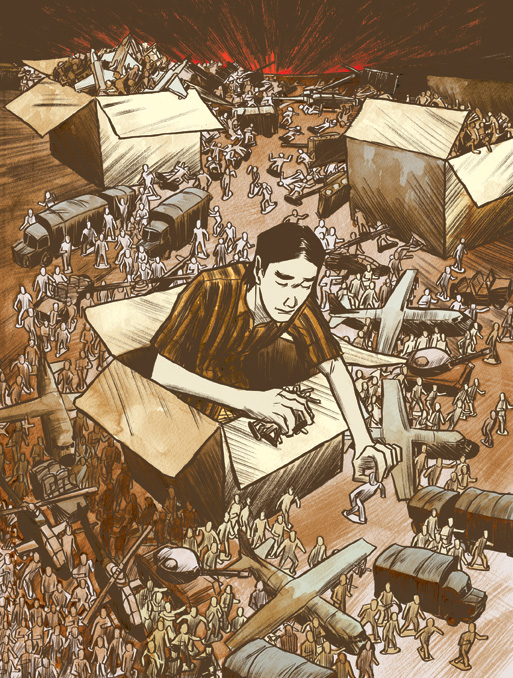
VietnamericaTran’s artwork is captivating. He captures the chaotic scenes of Saigon and the evacuation of refugees particularly well. His use of color is deliberate and thoughtful. Scenes in the past are often muted shades of sepia and gray, while the present is generally drawn in brighter colors. I found it a little hard to keep track of the cast of characters at first, but by the end of the book, I had it figured out. Tran also captures well the feeling of the first generation American in a family of immigrants who have different histories, cultural ideals, and personal beliefs. I liked, for instance, his motif of his family’s celebration of Tet, a small way he shows the cultural gap he feels between his parents and himself.


Vietnamerica

One interesting thing I learned from this book, and it is something I have wondered about for many years, is why America (and before America, France and Japan) did not achieve their goals in Vietnam. Tran’s answer, given through his family members, makes a great deal of sense to me. I won’t spoil it for you if you want to read it, too, but it underscores the importance of being exposed to multiple narratives. As Chimimanda Ngoze Adichie says, the problem with stereotypes is not that they are “wrong” but that they are “incomplete,” and when we are only only exposed to a single story about an event—and war often lends itself to “right sides” and “wrong sides” when reality is more complicated—we naturally have a limited understanding of the event.

Vietnamerica

Vietnamerica is not so much a personal memoir as a memoir of a family and Tran’s journey to learning who his parents and grandparents were. It is not a linear story, and it took me a little while to figure out the storylines, but it was worth it. If you enjoyed Art Spiegelman’s Maus, you would probably like Vietnamerica.

Vietnamerica

Rating: ★★★★★

Images © GB Tran and used for the purposes of criticism.

Wild Goose Chase Reading Challenge 2017I am counting Vietnamerica as my first book for the Wild Goose Chase Challenge as my “book with an exotic or far-flung location in the title.”

Sherlock Holmes: The Adventure of the Yellow Face, Sir Arthur Conan Doyle

The Yellow Face
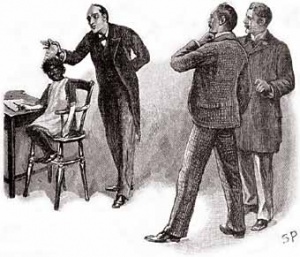
Sidney Paget illustration for “The Adventure of the Yellow Face” in The Strand

This week’s story in the Chronological Sherlock Holmes Challenge is one I don’t remember reading about 20 years ago, though I must have because I did read all the stories. It’s interesting that I don’t recall it because of the stories I have read so far, I probably enjoyed it the most. A man named Grant Munro shows up to obtain Sherlock Holmes’s services to solve a mystery concerning his wife. Holmes makes a series of impressive deductions about the man’s background and money situation based on the man’s pipe. Munro relates that new neighbors appear to have moved into the cottage across the street from where he lives in Norbury, and he has seen a ghastly face looking out the window. Upon searching the house, he discovers a mysterious portrait of his wife. Further, his wife sneaks out in the middle of the night, and Munro deduces she is visiting the house. Holmes concludes that the occupant of the house must be none other than Mrs. Munro’s first husband, and he must be blackmailing Mrs. Munro. However, once Holmes travels to Norbury at Grant Munro’s request to help Mr. Munro uncover the truth, Holmes discovers he was wrong—the woman is not hiding a first husband at all. The remainder of the review is a tiny bit spoilery.

I have to say, this story surprised me for several reasons. First, it’s refreshing to see Holmes make an incorrect deduction. His deduction makes perfect sense, but he, like many others in the Victorian era, couldn’t have imagined the truth. In addition to the revelation of Holmes’s failure, the ending is a surprise given the times in which the story was written. I would imagine quite a few readers found it shocking, and I know the readers in America would have found it so. I’m not sure if it matters or not, but Mrs. Munro’s first marriage would not have been legal in America in the time at which the story is set (or at least not legal in Georgia, where she lived). Mrs. Munro would not have had an easy time being married to an African-American man at that time. It was not accepted, and Mrs. Munro’s fear regarding the exposure of the truth about her first marriage is quite realistic, though perhaps Mr. Munro’s reaction is less so—it’s the reaction we would want him to have, with our more modern sensibilities, and Watson definitely approves, but it is not the reaction most men in that era would have had.

I see a few references to “The Adventure of the Yellow Face” in the BBC’s Sherlock. First, Mary Morstan’s secretiveness through the series as she hides her past as a hired assassin mirrors Mrs. Munro’s secretiveness about her past. Mary’s behavior is not that different from that of Mrs. Munro’s, and both women seem to expect their new marriages will crumble if their husbands find out about their pasts. There is also a yellow happy face painted on the wall in Sherlock’s apartment. In addition, when Mary is killed by Vivian Norbury, Lady Smallwood’s secretary, Sherlock echoes the request made at the end of this story:

“Watson,” said he, “if it should ever strike you that I am getting a little overconfident in my powers, or giving less pains to a case than it deserves, kindly whisper ‘Norbury’ in my ear, and I shall be infinitely obliged to you.”

In the series, Sherlock makes the request not of Watson (who wasn’t in any shape to listen to it), but of Mrs. Hudson:

Sherlock Holmes: If you ever think I’m becoming full of myself, overconfident or cocky, would you just say the word “Norbury” to me, would you?

Mrs. Hudson: Norbury?

Sherlock Holmes: Just that. I’d be very grateful.

Rating: ★★★★★

The Chronological Sherlock Holmes ChallengeI read this story as part of the Chronological Sherlock Holmes Challenge. It is the fifth story in the chronology (time setting rather than composition). Next up is “The Red Circle.”

Sherlock Holmes: The Adventure of the Speckled Band, Sir Arthur Conan Doyle

The Adventure of the Speckled Band
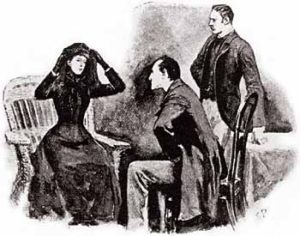
Sidney Paget illustration for “The Adventure of the Speckled Band” in The Strand

This week’s story in the Chronological Sherlock Holmes Challenge is one of the most famous in the Holmes canon, “The Adventure of the Speckled Band.” A mysterious woman in black arrives early in the morning to ask for Sherlock Holmes’s help. She is terrified because her twin sister died under mysterious circumstances a few years prior, and she now finds hints that history is about to repeat itself. Holmes agrees to take on her case. The woman’s stepfather shows up shortly after she leaves to threaten Holmes, who is not in the least perturbed, and Holmes and Watson travel to the estate where the young woman lives with her stepfather. After investigating the room where the woman sleeps and her stepfather’s room, Holmes believes he may know what is happening, but he and Watson keep a vigil in the woman’s room that night to be sure.

I actually remembered most of the details of this story, though I hadn’t read it in over 20 years, which I think is a testament to the story’s strength. If I have one quibble, it is once again we see a British prejudice about the tropics being a breeding ground for a passionate temper. It’s probably too much to expect a Victorian writer not to display the prejudices of his era, though, and it’s not as bad as A Study in Scarlet‘s portrayal of Mormons. Also, it seems that Doyle was making up fictional snake breeds, but that doesn’t surprise me much. He is a storyteller, and it’s not like he had Google at his disposal. The swamp adder doesn’t jump out as a particularly false note, but it is true that even herpetologists have been stumped as to which snake Doyle might mean. On the other hand, this is one the stories in which the reader has all the details needed to solve the crime and can deduce alongside Holmes, if the reader is paying attention. I do feel some Holmes stories are a bit of a cheat in that we don’t have the information Holmes does, but in this case, we can put the probable scenario together in our heads, for the most part, as Holmes himself solves the mystery, and it may be for that reason that this story is so popular. The BBC series Sherlock chose not to adapt this story, but it is alluded to in the episode “A Scandal in Belgravia” as “The Speckled Blonde.”

Rating: ★★★★½

The Chronological Sherlock Holmes ChallengeI read this story as part of the Chronological Sherlock Holmes Challenge. It is the fourth story in the chronology (time setting rather than composition). Next up is “The Yellow Face.”

Related posts: