Review: Heartless, Marissa Meyer

Marissa Meyer’s novel Heartless tells the story of how the Queen of Hearts from Lewis Carroll’s Alice in Wonderland became the heartless monarch Alice encounters after falling down the rabbit hole. Meyer’s Queen of Hearts is Catherine Pinkerton, daughter of the Marquess and Marchioness of Rock Turtle Cove in the Kingdom of Hearts. More than anything, Cath wants to be a baker, and she dreams of opening a bakery with her maid, Mary Ann. Cath’s parents, however, have other plans. When the King of Hearts sets his heart on marrying Cath, she can’t figure out how to make her dream come true without disappointing her parents. Meanwhile, a court joker named Jest shows up at the palace and is employed by the King. Cath finds herself strangely drawn to Jest. The kingdom has bigger problems as a Jabberwock, a beast not seen in Hearts for centuries, returns and wreaks havoc on the kingdom. Cath’s dreams slip further and further from her grasp as she is drawn towards her inevitable fate to be the notorious villain we first meet in Alice in Wonderland.

I have to admit this book surprised me by the end. Partway through it, I was having trouble keeping going with it because I really wasn’t all that interested in Cath’s burgeoning interest in Jest. He’s your classic YA-novel charmer, and if I’m being honest, I’m bored with that guy. I assume the book’s audience (teenage girls) would find that part of the story more interesting than I did. However, after Cath bakes a pumpkin cake to enter into a baking contest with some devastating results for a new turtle friend of hers, the story grows more interesting. Cath is drawn to travel to the neighboring (and mythical) land of Chess to help Jest and Hatta (the Mad Hatter) in their quest, and she meets her fate precisely because of her heart—her inability to be heartless and put her mission before her loved ones. At that point in the story, I found it more difficult to put down and finished the book in one gulp. I admit this book was sitting on three stars for me until the last half, so my advice is if the premise intrigues you, but you are not digging it yet after 50 pages or so, maybe give this one longer.

I think I would have enjoyed the story even more had I re-read Alice in Wonderland first. Meyer brought in all the important characters and elements from that book and also explained the origins of few of those beloved characters as well. I know some of the references went over my head because it’s been too long since I’ve read Alice in Wonderland.

Meyer says this book began when she wished aloud to her agents for Gregory Maguire to “write the origin story for the Queen of Hearts.” Her foreign rights agent Cheryl Pientka replied, “Marissa, why don’t you write it” (453). I think some of the best books are born when writers wish the story existed, and because it didn’t, they decided to create it.

I haven’t read any of Meyer’s other YA books, though I understand they are popular, and she has sold film rights to the first of her Lunar Chronicles, Cinder. YA books certainly have become hot Hollywood properties lately. I am not sure if I’ll read Meyer’s other books. I might not have read this one had it not arrived in my Owl Crate box with a special edition just jacket just for Owl Crate subscribers back in November of last year. My copy is going right into my classroom library, where I know some of my students who like fantasy may enjoy it.

Rating: ★★★★☆

Because this book’s been on my backlist since it arrived in November, I’m counting it for the Beat the Backlist Challenge.


Review: Bread Toast Crumbs: Recipes for No-Knead Loaves and Meals to Savor Every Slice, Alexandra Stafford with Lisa Lowery

Bread Toast Crumbs
Image via Alexandra Cooks blog

I have not reviewed cookbooks on this blog before, though I have been collecting cookbooks for a few years, and I have some really good ones that I should share with you all.

Cooking is not really something I have a ton of time to do, but I actually do like cooking. I am a very slow cook, and I make a great big mess when I cook, but I enjoy the process.

Bread, however, is something I have always shied away from, especially after some failed attempts. I tried to make a pie crust for my pumpkin pie and failed. I made a white bread recipe from the Better Homes and Gardens cookbook, and it was okay, but certainly nothing to write home about. The only bread successes (discounting breads like zucchini bread and pumpkin bread, which didn’t use yeast and did not need to be kneaded) were my Thanksgiving dinner rolls. I credit the really excellent instructions for that success.

Everyone knows bread is picky. You have to knead it just right or else it will not turn out well. You have to have to fuss with the yeast, and everyone knows how finicky yeast is about how it’s handled. So, like many people, I was always a bit afraid to experiment with bread. A few weeks ago, that changed when I found Alexandra Stafford’s mother’s famous peasant bread recipe at her blog Alexandra Cooks. I read over the recipe. I watched one of the videos. It didn’t look hard. So I tried it with all wheat flour, not knowing (because I am not a bread baker) that I was going to get a denser loaf of bread. But you know what? It was still amazing. I couldn’t believe how easy it was. I hit on Alexandra’s advice to keep the flour weight at 512 grams, and the next time I made bread, I used about two cups of wheat flour and made the rest of the weight up with unbleached white flour. It was perfect. Measuring by weight was the trick. The consistency was just like Alexandra’s pictures, and the bread was not too dense. That’s how easy the recipe is. No kneading. The time you spend actually fussing with the bread is maybe five minutes. The rest of the time is just letting it rise. It’s a very forgiving recipe in that even if you mess up on a step, it still seems to turn out just fine.

My family loved the bread, too. The recipe makes two loaves, and twice, I’ve come into the kitchen to find my son has taken half a loaf before I could even cut it. I knew I wanted to try the variations on the recipe in Alexandra’s book Bread Toast Crumbs: Recipes for No-Knead Loaves and Meals to Savor Every Slice. I have read through the book, though I haven’t made many of the recipes yet. The recipes are straightforward and easy to follow. Alexandra offers some tricks and advice for those of us who don’t often bake (for example, toast nuts before using them in breads—this is a trick I had picked up from a friend of mine at work, but it was nice to see it validated in the book). The book has many variations on the peasant bread recipe in the Bread section. In the Toast section, Alexandra shares recipes for spreads, jams, soups, sandwiches, entrées, and desserts that use the various bread recipes. In the Crumbs section, she shares salads, soups, side dishes, pasta, entrées, and desserts that use crumbs made from the various breads. Each section has its own introduction with more tips.

The photography in the book (like most cookbooks) is beautiful and serves as a nice guideline for bakers. I can’t wait to try more of the recipes. I’m especially eyeing the Roasted Garlic Bread. Today, I tried out the Oatmeal-Maple bread on p. 41. Here are some pictures of one of the loaves I made today. It’s already been eaten, by the way.

Rating: ★★★★★

Related posts:

Sherlock Holmes: A Case of Identity, Sir Arthur Conan Doyle

A Case of Identity
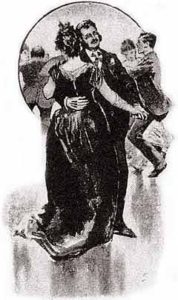
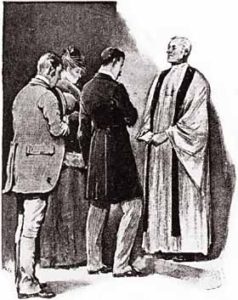
Illustration for “A Case of Identity” by Sidney Paget for The Strand

In “A Case of Identity,” Sherlock Holmes receives a visit from client Mary Sutherland, who is looking for her missing fiancé, Hosmer Angel. Sherlock Holmes has some fairly immediate (and as it turns out, accurate) suspicions about the missing Hosmer once he discovers that Mary’s mother and her mother’s much younger husband enjoy an income bequeathed to Miss Sutherland that they will no longer receive upon her marriage.

Years ago when I first read all the stories, I remembered there were a few that were pretty easy for the reader to solve right away. Also, it’s true the more you read the stories, the more you notice the clues and the more easily you solve the mysteries alongside Sherlock Holmes. In this case, it’s fairly obvious from the start who Hosmer Angel is, and there isn’t a whole lot to the story, but it is fun to see Sherlock Holmes admit there isn’t anything that can legally be done to the stepfather but that he can knock him over the head with a fireplace poker.

The BBC series Sherlock adapted a quick version of the story for its episode “The Empty Hearse.” Sherlock has asked Molly Hooper to fill in as his “John Watson” while Watson is stewing with anger over discovering Sherlock faked his death. A woman and her stepfather are consulting with Sherlock about the woman’s missing online pen pal (or boyfriend, if you like). Sherlock deduces that the online boyfriend was really the woman’s stepfather posing as the woman’s love interest in order to string her along so he could benefit from her wages. Sherlock whispers to Molly that the stepfather is a “complete and utter” and then the scene cuts to Watson saying “piss pot” as he offers one to a patient. This is similar to Sherlock Holmes’s reaction upon confronting the stepfather in the print story. The main focus of the episode, however, has nothing really to do with this story. It’s more of a quick allusion or call-out for Sherlock Holmes fans to catch. I will say this: it’s clear to me that Mark Gatiss and Steven Moffat, the show’s creators, are true Sherlock Holmes fans who have worked very hard to bring the detective stories into the modern day.

Rating: ★★★☆☆

The Chronological Sherlock Holmes ChallengeI read this story as part of the Chronological Sherlock Holmes Challenge. It is seventeenth story in the chronology (time setting rather than composition). Next up is “The Greek Interpreter.”

Related posts:

Review: 13 Rue Thérèse, Elena Mauli Shapiro

I found a copy of Elena Mauli Shapiro’s novel 13 Rue Thérèse at a used bookstore in Northampton, MA, where we spent my birthday weekend last year. As such, I suppose this book was a birthday present for myself. I loved the cover, and in flipping through the book, I was intrigued by the premise.

An American historian named Trevor Stratton is given a box of artifacts belonging to a woman named Louise Brunet, who lived at 13 Rue Thérèse in Paris with her husband Henri after World War I. He discovers through piecing together her story that she lost a cousin with whom she was in love and whom she wanted to marry in World War I. She married a man who worked in her father’s shop, and she was desperate for a child. She embarks on a flirtation with a new neighbor, a teacher, who surprises Louise by taking her up on her suggestions. Meanwhile, Trevor can’t explain why he knows things about Louise’s life that don’t appear in the artifacts. How can he know, for example, so intimately how Louise feels and what she does as she goes about her life in Paris in November 1928?

This book is based on an interesting idea. Shapiro apparently has a box of relics belonging to a real-life Louise Brunet who died alone. The landlord of 13 Rue Thérèse allowed the residents to claim her belongings, and Shapiro’s mother selected this box. From the artifacts in the box, Shapiro constructed this story. I’m not sure how I feel about her taking that kind of license with a real person’s life, especially when so much of the story is speculation and doesn’t necessarily cast Louise in a positive light. She is a likable character, but I wonder what her descendants, had she had any, would have thought about her fictional treatment. There is a time-travel element that is not quite gracefully handled as well. One wonders about the necessity of including Trevor Stratton at all. His story seems somewhat superfluous, perhaps because it isn’t woven into Louise’s story as seamlessly as it might be. I love a good time travel story, but I wonder if this book might not have been better as strictly historical fiction. In addition, I would have liked to have seen the plot hang together a bit more tightly.

Despite some flaws, I didn’t give up on it, and it was a very quick read, if not a gripping one. I think in the case of this particular book, I am probably just not the right audience because many reviewers seem to have liked it more than I did. The QR codes in the back of the book are a nice touch; they allow the reader to see higher resolution photos of the artifacts. I found the color images in the book sufficient. The book is a beautiful book, as well, with a gorgeous cover and thick creamy pages and a pleasant font. It isn’t quite like any other book I’ve read before. You might enjoy it if you like quirky French films.

Rating: ★★★½☆

I’m counting this book for several reading challenges. It’s Paris setting makes it my French book for the European Reading Challenge. I’ve had it on my backlist at least since September when I bought it, so I’m also counting it for the Beat the Backlist Reading Challenge. Finally, it is set mainly in 1928, so I’m also counting it for the Historical Fiction Reading Challenge.

European Reading Challenge 2017 Beat the Backlist

Related posts:

Sherlock Holmes: A Scandal in Bohemia, Sir Arthur Conan Doyle

A Scandal in Bohemia
Illustration for “A Scandal in Bohemia” by Sidney Paget for The Strand

I’ve been looking forward to the moment when the Chronological Sherlock Holmes Challenge would reach “A Scandal in Bohemia.” It’s one of my favorite Sherlock Holmes stories for a variety of reasons, and Irene Adler is at the top of the list.

Sherlock Holmes is visited by the King of Bohemia, who is about to marry and fears a scandal and the end of his hopes of marriage if a photograph featuring himself with his former mistress actress Irene Adler were made public. Holmes agrees to take on the case. He gains entry into Adler’s house at Briony Lodge under disguise as a clergyman. Using the ruse of a false fire alarm, he discovers where Adler has hidden the infamous photograph. Because he can’t take the photo at the moment, he resolves to return the next day. However, Adler outwits Holmes and escapes with the photograph. In her letter to Holmes informing him of her departure, she sends a photograph of herself for the king. Sherlock Holmes takes the photograph as a reward for his services.

This story has some great lines, starting with the opening line:

To Sherlock Holmes she is always the woman.

After one of Holmes’s deductions, Watson quips:

You would certainly have been burned, had you lived a few centuries ago.

Holmes also explains his powers of deduction to Watson:

You see, but you do not observe. The distinction is clear.

He also refers to Watson as his “Boswell,” and there is an indication in the story that the two had not been seeing each other much as of late. Again, the chronology of this one confuses me (its placement at this point in the chronological list of stories, that is). I should probably give up the idea that the chronology is going to work.

This story was made into one of the best episodes of the BBC Sherlock series: “A Scandal in Belgravia.” In the series’ version of the story, Irene Adler is a dominatrix who has incriminating photos of herself with a member of the royal family. Holmes’s brother Mycroft enlists Sherlock to help with the case. The story follows the basic plot of “A Scandal in Bohemia” while modernizing it for a 21st century audience. The connection between Sherlock Holmes and Irene Adler is deepened. A connection with Moriarty is also established in this episode. Lara Pulver is brilliant as Irene Adler. Watson jokes with Holmes, who protests when Watson writes about one of his failures, that people like to see that he’s human. A little hint about what is to come in the episode. I also noted the spray-painted “yellow face” on the wall. Sherlock wears the distinctive “deerstalker” cap to hide from paparazzi (it doesn’t work, and the cap becomes a running joke for the rest of the series so far). Watson’s blog posts make reference to several other stories as well, including “The Geek Interpreter” (“The Greek Interpreter”), “The Navel Treatment” (“The Naval Treaty”), “The Speckled Blonde” (“The Speckled Band”), “The Illustrious Client,” and “The Priory School.”

All in all, an excellent short story and adaptation, and one of my favorites so far.

Rating: ★★★★★

The Chronological Sherlock Holmes ChallengeI read this story as part of the Chronological Sherlock Holmes Challenge. It is sixteenth story in the chronology (time setting rather than composition). Next up is “A Case of Identity.”

Related posts:

Sherlock Holmes: The Valley of Fear, Sir Arthur Conan Doyle

The Valley of Fear
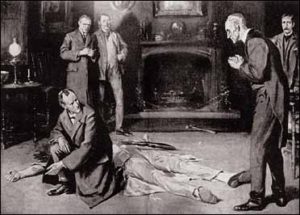
Illustration for The Valley of Fear by Frank Wiles for The Strand

The Valley of Fear is the second Sherlock Holmes novel I’ve read for the Chronological Sherlock Holmes Challenge. Holmes and Watson receive a strange message in cipher and divine that it reads “some devilry is intended against one Douglas,” the wealthy owner of Birlstone Manor in Kent. Sure enough, Inspector Macdonald turns up and tells the dynamic duo that Douglas has been murdered. Holmes is sure his nemesis Professor Moriarty is involved. Holmes and Watson travel to Kent to investigate, and Holmes quickly deduces that, as usual, the local constabulary has overlooked some important details and that there is a great deal more going on in the case than the murder of the gentleman of Kent. And also as usual, he’s right. Douglas’s murder is at the center of the Pinkertons’ infiltration of the Scowrers, a murderous gang affiliated with the Eminent Order of Freemen, a union/fraternal order that is somewhat harmless is some areas of the country, but which has a stranglehold on the Vermissa Valley in California. In the denouement, Holmes is more convinced than ever that Moriarty is at the heart of even this far-flung criminal organization.

I find myself perplexed again by this novel’s placement in the chronology adopted. I know I have mentioned this issue several times, but it feels so clearly late that it doesn’t seem right here; however, I should mention that in this novel’s case, there’s nothing to put my finger on really except writing style, and that’s explained by Conan Doyle’s having written it later. I enjoyed it more than I thought, especially after I caught wind that Conan Doyle was once again going to try to set part of the novel in America. My previous experience is that he doesn’t really understand Americans all that well. This novel, however, didn’t betray the usual issues (inaccurate dialect, being chief among them). It’s also based on the true case of Pinkerton agent James McParland’s infiltration of the Molly Maguires. Perhaps it’s the additional research Conan Doyle did that lends more of air of authenticity to the story. Once again, however, I found the parts of the story set in England to be far more interesting. Conan Doyle is clearly interested in America, but he writes more engagingly about his own home soil.

The only mention of this novel I found in the Sherlock series is in “The Final Problem” episode, in which Moriarty’s brother is described as being a station master, though in this case a broadcast station and not a railway station. I wouldn’t put this book as up there among the essential or the best, but it wasn’t bad. I found a few passages earlier in the book that I enjoyed, and this one the most, as it captures the characters in a way so many adaptations don’t seem to capture:

I believe that I am one of the most long-suffering of mortals; but I’ll admit that I was annoyed at the sardonic interruption. “Really, Holmes,” said I severely, “you are a little trying at times.”

Tell me you couldn’t hear Martin Freeman saying that to Benedict Cumberbatch.

Rating: ★★★½☆

The Chronological Sherlock Holmes ChallengeI read this story as part of the Chronological Sherlock Holmes Challenge. It is fifteenth story in the chronology (time setting rather than composition) and second novel. Next up is “A Scandal in Bohemia.”

Related posts: