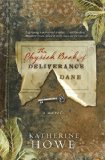
 I am about halfway through The Physick Book of Deliverance Dane, and what a delightful read it has been so far. Not since I first picked up Diana Gabaldon’s Outlander have I read a book that contains a confluence of so many things that interest me or that I can relate to. First of all, I was taken aback when the protagonist, Connie, referred to her grandmother as “Granna.” That’s what I call my grandmother, and I have always believed I invented it. I had to do a Google search to assure myself that other women have indeed been called Granna. You can learn more about my own Granna at my genealogy blog.
Second, Connie studies Colonial American history, a time period I have always found fascinating. She finds a mysterious key with a piece of parchment tucked inside its pipe or barrel or whatever you want to call the hollow part of an old key. The parchment has the name Deliverance Dane written on it. Connie sets out on a quest to find out more about Deliverance, whom she discovers was part of the Salem Witch Trials furor in 1692. I have been fascinated with this aspect of American history since about fourth grade. I just couldn’t believe that people in my own country, which prides itself now on freedom, had acted in such a bizarre fashion. I still don’t understand it.
Finally, in the last chapter I read, Connie is reading the diary of Prudence Lamson Bartlett. I was struck by how similar the diary entries were to my own great-great-grandmother Stella Bowling Cunningham’s own diary—so devoid of comment on emotions (although Stella occasionally discusses being irritated at someone), so repetitive in their description of the seemingly menial tasks of life. But as Connie says, “In some respects, Prudence’s daily work was her inner life” (158). In the last entry that Connie recounts, this is the entire text:
Febr. 24, 1763. Too cauld to write. Mother dies. (163)
I felt tears well into my eyes, despite the seemingly lack of emotion on the part of Prudence. Connie ascribes it to Prudence’s “cold practicality, her obstinate refusal to reveal her feelings, no matter how culturally proscribed” (163). My own Grandma Stella’s diary was so similar in the respects of recounting the weather, the daily work, where she went, what she bought and how much it cost. I could feel her relief when she wrote the following entry for April 4, 1894:
I paid Mrs. Bragg $7.50 for board & am now even. Owe no man anything (i.e. in $ and cts.)
On the day when her own grandmother died, she wrote:
9-3-’94
Homer & I went to town early.
Grandma died at 6 P.M.
Mr. Amos came & we came home.
Bought a buggy from John Houston $20.00.
Papa was at Aunt Panthea’s.
It couldn’t be more like Prudence Bartlett’s diary in the way it recounts so much pain alongside the mundane. It’s so spooky that if I didn’t know better, I’d swear Katherine Howe must have cribbed my genealogy blog! If you like, you can read my Grandma Stella’s journal (PDF). I transcribed it from a photocopy of the original.
Staying up at night reading this book under the low light of a book lamp over the last few nights has been a pleasure indeed, and I can hardly wait to see what happens next in Connie’s research.