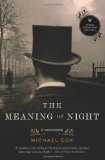
The Meaning of Night

The Meaning of Night: A ConfessionThe story of the writing of Michael Cox’s The Meaning of Night is an interesting one. Diagnosed with a rare cancer, Cox began to lose his sight. He had begun the novel in the 1970’s, but cancer gave Cox a new sense of urgency. He finished the book, which in my paperback version stretches to nearly 700 pages.

The Meaning of Night is the story of Edward Glyver’s quest for revenge against Phoebus Daunt, who robbed him not only of his Eton education, but all he holds most dear. The book begins memorably as Glyver kills an innocent man to be sure that he will have the resolve to murder Phoebus Daunt when he has the opportunity: “After killing the red-haired man, I took myself off to Quinn’s for an oyster supper.” Following his account of killing this stranger, Glyver tells the story of his childhood, including his expulsion from Eton, his employment with Christopher Tredgold, and his infatuation with the beautiful Miss Emily Carteret, the daughter of the 25th Baron Tansor’s first cousin and employee, Paul Carteret. Glyver uncovers the truth of his parentage and reveals his motive for wanting to kill Phoebus Daunt.

I read this book at the recommendation of my husband, and while I enjoyed parts of it, I had some major problems with it. First, I could find no characters to like. I didn’t feel much sympathy for Edward Glyver. He’s unlikeable in the extreme. He values the wrong things in life, and he spends his days in dissolution, feeling sorry for himself. He was indeed treated unfairly, but he certainly meted out the same sort of treatment to other undeserving and innocent parties. Another issue I had with the book was its length. The story moves at a slow pace, and I found it difficult to plow through the beginning of the book, particularly as Edward Glyver had given me no reason to be interested in or care about what happened to him. I am not sure what should have been cut, but I hate investing so much time in a book this long for so little reward. The story turns on coincidence, which normally I don’t mind and have actually used in my own writing, but for some reason in this novel it bothered me. It seems Alastair Sooke and I are in agreement on our reviews. What Cox does very well in this book is capture a sort of seedy underbelly of Victorian society and the sharp divisions between classes.

Cox succumbed to cancer on March 31, 2009 after finishing The Glass of Time, a companion to The Meaning of Night.

Rating: ★★★☆☆

This book is my eighth book for the Typically British Challenge, bringing me to the highest level of the challenge: Cream Crackered. Looks like I have finished this one.
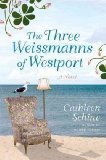
The Three Weissmanns of Westport

The Three Weissmanns of Westport: A NovelCathleen Schine’s novel The Three Weissmanns of Westport is a modern retelling of Jane Austen’s Sense and Sensibility. I first became intrigued by the novel after I heard Lois Reitzes interview Schine on Between the Lines. Here is the interview:

Cathleen Schine, author of The Three Weissmans of Westport

Schine explains in the interview that her motivation for telling the tale lay in part in the fact that in many ways, women today are as vulnerable to the same financial difficulties as the Dashwoods because of divorce. It was an interesting take. The story begins as Betty Weissmann learns her husband nearly fifty years, Joseph, plans to leave her for a younger woman, the Fanny Dashwoodish Felicity. In an argument over the apartment the Weissmanns share in the Central Park West area in Manhattan, Betty finds herself cut off from the money she has never had to worry about in the past. Meanwhile, Betty’s two daughters have troubles of their own. Schine has recast the characters into older counterparts, and I found it worked well. Annie is the Elinor figure; a librarian with two grown sons, she pines for Felicity’s brother, the novelist Frederick Barrows. Miranda is the Marianne figure, a literary agent who peddles fake memoirs and is outed by Oprah. Cousin Lou, the Mr. Middleton figure, comes to the rescue and offers the Weissmanns his cottage in Westport because they’re “like family.” The three women move in together. Miranda falls in love with the dashing young actor Kit and his son Henry. Betty mourns the death of her marriage like a true widow. Annie wonders how she is going to pay all the bills.

One of the enjoyable aspects of reading derivative works like this—modern updates or retellings—is seeing how an old story can still speak to a modern audience and can still be as fresh and as true as it ever was. I particularly liked A Thousand Acres, Jane Smiley’s retelling of King Lear for that reason. This retelling works. The situations were plausible, and the characters were flawed, but intriguing and funny and even charming enough to keep me interested. In this case, knowing Sense and Sensibility made me wonder how the author might, for instance, deal with Willoughby’s betrayal or Elinor’s introduction to Lucy Steele. It was satisfying to turn the page, then, and see it coming. For instance, as soon as Amber and Crystal walked on the scene, I thought “here come the Misses Steele.” Schine captured those two particularly well. The book has a lot of pop culture references, from James Frey, to Shamwow, to Snuggies, and more, but I wonder if these problems won’t date the book in the future. Then again, maybe it will be a snapshot of the early 21st century. Austen purists won’t like some of the changes made to the ending. I think the ending Sense and Sensibility of is one of the best endings ever. However, I liked the ending of this book. Around about the middle, I had to keep plowing through the book to see how Schine would modernize next.

Rating: ★★★★☆

This is my first book for the Everything Austen Challenge.

Medieval Lives

Terry Jones’ Medieval LivesTerry Jones is perhaps best known as one of the members of the British comedy troupe Monty Python. Anyone who has followed his career since his Python days knows that he has become a respected medievalist, something my Medieval Literature professor told us one day in discussing Chaucer’s Knight. Jones’s Medieval Lives may be seen as a companion to the series of the same name.

The book is broken down into eight chapters the explore the lives of people of different classes and occupations, sweeping away the glorification given to some (knights) and undue pity given to others (peasant). It’s a refreshing exploration of what medieval life was really like with the most intense focus on medieval life in England, which is clearly Jones’s background. The eight groups Jones explores in this book are peasants, minstrels, outlaws, monks, philosophers, knights, damsels, and kings. My favorite chapter on kings discusses incorrect perceptions and propaganda surrounding medieval English kings and is brilliantly constructed around analysis of the three Richards:

Kings of England can be divided into three types: the Good, the Bad and the Ugly. That, you can take it from us, is a reliable fact… Take all the kings of England called Richard: there’s Good King Richard I—Richard the Lionheart, the idealistic crusader and champion of England—or was he? Bad King Richard II— the vain, megalomaniac tyrant—or has his name been traduced by those who wished him ill? And Ugly King Richard III—the deformed monster of Shakespeare’s imagination—or is he nothing more than that: the product of our greatest playwright’s imagination? (“King,” location 3040)

Jones’s explanation of why Good King Richard the Lionheart was a terrible English king, why Richard II was a fairly good king, and Richard III not at all Shakespeare’s villainous tyrant made for interesting reading, though as an anglophile with a bizarre fascination for the British monarchy, much of it was not new to me.

I also enjoyed Jones’s deconstruction of the knight in the Middle Ages, particularly my favorite William Marshal. I liked Jones’s description of the value of knighthood, perfectly encapsulated by the English defeat of the French at Agincourt: “The flower of French chivalry was cut down by archers on sixpence a day” (“Knight,” location 2523). So much for the French assumption that the English would face them on horseback like proper knights!

Jones’s chapter on damsels gives the lie to the old saw that medieval women were powerless and in constant need of rescue. I was particularly interested in Jones’s discussion of the evolution of the Lady of Shalott:

In the original story the lady was not weak and helpless at all, and she was not under any curse. Nor was she passive and pathetic. She was a wilful, stubborn woman who boldly declared her passionate love for Lancelot. Her tragedy was that it was not returned. (“Damsel,” location 2755).

Later, Tennyson would describe her plight differently:

The story of the Lady of Shalott created an extraordinarily resonant echo in the Victorian and Edwardian imagination; Pre-Raphaelite artists, looking for images that expressed what they saw as a truly medieval perspective, returned to it time and time again… It is an image of womanhood as essentially confined and restricted; full participation in the world is forbidden and fatal. This is sentimentally regretted, but tragically unalterable. (“Damsel,” location 2748-2753).

The entire book is worthy of quotes, and I highlighted and annotated it more heavily than any other book I’ve read on my Kindle. Suffice it to say it’s as entertaining and funny as one would expect from a member of Monty Python and informative and educational enough that you’ll learn quite a lot of history as you read. I highly recommend it. As Jones says in my favorite quote in the book, “History consists of the tales we like to tell each other about our predecessors” (“King,” location 3046). If you’ve ever wondered what “tales” you’ve been told about medieval people, pick up this book.

Rating: ★★★★★

The Little Stranger

The Little StrangerI have never read anything written by Sarah Waters before. I had no expectations going into this book. The art teacher at my school said I would like it, and that the last page was a doozy. If what I think happened is what happened, then she’s right.

The Little Stranger is the story of Dr. Faraday and his long-standing obsession with Hundreds Hall, the home of the Ayres family. He first encounters the family as a small child when he visits the estate as part of an Empire Day celebration. Taken with the charm of the house, its grandness, its stateliness, he prizes a small acorn decoration from a plaster border in one of the passages in the house. The next time Dr. Faraday enters the house about thirty years later, it is to treat the Ayres family’s maid Betty. Dr. Faraday gradually becomes closer to the Ayres family and even becomes indispensable. Strange things start to happen around the house: a girl is badly bitten by the otherwise docile Gyp, the Ayres family dog. Strange marks begin to appear on the walls and ceilings. Objects move. Is it the ghost of poor little Susan Ayres who died before her younger sister and brother were born? Or is it something even stranger and more mysterious?

The book is as much a gothic ghost story as it is the story of the waning of the British class system, perfectly encapsulated by Mrs. Ayres as quoted by her daughter, “She said families like ours, they had a—a responsibility, they had to set an example. She said, if we couldn’t do that, if we couldn’t be better and braver than ordinary people, then what was the point of us?” In the post-WWII setting of the novel, many of the old gentry like the Ayres family are rapidly losing their money and are unable to keep up their grand estates. Course, nouveau-riche families like the Baker-Hydes are moving into the nearby estates. Keeping Hundreds Hall going occupies all of Roderick Ayres’s time (nice touch with the literary allusion in that name). Meanwhile, Dr. Faraday has risen from a humble background as the son of a shopkeeper and former Hundreds Hall servant to become a doctor. Even as the last vestiges of the class system seem to be dying away, some parts of it hang on with a frustrating tenacity that prevents Faraday from truly advancing in the ways he hopes to.

This book has some genuinely creepy parts. I was a little spooked reading it at night. One portion late in the book concerning the haunting of Mrs. Ayres was actually scary. Readers who like a definitive ending instead of one you have to mull over and determine what you think happened—because Waters does leave it up to your interpretation—might not enjoy this book. It is slow to start, but parts of it are gripping and will keep you turning the pages. I am knocking off a star for the plodding pace in portions of this book and the fact that I didn’t like the characters very much (with perhaps the exceptions of Betty and Mrs. Ayres). It’s been a long time since I read a really good ghost story, and I enjoyed this book a great deal. I know I’ve enjoyed a book when I close it and wish I could write one like it. If you enjoy spooky ghost stories like The Turn of the Screw, Rebecca, and The Ghost Writer by John Harwood, you’ll like this book. I’ve read it is also a cousin of The Haunting of Hill House, but I haven’t read that one yet.

Rating: ★★★★☆

This book is my seventh book in the Typically British Reading Challenge. One more book and I will meet the challenge’s highest level: Cream Crackered.

The Adventure of English

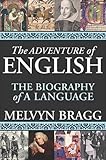
The Adventure of English: The Biography of a LanguageMelvyn Bragg’s book The Adventure of English: The Biography of a Language is a companion to the documentary series of the same name. It explores the twists and turns in the development and spread of English from its beginnings to the present day. I found it to be an entertaining read, and I certainly learned some interesting things about language that I will use in my American and British literature curricula next year. In many ways, it does seem astonishing that English has managed to become as important as it has given some of the close calls over the years: Alfred the Great’s defeat of the Danes (it was close) and 1066 just to name two. I did wish that Bragg had provided some footnotes and explained some of the etymologies he described. I can’t think of an example now that I’m reviewing, but I do recall as I read that at times I didn’t think his etymology agreed with what I read or learned elsewhere. It’s clearly in the camp of pop-history rather than scholarly writing, so perhaps readers should not expect a dissertation on the development of English going in, but it is highly readable. I did find myself lagging through the late middle of the book until I came to the section on Australian English, which I found much more intriguing than I thought I would.

It might just be me, but I found long lists of words difficult. For instance, when Bragg is describing a list of words from Old English that still appear in everyday conversation on p. 6, he chooses to list them separated by commas. It may be grammatically correct to do so, but I quickly became lost and would have preferred a chart or table. Another quibble: Bragg refers to Seamus Heaney’s translation of Beowulf several times, and while I love Heaney’s translation, Bragg obscures the fact that it’s a translation or interpretation. The first word of Beowulf in Old English is Hwæt, which Heaney translates as “So.” It has been variously translated as “Lo,” “Listen,” “What,” “Now,” and “Indeed,” among others. I really can’t explain why it bothered me that Bragg said hwæt translated as “so” without providing it within the context of a Heaney translation until the following paragraph (pp. 13-14).

The book was a mostly enjoyable diversion. I think anyone interested in the development of the English language will find it interesting. I do plan to view the companion DVD series, which we have at my school.

Rating: ★★★★☆

Remarkable Creatures

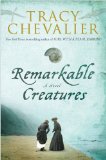
Remarkable CreaturesWhen I was a little girl, I loved dinosaurs. It might be I don’t remember things correctly, but I don’t remember dinosaurs being all that cool when I was a kid. Mrs. Jones taught us about the Trachodon in first grade, the first day of our unit on dinosaurs. I was hooked. The first “chapter” book I ever read was called Prehistoric Monsters Did the Strangest Things. As an accurate dinosaur book, it probably wasn’t very good, but I was fascinated by it. The book was part of a series on animals. I remember clearly that the chapter about Mary Anning’s discovery was titled “What Mary Found.” She wore a pink dress and a white mob cap over her blond curls. I was entranced by the idea of finding a real fossil, just like Mary Anning. Many years later, I still remember much of what I learned, and while my fascination with dinosaurs waned with time, I couldn’t resist picking up a novel about Mary Anning.

Remarkable Creatures is the story of Mary Anning and Elizabeth Philpot, women who paved the way for a great deal of scientific discovery in an age when women weren’t even allowed to join the scientific societies that celebrated their discoveries. Mary and Elizabeth come from two very different classes: Mary’s family is poor, working class, while Elizabeth is solidly middle class. Theirs is an unlikely friendship established over their shared fascination with fossils of the remarkable creatures they find on the beach at Lyme Regis. The novel explores their complicated relationship with each other and with the men of science who take credit for their discoveries.

Chevalier brought the setting of Lyme Regis alive, the beaches teeming with fossil ammonites and belemnites. The reader can feel the sea spray and the hard rock holding the fossils fast until they are released by Mary’s skilled hands. Her attention to detail is precise. I could see the layout of Morley Cottage, where the three Philpot sisters lived as well as if I had been there. If you’ve read Girl with a Pearl Earring or Chevalier’s other books, you know she’s a thorough researcher. Chevalier managed to bring these fossil hunters alive for me—they are my kindred spirits. Some of the male characters seem to run together, and I found them hard to distinguish from one another and perhaps not as fully realized, but I think that was most likely Chevalier’s aim.

I am not sure this book qualifies for the Typically British Challenge, as Chevalier is an American living in England and writing about England, but not an English writer herself, so I’ve elected not to count it. I am, however, tagging the post with my Jane Austen tag because the book mentions her and her visit to Lyme Regis as well as Persuasion, which is set there.

Rating: ★★★★★

Charlotte and Emily

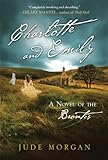
Charlotte and Emily: A Novel of the BrontësJude Morgan’s Charlotte and Emily is mistitled. It is actually the story of Maria, Elizabeth, Charlotte, Branwell, Emily, and Anne Brontë, as well as their parents. In the UK, the book was titled The Taste of Sorrow, a title much more apt, though one could argue again that the Brontës endured much more than a taste of sorrow. I imagine the reason for the change stems from the notion that Americans will be more interested in Charlotte and Emily, as though we aren’t as likely to buy a book the book with Morgan’s title. I grow tired of this sort of retitling.

Morgan’s novel begins on the deathbed of Maria Branwell Brontë and traces the familiar family story from the coming of Aunt Branwell to help care for the children, to the loss of Maria and Elizabeth, casualties of the harsh conditions at the Clergy Daughters’ School in Cowan Bridge. Branwell is given the gift of toy soldiers, and he and his sisters create imaginative stories. As they grow, they find it difficult to leave behind their created worlds of Angria and Gondal. As adults, the sisters try their hand at teaching and governessing, but they are ultimately unhappy. Their brother Branwell succumbs to drinking and dissolution; meanwhile, they write.

Morgan’s writing style draws you in. He doesn’t attempt to mimic the style of the Brontës, and some expressions (Tabby’s “What’s up?”, for instance) seem jarring, but the overall effect is an admirable piece of work that brings the Brontë family alive. Patrick Brontë, the family patriarch, suffers a little under Morgan’s characterization, but as I don’t know much about the man, I can’t say that the characterization is unfair. Once again, I walk away from a book about the Brontës with the notion that no matter their unhappiness in life, I would really like to have sat at the table with all of them for tea and conversation. Branwell is the great unrealized genius, fiery and passionate. Anne, the dutiful, honest thinker. Emily, the blunt, private dreamer. Charlotte, much like her heroine Jane Eyre, a person whose passions run deep beneath the surface.

I highly recommend this novel to fans of the Brontës. It’s highly readable historical fiction that brings the reader into the world of the Brontës. Don’t take my word for it, however. The BrontëBlog has a glowing review of the book.

Rating: ★★★★★

This book concludes the All About the Brontës Challenge for me and is my fifth book in the Bibliophilic Books Challenge (one more will bring me to Litlover status). This book is also my sixth selection for the Typically British Reading Challenge, bringing me to the “Bob’s Your Uncle” level. I’ll keep going.

Good Omens

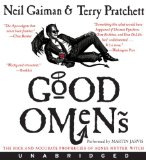
Good Omens (audio)Neil Gaiman & Terry Pratchett’s Good Omens examines the apocalypse with a sense of humor. I have not previously read any Terry Pratchett, but Neil Gaiman’s books, especially The Graveyard Book, have been favorites. So… exactly what would happen if the Antichrist wasn’t terribly invested in making Armageddon happen?

The novel begins with an introduction of Crawly (later Crowley), a demon, and Aziraphale, an angel—unlikely friends present at the fall of man (Crowley was the serpent) who remain on earth until the fulfillment of God’s ineffable plan. The thing is, they like it a little too much and make an unlikely team as they try to prevent the apocalypse. Meanwhile, Adam Young grows up in the small English town of Tadfield, the leader of a small gang of children, not knowing his destiny is to bring about the end of times. His neighbor, Anathema Device, is the descendant of Agnes Nutter, a witch whose prophecies are so accurate they’re very nearly useless, moves to Tadfield to be in place as Armageddon unfolds. The Four Horsemen of the Apocalypse—Death, War, Famine, and Pollution (Pestilence retired, muttering something about penicillin)—descend on Tadfield.

I found the book entertaining, and Martin Jarvis is a good narrator. The book seemed to go fast. It was funny—some moments of genuine laugh-out-loud humor. I particularly liked the characterization of Death as being technologically illiterate. The characters are likable, especially Crowley and Aziraphale. In the end, however, the book felt more like a snack than a meal—light fun, but ultimately not terribly memorable.

Rating: ★★★½☆

Typically British Challenge

This book brings me one book closer to meeting the “Bob’s Your Uncle” level (six books) for the Typically British Reading Challenge.

Freakonomics

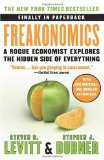
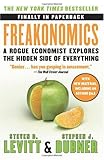
Freakonomics: A Rogue Economist Explores the Hidden Side of  Everything (P.S.)The faculty at my school volunteers to sponsor one summer reading selection. Students have more choices (and more eclectic choices) and can discuss a book with a faculty member they might not otherwise have the opportunity to discuss books with. We limit seminars to ten students, so popular books fill up fast. For the second year in a row, Freakonomics by Steven D. Levitt and Stephen J. Dubner has been one of the fastest-filling seminars. Last year it was sponsored by one of our Assistant Co-Heads who has a background in business and manages finances for our school. This year, it was sponsored by one of our social studies teachers who counts economics among his responsibilities.

The book is a fascinating look into some of the economic factors that you might not necessarily think about but that nevertheless have an impact on our lives. When I was a young teen, one of my favorite books was called Boyd’s Book of Odd Facts. I find trivia interesting, and I love learning about weird things. I wouldn’t necessarily say that Levitt and Dubner are dealing in trivia, but the book reminded me of Boyd’s Book in that I had the same feeling reading both: my verbal exclamations prompted Steve to ask me to read what I was reading. The book might be best known for its controversial stance that the passage of Roe v. Wade led to a decrease in crime in the 1990’s when the effects of unwanted children being born might first have been felt in terms of crime. While I found that chapter compelling, I was less interested in sumo wrestlers. I found the chapter on naming practices to be one of the more interesting parts of the book, but perhaps that is because I’m intrigued by naming practices.

The inclusion of some additional materials added only nominally to my enjoyment of the book. I will bet that French Roast in Manhattan wishes the extra material hadn’t been included. Overall, I would have to say the book is a light, interesting read, and I can certainly see why so many of our students are drawn to it. You can learn more about Freakonomics at its website.

Rating: ★★★★☆

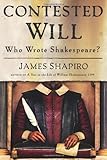
Contested Will: Who Wrote Shakespeare?

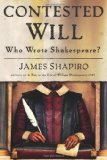
Contested Will: Who Wrote Shakespeare?James Shapiro’s latest book Contested Will: Who Wrote Shakespeare? examines the Shakespeare authorship question in a way that it traditionally hasn’t been examined by academics: seriously. An interesting problem has arisen in the age of the Internet: the conspiracy theorists have been able to be heard in ways that were impossible 20 or 30 years ago, and their claims have been taken much more seriously as a result. We live in an era that thrives on conspiracy and hidden history. Shapiro, rightfully I think, recognized that it was time for a serious Shakespeare scholar to examine and present the case for Shakespeare as the writer of his plays—which he has managed to do brilliantly and without resorting to attacking the intellect of the anti-Stratfordians.

Shapiro begins by examining the origin of the anti-Stratfordian movements in an unlikely place—the early biographies of Shakespeare, which sought to correlate Shakespeare’s life to his plays and sonnets. It’s a slippery slope, Shapiro warns, because it ultimately deprives Shakespeare of an imagination. Shapiro also examines the rise and fall of the Baconians. The history of the Oxfordian movement was particularly interesting in light of the fact that many famous actors and even Supreme Court justices have decided in favor of Oxford over Shakespeare. And Shapiro does not flinch from describing the uncanny resemblances some parts of Oxford’s life have to the plays; however, he also presents solid evidence in favor of Shakespeare that should put to rest any doubts. It should, but it won’t precisely because people seem compelled to believe in their favorite candidates with the zeal almost of adherents to a religion. Terms like “heretic” and even “blasphemy” are thrown around. And in such a tightly contested matter, even if the preponderance of the historical evidence is in favor of Shakespeare, minds are not going to be changed. However, what Shapiro’s book likely will do is offer those skeptical but not entrenched a solid argument for Shakespeare. This book is a must read for Shakespeare lovers and teachers of Shakespeare. Every year my students ask me about authorship. I feel much more informed now than I have felt in the past.

Rating: ★★★★★

I don’t know that I can attain Litlover status in the Bibliophilic Books Challenge, but this book would make a fourth book toward the six required to meet that challenge level. I committed to reading three: the Bookworm level.

As a postscript, I enjoyed reading this book on my Kindle very much. I was much more absorbed into the book than usual, interestingly enough, and I forgot these books usually have a lot of notes and a large index, so I reached the “end” well before I realized it.