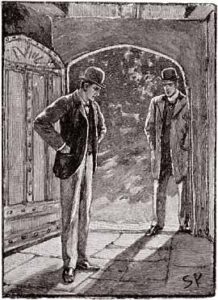
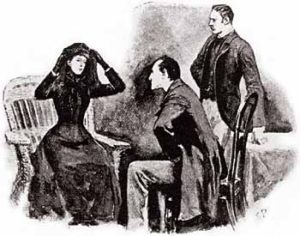
This week’s story in the Chronological Sherlock Holmes Challenge is “The Adventure of the Beryl Coronet,” which was published in The Strand in 1892, and collected in The Adventures of Sherlock Holmes. Banker Alexander Holder seeks Holmes’s help in finding a missing beryl coronet, offered to him as security for a loan to a high-ranking government official. Holder suspects his son of taking the coronet, as his son has had some problems with money and has been borrowing from his father. Holmes, on the other hand, isn’t so sure that young Arthur Holder is the guilty party.
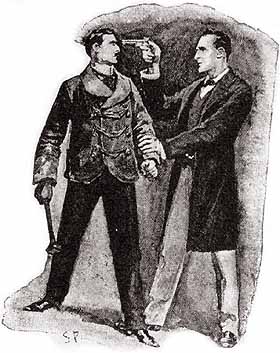
This story contains Holmes’s famous statement: “It is an old maxim of mine that when you have excluded the impossible, whatever remains, however improbable, must be the truth.” Other than that, I didn’t find too much to like about it, to be honest. It was an easy mystery. There were not too many people who could be guilty, and Doyle seemed to be rather leading the reader away from suspecting Arthur from the outset. The line, “I knew my man, however, and I clapped a pistol to his head before he could strike. Then he became a little more reasonable” struck me as funny in the way of many of the best lines Holmes delivers in the series Sherlock are funny. We also have Holmes in disguise in this story. Ultimately, however, it didn’t satisfy as a mystery, and I didn’t find the client and his family all that interesting or likable. This one gets a “meh” from me.
Rating:

 I read this story as part of the Chronological Sherlock Holmes Challenge. It is the seventh story in the chronology (time setting rather than composition). Next up is “The Resident Patient.”

 As I mentioned in my review of Tim O’Brien’s
 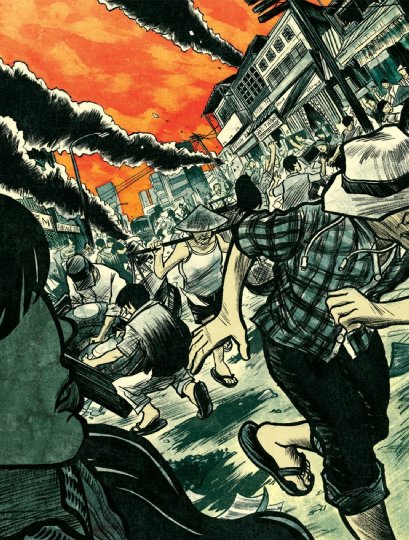 Tran’s artwork is captivating. He captures the chaotic scenes of Saigon and the evacuation of refugees particularly well. His use of color is deliberate and thoughtful. Scenes in the past are often muted shades of sepia and gray, while the present is generally drawn in brighter colors. I found it a little hard to keep track of the cast of characters at first, but by the end of the book, I had it figured out. Tran also captures well the feeling of the first generation American in a family of immigrants who have different histories, cultural ideals, and personal beliefs. I liked, for instance, his motif of his family’s celebration of Tet, a small way he shows the cultural gap he feels between his parents and himself.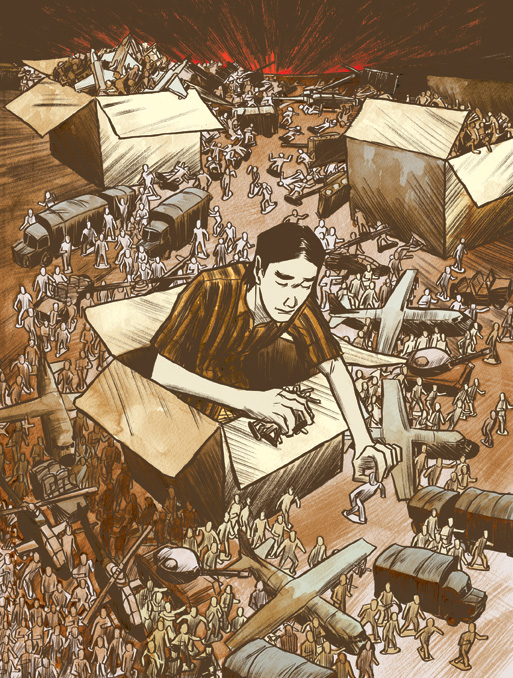





 Sarah Maine’s novel