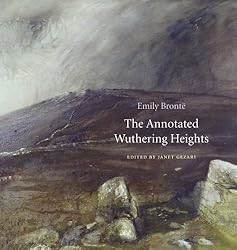
Review: The Annotated Wuthering Heights, Emily Brontë, ed. Janet Gezari

I have read Wuthering Heights in several formats now, from my first Barnes and Noble paperback, to an audio book, to this new annotated version edited by Janet Gezari. It’s interesting how one notices different things about books upon re-reading, and no matter how good a friend a book might be, a re-read introduces nuances never noticed before. So it is with this annotated edition of Wuthering Heights.

In the past, when people have asked me (rather aghast upon my pronouncement that this is my favorite book) why on earth I liked it so much, I have been at a loss. After all, aren’t the characters all horrible human beings, impossible to like and therefore sympathize with? I had no real answer for that observation. I shared it. I don’t think I do anymore, however.

I mentioned in my Sunday Post recently that I had noticed Nelly Dean emerging as a much more troublesome character—I might even say a villain—than I had previously thought. Because she tells most of the story, the people she does not like, Catherine and Heathcliff, suffer the most from her descriptions of their character. Heathcliff probably is a pretty horrible person, though the case can be fairly argued that he was made horrible by the way he was treated. We want to feel sorry for him, and then he does something cruel, so we can’t. I am not so blind as to argue he’s a poor, misunderstood innocent. I think people who think of Heathcliff as a great romantic hero either haven’t read the book or don’t understand his character very well. But to me, he’s interesting precisely because he’s horrible. Not interesting as in “I want him to be my book boyfriend.” Let’s get that straight. Yet, Catherine is the one person who sees who Heathcliff really is because, as she says, “Nelly, I am Heathcliff.”

Catherine is probably not as horrible as Nelly depicts her. Nelly doesn’t like her, and her daughter, Cathy, shares many of her mother’s faults but comes off better in Nelly’s description. I think I really understood in this reading how much Nelly prejudices the reader against Catherine. One of the annotations remarks that the Heights’ housekeeper, Zillah, describes young Cathy in much the same way as Nelly describes her mother. I had found young Cathy’s treatment of Hareton inexcusable in the past, but I felt I understood it better in this reading. After all, she considers him in league with Heathcliff, and he did help Heathcliff imprison her in Wuthering Heights. That she ever does, in fact, warm to him and come to love him is miraculous given the start they had, and it shows her capacity for love and forgiveness. Nelly certainly comes off as meddling and judgmental. And why is she spilling all the family dirt to a perfect stranger in the first place?

Another thing I noticed really for the first time in this reading was the bird motif. Birds appear in various forms throughout the narrative. Nelly introduces Heathcliff’s history by describing him as a “cuckoo,” and birds, nests, and feathers are woven through the remainder of the narrative. Birds can be petted caged creatures, like Isabella Linton, or wild creatures like Catherine and Heathcliff. I was thinking about the part in the story when Catherine describes Heathcliff allowing the lapwings to die when she is sorting the feathers in her torn pillow:

And here is a moor-cock’s; and this—I should know it among a thousand—it’s a lapwing’s. Bonny bird, wheeling over our heads in the middle of the moor. It wanted to get to its nest, for the clouds touched the swells, and it felt rain coming. This feather was picked up from the heath, the bird was not shot—we saw its nest in the winter, full of little skeletons. Heathcliff set a trap over it, and the old ones dare not come. I made him promise he’d never shoot a lapwing after that, and he didn’t. (188)

Later in the novel, Heathcliff’s son Linton, Catherine’s daughter Cathy, and Hindley’s son Hareton become like the lapwings in Heathcliff’s trap. Linton is killed, but once Heathcliff notices Cathy and Hareton’s affection for one another, all the will to continue his revenge seems to vanish. He tells Nelly,

It’s a poor conclusion, is it not… An absurd termination to my violent exertions? I get levers and mattocks to demolish the two houses, and train myself to be capable of working like Hercules, and when everything is ready, and in my power, I find the will to lift a slate off either roof has vanished! My old enemies have not beaten me—now would be the precise time to revenge myself on their representatives—I could do it; and none could hinder me—But where is the use? I don’t care for striking. I can’t take the trouble to raise my hand! That sounds as if I have been labouring the whole time, only to exhibit a fine trait of magnanimity. It is far from being the case—I have lost the faculty of enjoying their destruction, and I am too idle to destroy for nothing. (416)

I believe Heathcliff has come to equate the children with the lapwings. He destroyed them for no reason, and remembering Catherine’s injunction, he stays his hand just as his perfect revenge is in his grasp. And he quite literally gives up on living and dies.

I also think I fully appreciated for the first time that young Cathy’s story is her mother’s story “in reverse,” as the “‘movement of the book’ is away from Earnshaw and back, like the movement of the house itself. And all the movement must be through Heathcliff” (65). I think of the scene in which Lockwood finds himself in Catherine and Heathcliff’s old room and sees her three names written: Catherine Earnshaw, Catherine Heathcliff (a name she hoped to have), Catherine Linton. Her daughter begins Catherine Linton, becomes Catherine Heathcliff, and eventually Catherine Earnshaw. The book ends on a hopeful note that what was lost will be restored in this second generation.

Reading this annotated version opened many connections, especially to Romantic writers such as Byron, Shelley, Coleridge, and Wordsworth, that I had not considered before in Brontë’s writing. Though Heathcliff is a famous Byronic hero, I didn’t know, for instance, that Thomas Moore’s Life of Byron may have been in Brontë’s mind when she wrote the scene in which Catherine says she cannot marry Heathcliff because it would degrade her, but that she can marry Linton and help Heathcliff to rise in the world. Byron apparently overhead or perhaps was told that Mary Chaworth, a woman whom he loved, said “Do you think I could care anything for that lame boy?” (140). I was also surprised to learn of a possible connection to Shelley’s Epipsychidion in the declaration that Catherine makes that she “is” Heathcliff: “I am not thine: I am a part of thee” (142). Natural references similar to Wordsworth and Coleridge’s observations occur throughout. It was a more fitting choice for the Romantic era in the Literary Movement Challenge than I even realized when I decided to read it.

It’s a gorgeous book with a great many illustrations and illuminating footnotes. It also includes Charlotte Brontë’s biographical notice and preface to the 1850 edition of the novel. I don’t think Charlotte fully understood what her sister had written, and I don’t agree with much of what she has said about the novel.

If you are a fan of this novel, you definitely want this beautiful edition for your library. If you haven’t read the novel, this edition will enrich your reading. If you don’t like the novel, but you want to figure it out anyway, you might find this edition will give you a lot to think about, and it might just change your mind. I have to say, I fell in love with it all over again on this reading.

Rating: ★★★★★

I will count this selection as my Yorkshire novel for the Reading England Challenge. Taking place some 50 or so years before it was written, this one qualifies as historical fiction, and I am counting it as my Classic by a Woman Author for the Back to the Classics Challenge as well.

Sunday Post #15: Wuthering, Wuthering Heights

Sunday PostWhat has been happening this week? It’s been crazy busy. I haven’t had a ton of time to read, so I sat down and read most of today (with the exception of doing a little bit of work and washing the dishes). I have been spending most of the day wandering the moors, reading The Annotated Wuthering Heights. What a great addition to my library. I am truly enjoying it. Each time I read Wuthering Heights, I notice something I didn’t pick up on last time, and this time, it’s how horrible Nelly Dean is. I mean, I have often thought of her as mostly a reliable narrator, and because of her, I have really disliked Catherine. Heathcliff is just plain hard to like, no matter what. As soon as you start feeling sympathy for him, he goes off and kills lapwings for no reason or hangs a dog. Perhaps because I’m reading an annotated version, I am noticing so many more things than I ever have before. All the birds, for one thing; I’m sure I noticed that before, but even though the annotations don’t discuss the birds in a great amount of detail, I think my antennae are up, so to speak, and I’m noticing the symbolism more than I usually do. And there are birds just everywhere in this book. Another thing I am seeing are the close connections to the Romantic poets. The annotations help there, and I am really pleased I chose to read this one for the Literary Movement Reading Challenge. Hope I can finish it in time! Even if I don’t, I definitely want to finish reading this lovely annotated version. I realize a lot of people hate this book, but I think if you peel it apart and and see what makes it work, it is genius. I am especially enjoying the nuances I am noticing in Nelly’s character this time around.

I finished reading Pleasantville by Attica Locke and wrote a review for the TLC Book Tour this week as well. A good read. I am also still working away on Katherine Howe’s Conversion on audio. The reader for that one is really good. I recommended it to a bunch of my students this week when I saw it was one of their choices for a summer read.

This week’s Top Ten Tuesday topic was top ten favorite authors of all time. You know, I am actually liking the idea of saving these for my Sunday Post instead of doing them on Tuesday. I just have less time to write during the work week. To qualify as a favorite author, I decided that I needed to love multiple books by the same author. So I didn’t count authors who have only written one novel. I also didn’t count authors if I had read only one of their works (even if I loved it). So here is my list:

  1. William Shakespeare
  2. Jane Austen
  3. J. K. Rowling
  4. J. R. R. Tolkien
  5. Diana Gabaldon
  6. Ernest Hemingway
  7. Sharyn McCrumb
  8. Jasper Fforde
  9. Neil Gaiman
  10. Judy Blume

Who would be on your list?

Authors whose work I love, but whom I didn’t count because of my self-imposed rules are Toni Morrison, Zora Neale Hurston, F. Scott Fitzgerald, Harper Lee, and Emily Brontë.

Some links I enjoyed this week:

Here’s a bonus for you:

For the record, I have always believed it really was Catherine’s ghost who disturbed Lockwood early in the novel.

The Sunday Post is a weekly meme hosted by Caffeinated Book Reviewer. It’s a chance to share news, recap the past week on your blog, and showcase books and things we have received. See rules here: Sunday Post Meme.

Related posts:

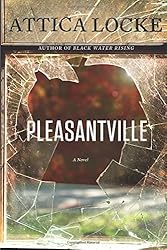
TLC Book Tour: Pleasantville, Attica Locke

Jay Porter, the hero of Attica Locke’s new novel Pleasantville, has had a devastating year. Barely able to cope with the death of his wife, he finds himself a single father to his two children and his law practice is shriveling on the vine. He won a major victory against Cole Oil, but appeals have dragged the case on, and Porter is losing his conviction that he will ever see a dime of the money his clients were awarded. Furthermore, so are his clients, who are being wooed away by a slick attorney trying to make a buck. Meanwhile, Jay’s office is broken into, and a young girl connected with the Houston mayoral campaign goes missing, and Jay is dragged into the crime when he is coerced into taking on one more difficult case—this time, a murder trial.

I have never read the first book about Jay Porter, Black Water Rising. I loved Locke’s novel, The Cutting Season, however. I think reading Black Water Rising would probably have been helpful, as I know I might have understood some elements of Pleasantville a little better. I do wish I’d kept a character list or that one had been provided. I found some of the characters difficult to distinguish from one another (it could just be me, however). Pleasantville is a tight crime thriller. I might compare it to a John Grisham novel had I read one, though having seen the movies, I have an idea this novel is along those lines. In some places, the pace dragged a bit for me, but I always wanted to finish and find out what would happen, and as the court case really started, I finished the book in two big gulps. I think it might make a pretty good movie as well. The political intrigues were fascinating in their way. Politics are dirty business. The ending also went a little crazy for me, and some aspects of it seemed a little far-fetched, but overall, I have to say I enjoyed reading this book. I think anyone who likes a crime thriller, courtroom novel, or a good mystery would enjoy Pleasantville.

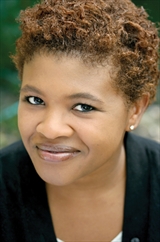
Attica LockeAbout Attica Locke

Attica Locke is the author of the widely acclaimed debut novel Black Water Rising, which was nominated for a Los Angeles Times Book Prize, an Edgar Award, and an NAACP Image Award, and was shortlisted for the UK’s Orange Prize. She lives in Los Angeles with her husband and daughter.

Find out more about Attica at her website, and connect with her on Facebook and Twitter.

tlc logo

Rating: ★★★½☆

Related posts:

Sunday Post #14: Top Ten Tuesday

Sunday PostSunday? Tuesday? What is she on about? I keep forgetting to check in with the Top Ten Tuesday meme, so I’m plucking a couple of recent topics and posting about them today for the Sunday Post.

First up, “Ten Books You Recently Added To Your To-Be-Read List.” These are the ten books most recently added to my Goodreads to-read list in order from most recent to least:

It might be fun to list the novels I added to my to-read pile each week in my Sunday Post. I think I might just do that.

Next up:

Top Ten Characters You’d Like To Check In With (meaning, the book or series is over and you so just wish you could peek in on the “life” you imagine they are leading years down the line after the story ends). Does this prompt make sense?? It makes sense in my head! Let me know and I can clarify haha

In no real particular order:

  • Harry Potter and the gang. I’d read any TNG or even Marauders books Rowling might want to write, but I’m not sure she’s keen.
  • Scout Finch. And guess what? We get to! This summer!
  • Holden Caulfield. I often ask my students to write a new ending chapter because the end of his book is so ambiguous. Is he going to be okay?
  • Huck Finn. I think Twain wrote some stuff about Huck and Tom as adults. I am curious as to how he turned out in the end.
  • Samwise Gamgee. I know he had a bunch of children, but I sure would like to have checked in with him and his (hopefully) quiet life in the Shire.
  • Ennis Del Mar from “Brokeback Mountain.” Did he ever learn to accept himself and find love?
  • Peter Hatcher. What kind of people did Peter, Sheila Tubman, Fudge, and Tootsie grow up to be?
  • Taran and Eilonwy from Lloyd Alexander’s Prydain Chronicles. Tell me they got married.
  • Cathy Linton and Hareton Earnshaw. Did they break the family curse and find happiness together?
  • Jane Eyre. What were the Rochesters like after they married? I can’t believe all the adventure was over.

And finally, Top Ten Inspiring Quotes from Books (anything that inspires you, challenges you, makes you think, encourages you, etc.).”

I have a blog widget that shuffles my favorite book and bookish quotes, but here are my favorites:

  • “The man who doesn’t read good books has no advantage over the man who can’t read them.”—Mark Twain
  • “You don’t have to burn books to destroy a culture. Just get people to stop reading them.”—Ray Bradbury
  • “All good books are alike in that they are truer than if they had really happened and after you are finished reading one you will feel that all that happened to you and afterwards it all belongs to you; the good and the bad, the ecstasy, the remorse, and sorrow, the people and the places and how the weather was.”—Ernest Hemingway
  • “The person, be it gentleman or lady, who has not pleasure in a good novel, must be intolerably stupid.”—Jane Austen
  • “There are only two or three human stories, and they go on repeating themselves as fiercely as if they had never happened before.”—Willa Cather
  • “So we beat on, boats against the current, borne back ceaselessly into the past.—F. Scott Fitzgerald
  • “Ships at a distance have every man’s wish on board. For some they come in with the tide. For others they sail forever on the same horizon, never out of sight, never landing until the Watcher turns his eyes away in resignation, his dreams mocked to death by Time. That is the life of men. Now, women forget all those things they don’t want to remember, and remember everything they don’t want to forget. The dream is the truth. Then they act and do things accordingly.”—Zora Neale Hurston
  • “Most men lead lives of quiet desperation and go to the grave with the song still in them.”—Henry David Thoreau
  • “If a man does not keep pace with his companions, perhaps it is because he hears a different drummer. Let him step to the music he hears, however measured or far away.—Henry David Thoreau
  • “We are all in the gutter, but some of us are looking at the stars.”—Oscar Wilde

In other news this week I finished Attica Locke’s novel Pleasantville, and I’m scheduled to review it for TLC Book Tours tomorrow. Stay tuned for that.

The Sunday Post is a weekly meme hosted by Caffeinated Book Reviewer. It’s a chance to share news, recap the past week on your blog, and showcase books and things we have received. See rules here: Sunday Post Meme.

Related posts:

Sunday Post #13: Not Much Reading Going On

Sunday PostI have not had a lot of time to read over the last two weeks with some extra work, and I’m hoping it changes in week ahead. I did finish the first volume of John Lewis’s memoir March, and I immediately purchased the second volume. It was weird. I ordered the book from Amazon on a Friday night, and I received the book the following Sunday. I have never had that happen. Since when do carriers deliver on Sunday? I must have missed that memo. I am not complaining—just surprised. I don’t know. Maybe I am a bit worried about carriers and days off. Still, if they are delivering on Sunday, they must get some other day off, right?

I am still reading the other books I started prior to or near the beginning of the month: Marie Antoinette: The Journey by Antonia Fraser, Pleasantville by Attica Locke, The Annotated Wuthering Heights by Emily Brontë. I have to admit I’ve put aside the Marie Antoinette bio for the most part because the other two books are more pressing for me to finish. Pleasantville is part of a TLC Book Tour stop here on April 17. I am trying to finish The Annotated Wuthering Heights for a challenge.

I like to listen to audio books while I clean house or make soap, so I started Katherine Howe’s Conversion, which I think is her first, and perhaps at this point, her only YA book. I am liking it so far. As someone who has visited Salem and lives in Massachusetts, I can appreciate the research that Howe always does with her books. I did notice she made Channel 7 the ABC affiliate in her book, but Channel 5 is actually Boston’s ABC affiliate. I wonder if she was made to change that because of legal concerns. Otherwise, I haven’t noticed any wrong notes. The book’s narrator, Khristine Hvam, nails an early American Massachusetts accent (at least based on what I understand it sounded like). I love Katherine Howe, not just as a writer, but as a person. She is so kind and personable to her fans. I am glad to see her returning to “witches” again. I will read practically anything with a Salem Witch Trials connection (practically, I said—I imagine there are some books I’d avoid). As a teacher at a New England prep school, there is much about St. Joan’s that I recognize, too.

Last week was the first week I’ve missed the Sunday Post meme since I started doing it. Truthfully, I didn’t have much to report at that point. Still, I am a little bummed I forgot to post. I am hoping some things settle down so I have more reading time. I always, always say that we make time for things that are important, and when people ask me how I find time to read, I say that I make time because it’s important. I have not been making much time lately.

The Sunday Post is a weekly meme hosted by Caffeinated Book Reviewer. It’s a chance to share news, recap the past week on your blog, and showcase books and things we have received. See rules here: Sunday Post Meme.

Related posts:

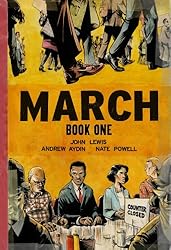
Review: March: Book One, John Lewis, Andrew Aydin, and Nate Powell

Congressman and Civil Rights Movement legend John Lewis teamed up with his Digital Director & Policy Advisor Andrew Aydin and graphic novelist Nate Powell to write his memoir in the form of a graphic novel. The first part of this memoir, March: Book One, tells Lewis’s story from his beginnings as the son of sharecroppers to his days as a student leading lunch-counter sit-ins in Nashville. The second volume of the memoir, March: Book Two, was published in January.

I became intrigued by the memoir after seeing Rep. Lewis talking about it on his Facebook page. I have to admit he is one of my own personal heroes. He has displayed bravery that I am not sure I’d be capable of. I had the good fortune to meet him when he visited my previous school upon the dedication of an art installation. He said very kind things about the artwork, and I was able to meet him and shake his hand and tell him how much I admired him. I do remember crying. It was amazing. He was so kind and so generous with his time, which is how he comes across in this memoir as well. The story opens as Lewis awakens on the day of Barack Obama’s inauguration and goes to his office. He meets two young boys, and he begins telling them the story of his life, starting with the story of his father purchasing his own farm and Lewis caring for the chickens, through his experiences going to school and yearning to learn, his introduction to Martin Luther King, Jr., and his lunch-counter protests while a college student in Nashville.

My school is considering several books as an all-school summer read, and March: Book One is one of the books under consideration. I loved it. It tells the story of the Civil Rights Movement in an engaging way. Reluctant readers and voracious readers alike will appreciate the way it brings the struggles of the Civil Rights movement to life. Many teenagers are not aware of what African Americans suffered when protesting for their basic civil rights. This book would fit in quite well with our American literature course’s units on social justice and civil disobedience.

The device of the flashback works well as a means for telling Lewis’s story as well. One quibble I have is that some of the speech bubbles are difficult to read. I think it was purposeful because I believe that the indecipherable speech bubbles were supposed to represent speech that was not completely heard or took place a “offstage,” if that makes sense. Still, I wanted to read them and see what was being said.

I liked the artwork, and I loved the concept of casting Lewis in the role of a superhero (a little bit). Lewis’s personality shines through the pages, too. He comes across as warm and intelligent—he’s serious, but he also knows when to use his sense of humor. I learned some things reading the book as well. I didn’t realize, for instance, that Thurgood Marshall encouraged the African-American students to pay bail or to get out of jail.

Graphic novels aren’t for everyone. Despite the success of books like Maus and Persepolis, graphic novels are still not accepted by all as a legitimate medium. If you are one of those folks who do not see graphic novels as legitimate literature, you might not like this book… but if you are one of those folks, I would urge you to give them a try with an open mind.

Rating: ★★★★★

Related posts: