Review: Murder on the Orient Express, Agatha Christie, narr. Kenneth Branagh

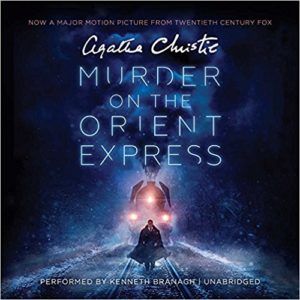
Review: Murder on the Orient Express, Agatha Christie, narr. Kenneth BranaghMurder on the Orient Express by Agatha Christie
Narrator: Kenneth Branagh
Published by HarperAudio on October 24th 2017
Format: Audio
Buy on Amazon
Goodreads
five-stars

A new recording of the most widely read mystery of all time, performed by Kenneth Branagh.

Now a major motion picture from Twentieth Century Fox, releasing November 10, 2017 and directed by Kenneth Branagh.

"The murderer is with us - on the train now..."

Just after midnight, the famous Orient Express is stopped in its tracks by a snowdrift. By morning, the millionaire Samuel Edward Ratchett lies dead in his compartment, stabbed a dozen times, his door locked from the inside. One of his fellow passengers must be the murderer.

My husband and I decided to listen to this on audio as we cook dinner—listening to books while we cook has become a habit. I hadn’t read this one yet. In fact, I haven’t read anything else by Agatha Christie except And Then There Were None. I had the advantage of not having the mystery spoiled for me, so I will not spoil it for you, either (just in case). However, I will say it was quite a satisfying murder mystery, and I was guessing up until the end.

This was my first Hercule Poirot book, and I haven’t really watched any movies or television featuring the character, either. He definitely owes something of a debt to Auguste Dupin and Sherlock Holmes, and I liked him. Kenneth Branagh is an excellent narrator. He does accents really well, which is something I noted when listening to his reading of Heart of Darkness. He even does a really good American accent. His reading of Mrs. Hubbard was fantastic.

I know the reason he read this book is that it’s a movie tie-in for the film he directed and starred in last year. I might want to watch it. It has a stellar cast, though reviews on IMDb are not awesome.

If you haven’t read this book, treat yourself to this audio version. You won’t be disappointed. Kenneth Branagh is a great reader.

This book counts towards the British Books Challenge, as Agatha Christie is a British writer, though the book is set in modern-day Croatia (Yugoslavia at the time). Because of its setting, I’m also counting it for the Literary Voyage Around the World Challenge. I’m counting it as my selection for a classic crime story for the Back to the Classics Challenge.
five-stars

Related posts:

Review: The Miniaturist, Jessie Burton

Review: The Miniaturist, Jessie BurtonThe Miniaturist by Jessie Burton
Published by Ecco on June 2nd 2015
Genres: Historical Fiction
Pages: 416
Format: E-Book
Buy on Amazon
Goodreads
four-stars

Set in seventeenth-century Amsterdam—a city ruled by glittering wealth and oppressive religion—a masterful debut steeped in atmosphere and shimmering with mystery, in the tradition of Emma Donoghue, Sarah Waters, and Sarah Dunant.

"There is nothing hidden that will not be revealed . . ."

On a brisk autumn day in 1686, eighteen-year-old Nella Oortman arrives in Amsterdam to begin a new life as the wife of illustrious merchant trader Johannes Brandt. But her new home, while splendorous, is not welcoming. Johannes is kind yet distant, always locked in his study or at his warehouse office—leaving Nella alone with his sister, the sharp-tongued and forbidding Marin.

But Nella's world changes when Johannes presents her with an extraordinary wedding gift: a cabinet-sized replica of their home. To furnish her gift, Nella engages the services of a miniaturist—an elusive and enigmatic artist whose tiny creations mirror their real-life counterparts in eerie and unexpected ways . . .

Johannes' gift helps Nella to pierce the closed world of the Brandt household. But as she uncovers its unusual secrets, she begins to understand—and fear—the escalating dangers that await them all. In this repressively pious society where gold is worshipped second only to God, to be different is a threat to the moral fabric of society, and not even a man as rich as Johannes is safe. Only one person seems to see the fate that awaits them. Is the miniaturist the key to their salvation . . . or the architect of their destruction?

Enchanting, beautiful, and exquisitely suspenseful, The Miniaturist is a magnificent story of love and obsession, betrayal and retribution, appearance and truth.

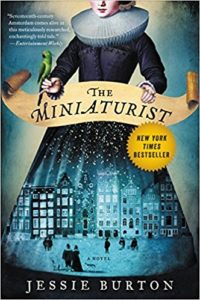
I can’t remember when I bought this book for my Kindle. I think maybe it was one of those deals, and the book had caught my eye in any case because of its cover. However, it looks like it’s been shelved on Goodreads since June 2014, which is around the time it was released, I believe.

I read most of this book (nearly 2/3 of it) today in one pretty big gulp. It takes a little while to get going, but once it does, things seem to be happening left and right. The book feels well-researched, with strong historical details that ring true. The book even has a glossary detailing further information about economics and Dutch terms from the seventeenth century. The characters are also vivid and interesting. One thing that struck me as I finished this book is one constant in human history is man’s inhumanity to man as well as the perseverance of strong women in the face of the world’s cruelty. On the other hand, some details don’t ring true—women characters in historical fiction are often more a reflection of our own times than theirs, and I can see why. I don’t really want to read about a meek woman who keeps her mouth shut and does as she is told, either. Perhaps the least plausible aspect of the book is Nella’s devotion to Johannes. He hasn’t been all that great of a husband, truth be told. And while certain aspects of his behavior would be viewed differently today than in seventeenth-century Amsterdam, the way that he consistently ignores Nella and her feelings didn’t engender a whole lot of sympathy from this reader.

Many times when I am reading a book, I am curious what others on Goodreads have to say about it, and in the case of this book, one reviewer noted she thought the conceit of the miniaturist was unnecessary. This might merit a spoiler alert, but really, we never do learn much about the strange miniaturist who knows so much about Nella’s home and the dangers coming or what motivates the miniaturist, so in that sense, I can understand why some might consider the character unnecessary. I am undecided, myself. Mainly, I was curious as to what inspired the book, because it reads like something definitely inspired it, and I found this snippet from an interview Jessie Burton gave in advance of the BBC’s miniseries based on The Miniaturist:

I was in Amsterdam on holiday. We went to the Rijksmuseum and that’s where I first saw the real dolls’ house, which is actually called a cabinet, which became the symbol of the novel and my point of focus for writing it. I was immediately struck by how beautiful it was and how imposing it was, as well as intricate and intimate. Then when I found out that the woman who owned it, Petronella Oortman, spent as much money on it as a real house, I became interested in the psychology of the cabinet house and what it symbolised, both in regards to the city of Amsterdam and this woman is her domestic, claustrophobic existence. It took her 19 years in total to complete it and she hired the services of over 800 craftsmen and women in the city of Amsterdam and beyond. In my mind’s eye all I could see was one woman, Nella, turning up at this imposing merchant house in Amsterdam.

Using the real Petronella Oortman as inspiration, Burton invented Petronella Oortman Brandt. I didn’t realize it had been made into a miniseries before searching for information about the book’s inspiration. I don’t believe the miniseries has been released in the USA.

In all, I enjoyed the book quite a bit for what it was—an interesting peek into the life of a merchant’s wife in seventeenth-century Amsterdam rendered with some very nice passages of good writing.


This book counts for the Literary Voyage Around the World Reading Challenge, the Historical Fiction Reading Challenge, and the Monthly Motif Reading Challenge due to its setting of seventeenth-century Amsterdam, Netherlands. March’s motif for the latter challenge is “Travel the World.”


four-stars

Related posts:

Review: House of the Seven Gables, Nathaniel Hawthorne

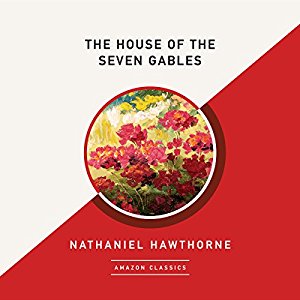
Review: House of the Seven Gables, Nathaniel HawthorneThe House of the Seven Gables by Nathaniel Hawthorne
Published by Brilliance Audio on June 25th 2006
Genres: Classic
Pages: 13
Format: Audio
Goodreads
three-stars

From the author of >The Scarlet Letter comes a landmark of American literature, an embodiment of the greed which can compel people to treacherous actions.

Hawthorne's The House of the Seven Gables is a study of guilt and renewal from generation to generation. At the time of the Salem witch trials, the patriarch of the Pyncheon family finds himself so covetous of his neighbor’s property that he is led to sinister deeds, turning the community against his neighbor who is ultimately hanged for witchcraft. Though his plot to acquire the land is successful, the dying man's curse on the Pyncheon family comes true generation upon generation. That is, until six generations later when the long-hidden truth is revealed….

This novel is part of Brilliance Audio's extensive Classic Collection, bringing you timeless masterpieces that you and your family are sure to love.

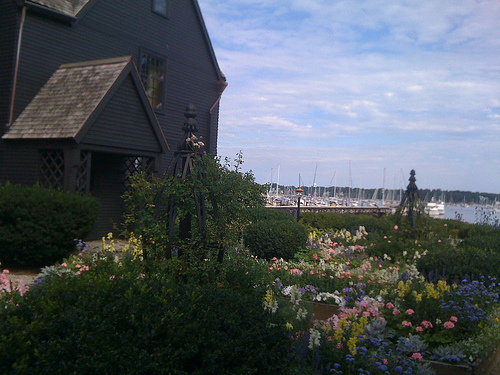
My family visited the actual House of the Seven Gables some years ago.

I’m not sure how much resemblance the actual house shares with Nathaniel Hawthorne’s fictional version, but ever since visiting the house, I’ve had Hawthorne’s The House of the Seven Gables on my TBR pile. I picked it up to read some years ago and stalled out. My husband suggested we listen to it as we cook dinner, and I was game.

First, let me say the narrator, Buck Schirner, was great. His Hepzibah Pyncheon was brilliant. In theory, the story idea is intriguing as well: a house with a storied history, haunted by the ghosts of the past, including an accused Salem witch; a family curse. There are some genuinely good moments. As a whole, the book doesn’t compare to The Scarlet Letter, or even to Hawthorne’s short stories. After a certain point, I was just ready for it to be over, to be truthful. I don’t know what it says that my favorite character is the little boy, Ned Higgins, who develops a taste for Hepzibah’s gingerbread menagerie.

This book counts as my Nineteenth Century Classic for the Back to the Classics Challenge.

three-stars

Related posts:

Review: A Wrinkle in Time, Madeleine L’Engle

Review: A Wrinkle in Time, Madeleine L’EngleA Wrinkle in Time (Time Quintet, #1) by Madeleine L'Engle, Anna Quindlen
Published by Square Fish Genres: Classic, Fantasy/Science Fiction, Young Adult
Pages: 247
Buy on Amazon
Goodreads
four-stars

Meg Murry and her friends become involved with unearthly strangers and a search for Meg's father, who has disappeared while engaged in secret work for the government.

I first read this novel in elementary school, probably fourth or fifth grade. I decided I wanted to see the movie, but since it had been so long since I had read the book, I thought I should read it again.

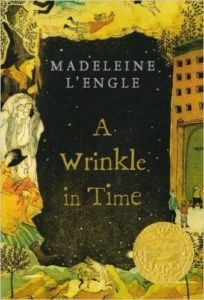
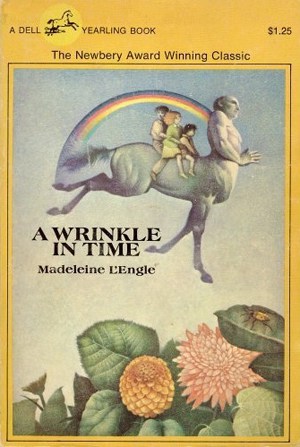
Wrinkle in Time Old Cover
The cover of the copy of A Wrinkle in Time I had when I was a kid.

Things I remembered:

  • Meg Murry is pretty badass.
  • Charles Wallace is an awesome character.
  • Mrs. Whatsit, Mrs. Who, and Mrs. Which are a lot of fun.
  • There is this thing called a tesseract, and Meg has to save her father.

Things I had no memory of whatsoever:

  • The religious overtones.
  • Wow, Meg and Calvin got really close fast, didn’t they?
  • Just how long Meg’s father had been gone.

New observations:

  • Meg and Charles Wallace might be on the autism spectrum. My children are, and Meg and Charles Wallace remind me of them.
  • The storyline really moves fast. I mean, much faster than I remembered. Almost too fast (see below).

I haven’t read a middle grades novel in a long time, and I kept thinking, hold up! You’re going too fast! You need to develop that a bit more! I thought maybe, well, this is the speed you need to go with middle grades fiction, but after finishing the book, I’m not so sure. I think some parts were just unevenly developed. As a result, I didn’t buy Meg and Calvin’s friendship. Too fast, even for a kids’ book. I forgot how creepy Camazotz was. In the end, IT was not as scary to me as the spreading darkness. Plus, hold up: what parent leaves a child behind on Camazotz like Mr. Murry does? Unthinkable. I will probably read the other books in the series because I never did read the whole series. I think I read A Wind in the Door. That’s probably it.

I’m counting this book as my children’s classic for the Back to the Classics Challenge.

four-stars

Related posts:

Sherlock Holmes: Six Stories Catch-Up

The Three Garridebs
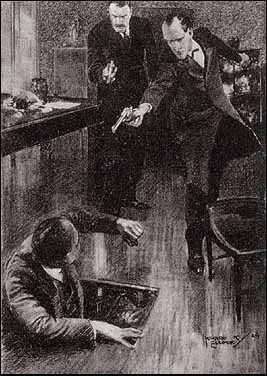
Illustration from “The Three Garridebs” by Howard K. Elcock for The Strand

I have been keeping up with the Chronological Sherlock Holmes Challenge, but I haven’t posted reviews for the stories I’ve read since my last update in January:

  • “The Problem of Thor Bridge”: Holmes investigates the mysterious “murder” of Maria Gibson. Things look bad for her husband, especially when Holmes discovers Neil Gibson had fallen in love with his child’s governess and the alleged murder weapon was found in her room.
  • “The Adventure of the Priory School”: School principal Dr. Thorneycroft Huxtable seeks Holmes’s help in finding a missing pupil, Lord Saltire.
  • “The Adventure of the Sussex Vampire”: Robert Ferguson, believing his Peruvian wife is a vampire, writes to Holmes for help after he believes his wife has tried to suck their baby’s blood.
  • “The Adventure of the Six Napoleons”: Shattered busts of Napoleon might not seem to be of much consequence, but Lestrade is puzzled and seeks Holmes’s help on the suspicion that there is more to the odd cases of vandalism. He’s right.
  • “The Adventure of the Three Garridebs”: Nathan Garrideb writes Holmes seeking his help. If he can find a third man with the last name Garrideb, he stands to inherit a lot of money.
  • “The Disappearance of Lady Francis Carfax”: Holmes sends Watson to continental Europe to start searching for Lady Francis Carfax. Holmes fears for her life, but Watson is quite out of his element without the help of the detective.

I liked all of these stories. Two dealt with the friction between older siblings and younger siblings. Yet again, Conan Doyle can’t seem to write about people from other countries without being racist or inaccurate. I think he should have avoided trying to write about Americans. He just can’t get them right. And it seems like anytime he has a black or brown character, they have some “primitive” qualities. Two women in these stories come from South America, and Conan Doyle’s description of them made me roll my eyes. Laying those issues aside, though—not to say they’re insignificant but more a sign of the times in which they were written—I’d say pretty much all of these stories are four-star stories. Two stories are mentioned in BBC’s Sherlock: “The Three Garridebs” comes up in “The Final Problem,” when Sherlock has to identify which of the three Garrideb brothers committed a murder or his sister Eurus will kill them all, which she does anyway after Sherlock determines which one is the murderer. “The Six Napoleons” is referenced in “The Six Thatchers,” though the reason for the smashed busts of Margaret Thatcher are more interesting than the reasons for the smashed busts in of Napoleon.

“The Three Garridebs” is interesting for another reason. Watson is wounded, and Holmes freaks out and betrays the tiniest bit of concern. Watson thinks he could probably live on that little glimmer of emotion for the rest of his life.

It was worth a wound—it was worth many wounds—to know the depth of loyalty and love which lay behind that cold mask. The clear, hard eyes were dimmed for a moment, and the firm lips were shaking. For the one and only time I caught a glimpse of a great heart as well as of a great brain. All my years of humble but single-minded service culminated in that moment of revelation.

Get a grip, Watson.

Rating: ★★★★☆

The Chronological Sherlock Holmes ChallengeI read these stories as part of the Chronological Sherlock Holmes Challenge. They are the 48th-53rd stories in the chronology (time setting rather than composition). Next up is “The Adventure of the Illustrious Client.”


Related posts: