Required Reading

Share

The Boston Globe reports that the dead white-male dominated canon of literature is gradually caving to allow for books by multicultural authors, women, and (gasp) living authors. What does that mean for schools? According to Carol Jago, high school English teacher at Santa Monica High School and author of With Rigor for All: Teaching the Classics to Contemporary Students, “it’s a waste of instructional time.” Jago compares the search for “new classics” to “walking down a blind alley to look for books that the kids will think is fun.” She worries that we will not sufficiently prepare students for the rigors of college-level reading if we remove the classics.

On the other hand, other teachers note a frequent disconnect between today’s student and the classics. According to Will Cook, “the English chairman at Framingham High, where many students hail from Brazil … working-class immigrants may find it difficult to relate to world-weary Holden Caulfield, the prep school protagonist of The Catcher in the Rye.”

I feel somewhere in the middle on this. I think the classics need to have a solid place in our curriculum, but I like teaching new books, too. However, you can’t do it all, so you have to make choices in the best interests of your students. Students at my school have the following required reading for summer:

9th grade College Prep

9th grade Honors

10th grade College Prep

10th grade Honors

Read the rest of the list here: Summer Reading Brochure 2005 (pdf).

I was rather insistent on Huck Finn being placed on the list and I was also responsible for placing The Color Purple on the 10th grade list and moving I Know Why the Caged Bird Sings down to recommended reading for 9th grade. Other than that, I made no changes to the list in either 9th or 10th grade.

During the course of the year, my 10th grade students will read such perennial classics as:

And my 9th graders’ reading will include:

Modern novels I think it would be worthwhile for students to read include:

I could probably add more if Dylan were not demanding that I wrap this up. Basically, I feel that students need some of the classics in order to be prepared for college, but we need to teach them in such a way as to influence them to choose good modern books to read. I don’t think a recommended reading list would hurt. When I was a junior in high school and about to move to Georgia, I asked my English teacher for a list of recommendations. She was clearly stunned by my request and said she’d put one together. Instead, she gave me a box of old books. I was very touched by the gesture, but after having been a teacher for several years, I understand it was a much more fair exchange than I thought then. Also, after teaching at my school for a year, I have discovered that I wasn’t that weird. Plenty of kids enjoy book recommendations.
Related posts:


Share

The Complete Idiot’s Guide to Jewish History and Culture

Share

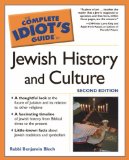
The Complete Idiot's Guide to Jewish History and CultureI just finished The Complete Idiot’s Guide to Jewish History and Culture by Rabbi Benjamin Blech. I did not find it to be as comprehensive as I would have liked. For instance, the only holidays he really explains are Purim, Hanukkah, and Yom Ha-Shoah. He mentions Yom Kippur only in passing; considering it is the most important Jewish holiday, I think merited much more explanation. There was no mention of Rosh Hashanah. I did find the coincidences of tragedy falling on Tisha B’Av interesting — I definitely did not know that so many devastating events, from the destruction of both Temples to the expulsion of Jews from Spain all occurred on the same day. Rabbi Blech’s notion that it is a message from God certainly seems plausible.

I was struck by the rather biased tone of the book. There are several instances in which Rabbi Blech infers he believes the Jews to be a superior people. He states twice that Jews have higher IQ’s than other ethnic groups. While I’m not saying he doesn’t have a point, I think it is dangerous to proclaim any group superior to another, even a group that has fought adversity (and won) since its beginnings and survived despite several attempts to exterminate them. He seems to have a somewhat anti-Christian bias, which is not something I have encountered with my co-workers or students. To be fair, most of that comes out in the chapters in which he recalls the worst acts carried out by Christians against Jews — the Crusades, the Inquisition, expulsion from various countries. I did find some of his remarks about Jesus interesting. I wonder if it is widely accepted, for instance, that Jesus was an Essene? It wasn’t something I knew.

I felt that the book was not as comprehensive as it might have been, but it is understandably hard to define the history and culture of an entire people who have survived over 5700 years. I realize the “Complete Idiot’s” series is designed to be an introduction, but I can’t help but feel like I ate what I thought would be a fairly decent meal that left me still hungry.

Related posts:


Share

Is English Class Killing Pleasure Reading?

Share

A Washington Post story (via MSNBC) explains that time-constraints and lack of choice are killing reading for pleasure in America’s high schools.

I think we have all been asked to read a book we didn’t really like, but I think we have all also been exposed to literature we might not otherwise have read (and therefore, enjoyed) had we not been required to read it for school. I do think students need more choice, but there is that sticky problem of standardized tests, curriculum mandates, and, perhaps most importantly, time.

Jim Burke has some great ideas for incorporating personal reading into the curriculum. I plan to do so in my Oral and Written Communications classes (provided I do teach them) next year, but I freely admit I won’t have time to do it in American Literature. I have required students to read at least one personal book per semester in the past, often with surprising results. Students picked books that should have been in the curriculum, but for time. They often stretched themselves and tested their limits. I wouldn’t be at all surprised if many of them remember that as the best part of the class.

If I only had more time. I barely touched the 20th century in American literature this year, which is not a travesty I plan to repeat next year. Therefore, I’ll be even more crunched. I think we picked some really good books for our curriculum. I wish we could read it all! All in all, the students seem fairly happy with the reading selections. Frankly, most of my students are readers, anyway, so they can make time for personal reading that interests them. I do worry about those that do not read. There are worlds upon worlds out there, and I would hate to think that English teachers, the very people charged with opening the doors to those worlds, are actually closing them instead.

Related posts:


Share

englishcompanion.com

Share

The majority of you all who don’t teach (or don’t teach English) might not be interested in this, but I found a great link today. I was reading my English Journal, and I saw an ad in it for The Teacher’s Daybook. It looked intriguing, so I went to the website to see if I could learn more about it. In the process, I discovered the author, Jim Burke, is the author of The English Teacher’s Companion, a book I think I had once, but can no longer find — the joys of moving. At any rate, Jim Burke has a website — a companion to the companion, if you will, at englishcompanion.com. What a wonderful resource for English teachers! He has tons of handouts, ready to print in the form of pdf’s (if you don’t mind they all say Mr. Burke on them). He has great note-taking handouts, especially. I really like his handouts for his personal reading assignment, too. Overall, it is a great site. Now, I wish I could find that book.

School will be out soon, but I am finding myself already starting to prepare for next year. I keep telling myself I have plenty of time for that, but it is hard to sit still when you find websites like Burke’s.

Related posts:


Share

FLDS in the News

Share

The Fundamentalist Church of Jesus Christ of Latter Day Saints (FLDS), a fundamentalist Mormon sect, is in the news often lately, and it makes me uneasy. I keep thinking about another splinter group of a… well, shall we say not exactly mainline Protestant denomination and their destruction in Waco about 12 years ago.

I understand that we have freedom of religion in this country, but when religious practice involves possible statutory rape and incest, what do we do? Waco proved we have to tread carefully, but what I’ve read of FDLS has me convinced that terrible things are happening to women and children in that sect.

Dr. Phil recently covered the sect on his show and plans a follow-up for Tuesday, May 24. A Current Affair also presented a somewhat sensationalized story on the FDLS.

Read more about FDLS in the news:


Share

Harry Pot-heads

Share

Steve is reading the Harry Potter series. Shh. Don’t tell him I told you. I think he wants to post something cheeky to the effect that he was finally beaten down and forced under pain of torture. Well, we all knew it would have to happen in the end. There is no resisting the appeal of the Boy Who Lived. I hope he’s enjoying them as much as I did. But I get to read Half-Blood Prince first, or else he’s got to get his own copy.

In other news, I glanced at my entry calendar over there to the right and noticed I haven’t posted much in May. School will be out in a couple of weeks, and I imagine I’ll have more time. I hate to use that old busy excuse, but it’s true. That, and I haven’t really felt like there’s much of interest going on that I wanted to write about here. Also, I suppose my new genealogy blog is taking time that I might have spent here, and I have been trying not to neglect my Harry Potter blog so much.

I will leave you with a couple of interesting links:

Related posts:


Share

Identity Theft Revisited

Share

Remember last summer when I mentioned I had been the victim of identity theft?

Well, I got a letter in the mail today from the U.S. Justice Department. They actually caught the persons involved. I am fairly surprised. I don’t hold out much hope that they’ll go to jail, but maybe they’ll have at least learned that they can’t get away with that sort of thing. Actually, one of them might do jail time, because it looked like he was involved in some pretty hairy schemes.

I am not sure what all I can say about it. I haven’t been put under a gag order or told not to reveal who it was, but considering they haven’t been arraigned yet, it feels wrong. Maybe once they’re convicted.

It feels really good to know that I wasn’t forgotten or ignored and that they found the guys. It is a horrible feeling to know someone is out there trying to get credit in your name, using your Social Security Number, and emptying your bank account. Not that they managed to do much harm to me financially — my bank was really good about it.

Related posts:


Share

Pressure to Change Grades

Share

Not that I have to deal with this in my current teaching position, but yes, I too have been pressured to change grades (bypass registration with BugMeNot). While I’m not proud of it, I have done it. Sometimes, I wasn’t given a choice. I’m not sure I would have lowered a student’s grade as a discipline issue, but when I taught at a rough school with no parental or administrative support, grades were the only (rather small amount) leverage I had, and I admit I used them. I called them participation grades. Perhaps that sort of thing is more acceptable than taking a grade a student earned and lowering it, but I still think the firing of the teacher was too extreme. This is a move that will impact Neace’s career. He may find it difficult to procure future employment. Please understand, I am not saying I think Neace made a good decision in lowering the grade, but he shouldn’t have been fired for it. I wonder what the system’s policy is on participation grading? I ought to know, as I worked there. Maybe that’s all I need to say…

Related posts:


Share

The Bible, Not Bible-Thumping

Share

It should come as no surprise to anyone who teaches literature that a good background in the Bible is really helpful for students. So much of Western literature derives influence from the Bible, whether through symbolism or allusion. As a teacher in the South, I never worried about bringing up the Bible in class when an author clearly referred to it. I have been known to find the reference and read that, too. I think that’s just good teaching. It is nice to work at a school where students are taught Tanakh (the Torah plus other books that make up the Christian Old Testament) and also Rabbinic literature. They know much more than any other students I’ve taught, and they pick up Biblical references. Therefore, “Call me Ishmael” means something to them, and I don’t have to spend a lot of time explaining it. I agree that studying the Bible as the most influential source for so much Western canon is a good idea, but I understand why it makes people nervous. There is a fine line to be walked. Oddly enough, my students are fairly well-versed in New Testament, having studied it in middle school, and I rarely have to describe references to the New Testament in great detail.

I think what people fear about the Bible is directly related to idiots like Republican Alabama State Representative Gerald Allen, who tried to push through a bill to ban books written by homosexuals or that have homosexual characters from public schools.

What that meant was no Tennessee Williams — The Glass Menagerie is a staple of American literature curricula across the country. It meant no Truman Capote. By extension, does that mean he might have banned To Kill a Mockingbird, as Dill was based on Harper Lee’s childhood friend Truman Capote? The Color Purple would have been gone. He even went after some of Shakespeare before backing down and allowing “classics” to be exempt, although the article’s author maintains Allen couldn’t define what a classic was.

Librarian Donna Schremser sums it up perfectly: “[T]he idea that we would have a pristine collection that represents one political view, one religious view, that’s not a library.”

Thank God for absenteeism:

When the time for the vote in the legislature came there were not enough state legislators present for the vote, so the measure died automatically.

Let’s hope it stays dead, for the good of Alabama’s schoolchildren.

Related posts:


Share