
Booking Through Thursday: Ground Floor

Share

Descending Memories

I know it’s Friday. Stop giving me the shifty eye. It was a hectic week. Sick children, missing Girl Scout sash, AP Information Night at the high school. I really like this week’s Booking Through Thursday prompt: Which authors have you been lucky enough to discover at the very beginning of their careers? And which ones do you wish you’d discovered early? I needed some time to think about it. I am not often the person who discovers a new author after his/her first novel, but I did get in on the ground floor, so to speak, with both Matthew Pearl and Katherine Howe. I read Matthew Pearl’s first novel The Dante Club probably when it had been released in paperback. He found a blog post directed to my students recommending the book and invited me to a reading/signing at the Decatur Library here in the Atlanta area for his new book—The Poe Shadow. It was great to meet him and have him remember that I was the “Ms. Huff” who mentioned his book to my students.

I was browsing at Borders and Katherine Howe’s first novel The Physick Book of Deliverance Dane caught my eye because it has a gorgeous cover. I saw that Matthew Pearl had written a blurb for it, and I grabbed it. Eye-catching cover, Matthew Pearl liked it—how could it not be good? And I truly did enjoy it. I have met Katherine, and she’s very friendly both in person and on Twitter.

I also read Kathleen Kent’s novel The Heretic’s Daughter after seeing it everywhere in Salem last summer. She has a new novel out called The Wolves of Andover. Kathleen Kent is a great example of how mining a fascinating family history can reap great rewards. I met her at the NCTE Conference in Orlando in November, and she was very friendly.

I was really lucky to discover Brunonia Barry early. I had an ARC of The Lace Reader and was able to read it before a lot of other folks did, although she had also previously published it with a smaller press. Those folks that read the very first edition must feel like they truly discovered her and that people like me are just posers.

What’s cool about all three is feeling like I haven’t missed out—and I’ve picked up all of their other works (except Katherine’s—she’s still working on her second).

You know, I’m such an English teacher nerd that most of the folks I wish I had discovered early are dead. For instance, William Shakespeare. How cool would it have been to go to the first production of the first play he wrote? Or the Beowulf author and Pearl Poet. Just to find out who they were. Or Shelley and Byron and Keats (oh my!). Or Oscar Wilde?

Psst. If you are so inclined, you could get in on the ground floor with me. I have one complete novel, a second that needs editing, and a third that isn’t finished yet. You can check out my novel here and see if it looks like something you’d like to read.

photo credit: bogenfreund

Related posts:


Share

Reading Update: February 5, 2011

Share

Nottingham CastleHow much am I enjoying Jude Morgan’s novel Passion? Well, I am prolonging the reading of it so as to enjoy it more, which will not help me meet my goal of reading 50 books this year, nor will it help me finish any reading challenges.

Some favorite passages, most of which come from the viewpoint of Lady Caroline Lamb:

And when in 1802 the peace was declared, after nine years of war between England and France, the Duke [of Devonshire] sighed, “I dare say we can go over to Paris again now,” as if a good shop had reopened after a fire; and patted his dog’s head.

The Peace of Amiens: the two punch-drunk prizefighters unable to carry on any longer: “a genuine reconciliation between the two first nations of the world,” according to “Doctor” Addington, the new Prime Minister: the peace, quipped the wits, that passeth all understanding. Too much conceded to Bonaparte, securer now in power as First Consul than any king, and lording it over Europe: wouldn’t last: bad times ahead. But for now, a feeling of relief and freedom. The tight little island had begun to seem like a prison. The fashionable world packed its trunks and headed for the Channel. Of course Boney and his upstart crew were devils, but who could resist a little tour of hell, just to see what it was like?

The Duke did not go, in the end, because of his gout. But everyone else did—”everyone,” in this case being roughly the whole section of English society that in France would have be guillotined. (84)

On Lord Byron:

It appeared to her [Lady Melbourne] highly probable that a man in his situation, and possessing those undoubted qualities that acrimony could not hide, nor dissipation impair, must seek sooner or later to leave behind the sins of his youth, and embark upon a new and restorative course. Lady Melbourne dropt one or two hints in that direction, the full import of which her niece [Annabella Milbanke] did not chuse to construe; though she must admit it as a truth universally acknowledged that a single man not in possession of a good fortune must be in want of a wife. (170)

Caroline Lamb, on the dissolution of her liaison with Byron:

Well, here is a thought for you. Now let me see if I can take you over the fences of this one. You’ll agree that there are times in your life that are happier than others—yes? And so out of all those there must be one time that is the happiest—yes?—just as among some trees that are taller than others, there must be one that is tallest of all even if only by an inch—yes? Thus there must be one period of time in your whole life that is, take all in all, the happiest, the truest, the most fulfilled, the best. So.

What if that time has already been and gone?

And you know it?

No, no—I’m quite well—I just fancied I heard my grandmother’s ghost at last. Saying that in her day they did not think of such things.

Well for them, perhaps. Part of me does long to lace up my feelings in that narrow bodice and tread that old narrow path. But I think it is closed off to us now, whether we like it or not.

Do I think my best time has gone? Why—how could I go on living, if so? (181)

And in a line worthy of Violet, Dowager Countess Grantham from Downton Abbey (played expertly by Dame Maggie Smith), Lady Melbourne to Lord Byron, on his affair with her daughter-in-law, Lady Caroline Lamb:

Lord Byron, how do you do? I am so used to seeing you disappearing upstairs, you must forgive my staring at your near and frontal approach. (181)

You know, with all the strange connections between historical persons in the Regency—William Lamb, Lady Caroline’s husband and Lady Melbourne’s son, would become Visount Melbourne, Prime Minister and mentor to Queen Victoria. His first cousin, Annabella Milbanke, would be Lord Byron’s wife, the Duke of Devonshire married to Georgiana Spencer and uncle and aunt to Lady Caroline—the time period begins to look almost as incestuous as Byron’s love affair with Augusta Byron Leigh.

Ba-dum-bum-psshh.

At any rate, it makes one think the period sounds like a game of six degrees of separation from Romantic poets.

photo credit: PeterXIII

Related posts:


Share
2011 Where Are You Reading? Challenge

One More Reading Challenge

Share

I2011 Where Are You Reading? Challenge know what you’re thinking. STOP! This reading challenge won’t mean any additional commitments, though. It works with what I’m already reading. It’s the 2011 Where Are You Reading Challenge.

Essentially, it works like this: after I finish reading a book, I mark its setting on a Google map.

Based on my reading so far, I suspect I’ll have a lot of dots clustered in England.

How much fun is that? Should be interesting to see if my reading is as focused on England as I think it is.

Here is my map so far:


View 2011 Where Are You Reading Challenge in a larger map

Related posts:


Share
Percy Bysshe Shelley

My Crush on Shelley

Share

Percy Bysshe Shelley
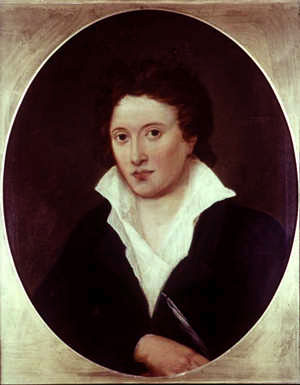
Percy Bysshe Shelley, 1819, by Amelia Curran

I wrote yesterday about Byron, and despite completely understanding Byron’s appeal, it is Shelley I have the crush on.

I probably first encountered Percy Bysshe Shelley’s poetry in twelfth grade. I can’t think of any reason I would have encountered him before that time. I did a group project on his poem “Ozymandias” with two classmates. We videotaped ourselves as the Shelleys and his “inspiration,” a basketball player who was past his prime and whose talent would quickly vanish, which I have to say was probably not a bad modernization of the text’s theme. Shopping in the bookstore with my parents, I found a Norton anthology of Shelley’s poetry and prose and had to have it. My dad bought it for me, and he must have been scratching his head over the purchase something fierce because what normal twelfth grader wants a Norton anthology of a British Romantic poet’s work? Even I would wonder what was up with such a kid if I met one today, but I have a sneaking suspicion I was on the extremely rare side in that particular area.

So I read some of the other poems in the Norton, and I was particularly entranced by Epipsychidion, a word Shelley made up which means “on the subject of the little soul.” This poem is about S-E-X. It is transcendent, a connection of souls. It’s written for a woman named Teresa Viviani with whom Shelley was quite enamored, but who was inaccessibly confined in a convent by her father. Just imagine! It reminds me of Romeo’s declaration that Rosaline’s decision to “remain chaste” in fact “makes huge waste.” In the poem, Shelley calls Viviani “Emilia,” the name of Hippolyta’s sister as described in The Teseida by Boccaccio. Later, Geoffrey Chaucer would rework the story in “The Knight’s Tale,” and Shakespeare and John Fletcher as Two Noble Kinsmen. Emilia, or Emily, desires to remain chaste also, but she has the misfortune to be spied by Palamone and Arcita, who fall in love with her on sight (because that’s what you do). I am much more familiar with Chaucer’s version of the story, so I’ll discuss it for a moment (still with me? bored out of your skull yet?).

In Chaucer’s story, Palamon and Arcite (same dudes, different spelling) are cousins who are like brothers. They are among the Thebans who fought against Theseus’s forces. They are captured and imprisoned in Athens, and it is from their prison window that first Palamon, then Arcite, spy Emily. They fall in love with her at first sight, but they can’t have her because they’re in prison. Eventually Arcite is released from prison, but is exiled from Athens, while Palamon remains behind bars. This scenario prompts the Knight to ask the company who has it worse: Palamon, who is imprisoned, but who can still look on Emily’s beauty from his prison window, or Arcite, who is free, but cannot see Emily. I usually ask students how they would answer the Knight’s question. How would you?

I won’t go too far into the rest of the story, but suffice it to say the men have really only fallen in love with Emily from afar. They don’t really know her, and in fact, no one really cares what she wants in all of this, which is to be a nun. Women didn’t get to choose so much in Emily’s day, however, so she eventually weds one of the cousins, and I won’t tell you which because I hope you’ll read the story. What Emily represents is the Knight’s ideal—an example of the lady on the pedestal. Of course, the Miller tells his story next, concerning men and women who are a little nearer to the earth.

At any rate, Shelley choosing that particular nickname for his beloved is fraught with all sorts of meaning. She is the unattainable Emilia, only she is imprisoned rather than her lover (presumably Shelley). Idealized, not real. Not really Teresa Viviani, but his hope for perfection.  He compares his wife, Mary Shelley, to the moon—cold, chaste. Teresa is the sun (can’t help but think of Romeo and Juliet once again).

I don’t know why, but I developed a sort of crush on Shelley that has lasted since twelfth grade, over 20 years now. I don’t think Shelley was particularly nice, at least not to his wives, and I’m not sure what it is about him. He is on the page, and his opinions and beliefs shine forth in clear language, but even after all this time, I don’t feel I really know him. He is still a mystery. I am looking forward to seeing how Jude Morgan gives him flesh and life. I have no trouble imagining Byron or Keats as real people, but Shelley has remained elusive. He is, in that way, like Emilia himself. All the descriptions I’ve read of him tend toward the idealized. I hope Morgan is able to make him walk on the ground.

See Shelley’s Ghost: Reshaping the Image of a Literary Family.

Related posts:


Share
Lord Byron

Byron Was a Bad, Bad Boy

Share

Lord Byron
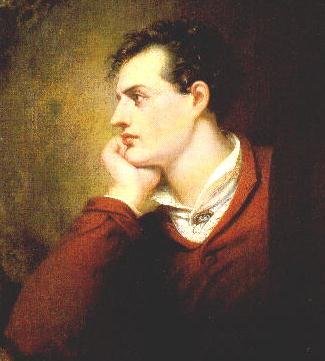
Portrait by Richard Westall

Byron seems to be cropping up on my radar a lot lately. Melvyn Bragg’s In Our Time recently recorded a discussion of his poem Childe Harold’s Pilgrimage. I subscribe to the podcast in iTunes and listened to it during my work commute last week. My favorite part:

Melvyn Bragg: Then he left [England] in 1816, as it happens never to return, but he left notorious—he was hissed in theatres, he was hissed in the House of Lords. He was more than a scandal; he was an outrage. They wanted him out—out of the country, off the island. What had happened?

Emily Bernhard Jackson: Well, he had had an affair with his half-sister, um, of some duration, uh—

Melvyn Bragg: And that got out.

Emily Bernhard Jackson: That got out. Although, interestingly, what seems to have caused more problems were the rumours that he had practised homosexuality in the East, that he had attempted to perform sodomy with his wife and with Lady Caroline Lamb, both. Um, these were all rumours. There was a—when the Byrons separated, Lady Byron mounted a kind of campaign to make sure that she would come out well, a very modern campaign, and part of that was spreading these rumours. Um—

Melvyn Bragg: What credence do you give them?

Emily Bernhard Jackson: I would say he certainly had an affair with his sister. I would stay that’s beyond question, although he didn’t announce it to the world. I give full credence to all of them.

I think it says something kind of weird about me that I laughed when Professor Jackson said that last sentence, mainly because she set it up to sound like a smear campaign headed by Lady Byron, Annabella Milbanke, but a true one.

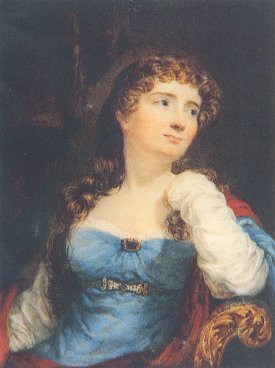
Annabella Byron, 1812
Annabella Byron, 1812 via Wikipedia

Caroline Lamb famously described Byron as “mad, bad, and dangerous to know,” and Melvyn Bragg and his guests hypothesized that Byron’s bad-boy reputation helped move copies of his books off the shelves. The Corsair sold 10,000 copies on its first day, apparently.

Byron will also be a character in the book I’m currently enjoying immensely: Passion by Jude Morgan—the story of the Romantic poets Byron, Shelley, and Keats as told through the voices of the women who loved them.

I have to admit that when I teach Byron, I can be somewhat irreverent, and it is my hope that Byron, wherever he is (I’m sure many folks would say hell), enjoys it a little. I think he liked being famous. One of my favorite ways to describe Byron’s death is that he was bored, so he decided to sail for Messolonghi and fight for Greek independence because that’s what you do.

He sounds like he would have been one of those guys who was fascinating to have as an acquaintance, but maddening to have as a close friend or lover. Kay Redfield Jamison, a clinical psychologist, expert on bipolar disorder, and author of Touched with Fire and The Unquiet Mind, speculates that Byron was bipolar, which would explain a lot about some of the choices he made in life. It also explains much of his behavior—by turns magnetic and charismatic, then frightening and cruel. Certainly he describes suffering from melancholy.

“My Soul is Dark”

My soul is dark—Oh! quickly string
The harp I yet can brook to hear;
And let thy gentle fingers fling
Its melting murmurs o’er mine ear.
If in this heart a hope be dear,
That sound should charm it forth again:
If in these eyes there lurk a tear,
‘Twill flow, and cease to burn my brain.

But bid the strain be wild and deep,
Nor let thy notes of joy be first:
I tell thee, minstrel, I must weep,
Or else this heavy heart will burst;
For it hath been by sorrow nursed,
And ached in sleepless silence long;
And now ’tis doom’d to know the worst,
And break at once—or yield to song.

When I read this poem, which seems to discuss Byron’s emotions on hearing music, I can’t help but notice the title seems to infer it’s really about his own turbulent feelings—the frustration he felt over being emotionally damaged or deranged in some way. His poetry must have been one of the few outlets he had for making himself feel better—his heart would “break at once—or yield to song.” And yet, he’s not without a sense of dark humor about himself. Thomas Medwin reports in The Angler in Wales, Or Days and Nights of Sportsmen, Vol. 2 that in discussion of an upcoming attack on the Castle of Lepanto in which he would act as commander-in-chief,

“I do not know how it will end,” said his Lordship, gaily, “but one thing is certain, there is no fear of my running,” at the same time glancing at his lame foot. (214)

I leave you with some audio of one of Byron’s most famous poems, “She Walks in Beauty,” set to music by Isaac Nathan. Nathan’s melodies for Byron’s poems (Hebrew Melodies) have largely been forgotten, but Byron’s poetry remains. This audio is from Romantic Era Songs.

She Walks in Beauty

Related posts:


Share
Mary Novik

Mary Novik: Author Interview

Share

Mary Novik
Photo © Janet Baxter

I recently connected with writer Mary Novik, author of the novel Conceit, on Twitter, and she graciously agreed to answer a few questions for me.

I noticed that the story of John Donne’s vision of Ann with a dead child appeared in the book. I tell this story to my students when we study “A Valediction: Forbidding Mourning.” What is one thing you wish your own English teacher had taught you about John Donne?

I would have loved to have known that, as a young man, John Donne sowed his wild oats with great abandon. Instead, my English instructors presented Donne as a devout husband and as a writer of holy sonnets. Sure, many of his best poems fall into those categories, but he also wrote seduction poems to women other than his wife, Ann. Knowing he was a bit of a lad rounds him out and makes him more intriguing. Although I’d admired his more sedate poems for years, it wasn’t until I discovered one of his racy elegies that I decided to write Conceit.

You have said you chose Pegge Donne because so little was known about her, so she aroused your curiosity. What do we know about her aside from Donne’s mention that she had the pox? For instance, were you able to find records for her family, such as the names of her children and grandchildren (the name Duodecimus kills me!)?

Donne only mentions his daughter Margaret in two letters, one about her baptism and one in which he announces “Pegge has the pox”. That was one of the triggering facts for Conceit. Smallpox could cause hair loss, scarring, and even death. My imagination ran riot. How would a fifteen-year-old in love with a family friend, the fisherman Izaak Walton, react to her hair falling out? Pegge’s personality began to take shape around this dramatic episode. Church and court documents only tell us the bare minimum about Pegge: her marriage, names of her children, her death. Duodecimus (which means “twelve”) was the real name she gave her youngest son. From that odd fact I came up with the idea that she was eccentric like her father and had twelve children like her mother. Did she identify with her mother? Did she read her father’s love poems? On it went, fact mingling with fiction, until I had my own Pegge, the main character of Conceit.

I enjoyed meeting up with the likes of Samuel Pepys and Christopher Wren in the novel. Some people might consider it coincidental, but I felt it showed the connectedness of humanity. In some ways, this book seemed to be about the ways in which we are all connected to one another and are important to one another—and it reminded me of Donne’s Meditation XVII in which he says, “No man is an island, entire of itself; every man is a piece of the continent, a part of the main. If a clod be washed away by the sea, Europe is the less, as well as if a promontory were, as well as if a manor of thy friend’s or of thine own were: any man’s death diminishes me, because I am involved in mankind, and therefore never send to know for whom the bells tolls; it tolls for thee.” I was wondering if you could discuss the influence of this work of Donne’s on the novel.

Meditation XVII is so powerful that people often think it’s poetry, but it’s actually one of the twenty-three prose meditations in Devotions, which Donne wrote when ill and in a spiritual crisis. He was an amazing prose stylist. Today we think of priests as rather stuffy, but Donne’s sermons (like “Death’s Duel”) have wild, obsessive imagery. I was very influenced by Donne’s writing when I was working on Conceit. It’s been called a woman’s novel but, looking at it now, I would agree it’s also a meditation about humanity and evolving personal relationships in the 17th century. Although most marriages are arranged, John Donne and Ann More are so feverishly in love they elope, sacrificing their worldly status. Later, Donne arranges safe marriages for his daughters, but Pegge’s turns out differently than expected. In Conceit, this dance between men and women is often narrated by men. Two of my favourite chapters are “Virtuoso,” in which Pepys aches with pity for his wife, and “Unbuttoning,” in which William struggles to understand Pegge and the mysteries of human love.

One of the things I admired about this book was the way you brought life in the seventeenth century into vivid relief. Many historical novels throw in a few trenchers, some stays, and an archaic word here and there, but otherwise have people walk and talk like we do. I didn’t forget for a moment that I was reading historical fiction because I felt immersed in another time. It also occurred to me that it must be difficult to capture another time period and yet still help the modern reader along. How do you think writing historical fiction like Conceit is different from other kinds of fiction?

When I was writing Conceit, I was totally immersed in the characters. I’ve visited London many times, but if Pegge is walking along a street, I try to show it through her eyes not mine. What has changed since she was last here? Where is she going, and why? I don’t want to gawk like a tourist at things Pegge won’t notice. Too much description of, say, the lack of hygiene will kick the modern reader out of the story. I want the reader to smell, hear, and taste as my character does. An example is the scene in which Pegge runs along Fleet street and counts the taverns she passes. I used the names of taverns that actually existed, but she’s just a kid, counting them off because she’s racing home, her gown flying, to hide in her bedchamber before her father discovers she’s been out late at night.

Do you have any advice for writers?

Start with something short, like stories! Send the stories out to periodicals. Take workshops. Form a writers’ group. If you decide you absolutely have to write a novel, be prepared to throw everything at it, time, money, energy, for about five years. Do it only if you absolutely must. Don’t rush. Don’t try to figure out everything in advance or take the most straightforward path. And don’t just tell the story: let your characters talk to one another and reveal it for you. When that happens, you’ll know they have come alive on the page, full of passion and surprise. That’s the most glorious feeling.

Thank you very much, Mary!

You can read my review of Conceit here. You can follow Mary Novik on Twitter, and be sure to check out her website.

Related posts:


Share

Conceit, Mary Novik

Share

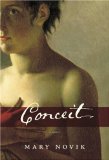
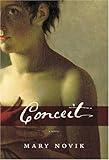
ConceitMary Novik’s novel Conceit is the story of John Donne’s daughter Pegge and her quest to discover what love is. She is entranced by her parents’ relationship—in an unusual move for their time, they married for love, but by the end of his life, Novik’s Donne seems to regret this decision in some ways as he searches for husbands for his own daughters and tries to suppress his past and his feelings for Ann, who died years before the novel’s events. He is concerned about the legacy he leaves behind and works hard to construct an expurgated life story for himself, focused on his work as Dean of St. Paul’s. The novel begins as Pegge braves the Great Fire of London in 1666 to save the effigy of her father in St. Paul’s and travels back through Pegge’s memories of her father’s death, the memories of her own parents, and forward again to Pegge’s life as a wife, mother, and grandmother.

Novik brings seventeenth century England to life in this novel. In many cases, I think writers of historical fiction create characters who act too much like modern people. This novel reminded me of Anthony Burgess’s Nothing Like the Sun (review here) in its attention to period detail. Novik has managed to capture a place that seems much more real than most historical fiction novels do. Even though Pegge is somewhat eccentric for her time, I found her completely plausible as a character because of Novik’s skill as a writer. What else would the daughter of John Donne be? I found myself shaking my head at her and sympathizing with her husband William a great deal, but she was oddly endearing. I really enjoyed reading about all of her experiments (from fish recipes to horticulture). A favorite quote by Novik’s Donne from the novel:

“That is my last poem, Pegge. See that it gets to Marriot for printing with the others.  I am glad it was you who came into the room just now. Of all my children, you have the most poetry in you, thought God knows how you will use it.”(214)

Conceit is a rare historical novel that allows the reader to feel immersed in a time period, learn some history, and enjoy the story all at once.

Rating: ★★★★★

I read this book for the Historical Fiction Reading Challenge. I’ve read three now. Twelve more to go!

Related posts:


Share

Booking Through Thursday: Periodically

Share

Hipster
This week’s Booking Through Thursday prompt asks “What magazines/journals do you read?”

I have subscriptions to several magazines through the mail: Newsweek, Wired, Mental Floss, and Jane Austen’s Regency World will be most familiar to readers, but I also subscribe to education journals in my field. Right now the only one I read is English Journal, which is produced by the National Council of Teachers of English for secondary school English teachers.

I will pick up a lot of magazines to read occasionally, particularly if there’s a story I really want to read. I like history magazines (BBC History is great, and I sometimes read Renaissance Magazine). I admit to glancing through People on occasion. I have been a subscriber in the past, and I’ll own up to it. I like magazines. They’re easy to pick up when I don’t have time to read a lot—I hate to put a book down in the middle of a chapter. I also like to read them in the tub where I don’t care if they get wet (unless they’re my Jane Austen’s Regency World magazines, which must stay pristine). I sometimes grab cooking or cross stitch magazines on impulse.

I also downloaded The Guardian‘s iPhone app yesterday, and I am looking forward to using it a lot. The app is free in the US because The Guardian is trying to expand their readership in the American market. It does have ads. UK readers have to subscribe to it. I like UK newspapers better than US ones, though I occasionally read articles in The New York Times.

You know what I don’t read, though? Women’s magazines. I used to look at them fairly often, but I haven’t read them in years. Just not all that interested I guess. I can’t stand the way they’re crammed with perfume samples. Ugh.

My son likes to look at Newsweek. He is only seven, but he’s a budding graphic designer, and I think he enjoys their design and page layouts. My daughters don’t really read magazines, and I haven’t noticed that Steve has a huge interest in them, either.

What magazines do you read?

photo credit: Joel Bedford

Related posts:


Share

Do You Hate Holden Caulfield?

Share

This is a book you must read.I have been thinking about this post at Forever Young Adult ever since I left a short comment, mainly because of all the commenters unloading on Holden Caulfield, and then throwing in folks like my beloved Lizzie Bennet. (Seriously? Someone petitioned to have Pride and Prejudice removed from her reading list? For the love of all that is holy, why?)

I think all of us have read books we were told were supposed to be classics, and we didn’t understand the fuss. We didn’t like them. In fact, we hated them. And we wondered if there was something wrong with us. This book is supposed to be a classic, right? That means lots of people love it, and if we don’t love it, we probably just didn’t get it.

Not true.

Books do become classics because people love them, and they stay classics because new people come along, read them, and love them, too. But I don’t think every book is for every person, and I think we sometimes assign books at the wrong time. I suspect that might be the case with the person who didn’t want to read Pride and Prejudice. I have taught that book to ninth graders, and they weren’t ready for it at all, and it was a mistake to teach it to them. Then again, Jane Austen is such an important British author for students to be exposed to. This year, instead of watching the books I love suffer the cruel hatred of my students, I offered them choices for a Jane Austen Book Club: Pride and Prejudice, Sense and Sensibility, Pride and Prejudice and Zombies, and Sense and Sensibility and Sea Monsters. None of my students signed up for either iteration of Sense and Sensibility, but I had a group of girls and one savvy boy who wanted to read Emma. Even though it wasn’t on my list, did I let them? You bet. They were choosing it. And that’s what makes the difference. It’s hard, but we have to let kids choose what they read more often. I am not advocating that we end class novel studies. I think a balanced approach works. Will students always choose the classics? No. I think we have to be OK with that. What we want to do is foster readers. Readers are people who will pick up classics later on, perhaps when they’re ready for them.

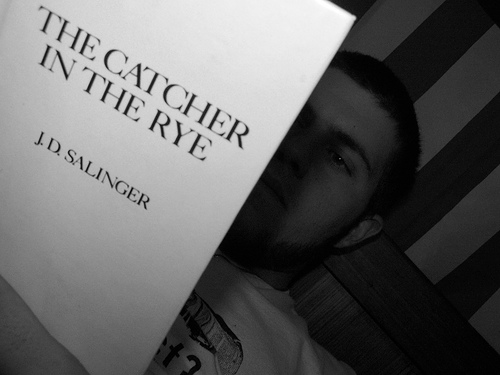
When I first read The Catcher in the Rye in high school (on my own, not assigned), I didn’t think much of it. I didn’t like Holden. When I read the book again in my thirties, I found new sympathy for Holden, and there are some beautiful passages in that book. The scene in which Holden prays to Allie to save him from disappearing is gorgeous and sad.

I am well aware that a lot of people strongly dislike, nay hate my favorite book, Wuthering Heights. I myself am at something of a loss to explain why I love it so much. I don’t really like the characters all that much, and usually that’s an absolute prerequisite for me. One thing I have done in my classroom the last two years is show the 1998 film so students at least have a grasp of the plot before we read. After watching the film two years ago, a group of girls in the back of the class applauded when it was over (note: this is not a common occurrence). I mentioned to that class that I found at least two Facebook groups dedicated to the eradication of Wuthering Heights. I’ll never forget my student Jake’s reaction. He turned to look at me, incredulous look on his face, and said, “Why?” I love that he was so dumbfounded. I didn’t have time to teach the book that particular year, so the movie was all the exposure we had. One student liked it so much that I gave her a copy of the book, which she read and proclaimed her favorite. She has since thanked me twice because it is now her favorite book. She only had room to take a few books with her to college, but, she informed me, Wuthering Heights was one of them.

Image via Brontë Parsonage Blog

Last year, I showed the film first, but before I did, explained to the students what this book meant to me and how scary it is to teach books I really love because they might not like them, or worse, they might hate them, and I explained how soul-crushing that is. I told them I was handing them something very personal and valuable to me when I handed them this book, and I begged them not to trample on it. Surprisingly, it worked. I don’t mean to say they all liked it, but they were kind to me about it. One student admitted to me that he didn’t really care for it, but he seemed to appreciate the fact that I shared my own feelings about the book. Another girl made me all kinds of paper dolls of characters from the book using a graphics program (software or online, I’m not sure). I asked her if she had liked the book. She said, “I can’t get it out of my head.” She looked kind of far away for a moment, then walked out the door.

What is the point of all this? I’m just wondering how many of us who consider ourselves readers can remember reading a book everyone else seemed to love, or was considered a classic, and we didn’t like it? Mine was Crime and Punishment (review here). What do you think English teachers or parents or anyone else responsible for fostering budding readers should do to encourage readers? Is it OK if we never read classics?

P. S. For the record, I cried a little when J. D. Salinger died.

photo credit: joseph.antoniello

Related posts:


Share
Rascal, Sterling North

Booking Through Thursday: Firsts

Share

This week’s Booking Through Thursday prompt asks “Do you remember the first book you bought for yourself? Or the first book you checked out of the library? What was it and why did you choose it?”

I’m not sure I could remember the very first because my mother took us to the library often, and when I was old enough to ride my bike there by myself, I went whenever I could. I was also a frequent patron of the school library.

When I was in elementary school, fifth graders had three jobs and rotated these jobs by class on a cycle. The jobs were Safety Patrol, lunch helpers, and office helpers. When it was our class’s turn to be Safety Patrol, we were responsible for ensuring the other students at our school could cross safely at the four intersections surrounding our school. The other two fifth grade classes were lunch helpers and office helpers at that time. We would rotate, and our class would next be responsible for either lunch or office. Lunch helpers left for lunch early and helped the cafeteria workers prepare lunches for the students. We had a free lunch on the day we helped. Office helper was my favorite job. I would be allowed to sit in the office and complete my school work for the day, and since I could work at my pace, I usually finished by 11:00 or so. Then I could read for the rest of the day (when I wasn’t delivering messages or forgotten lunches). The office staff would allow me to go to the school library to check out books.

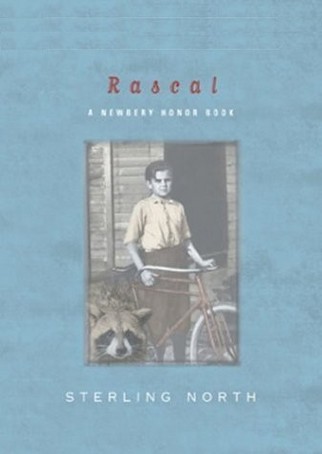
All of this sharing is a roundabout way of leading up to a book I remember checking out of the library more than any other, and it’s a book I checked out and read in the school’s office. The cover was a nondescript brown, and to be honest, I’m not even sure why I picked it up in the first place. All that business about not judging a book by its cover and all that is nice, but we all do it, kids especially. The cover had nothing inviting about it. Inside was a wonderful story of a boy who made a pet of a wild raccoon and, sadly, had to let it go when he realized it would never be a tame animal. It was called Rascal, and it was written by Sterling North.

Rascal, Sterling North
A new edition of Rascal

Sterling North’s story of the raccoon he loved and had to give up moved me so much that I wanted to write him. He was to be the first author I had ever written. I didn’t try to write him until I was in sixth grade, and I remember asking the media specialist at my middle school for help so I could figure out how to do it. She was so enthusiastic. She excitedly pawed through some book that displayed writing addresses, probably literary agents or similar, for authors, and I remember how crestfallen she was—more than I was, truth be told—when she discovered Sterling North was already dead by the time I thought to write him. In fact, he had died several years before.

As an adult, I am quite aware that raccoons make terrible pets, and I wouldn’t want one. I wanted a raccoon desperately as a kid, and it’s Sterling North’s fault.

Related posts:


Share