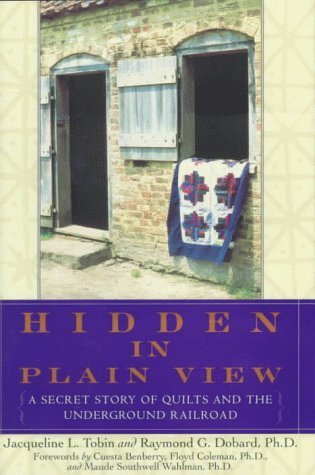
Review: Hidden in Plain View: A Secret Story of Quilts and the Underground Railroad

Review: Hidden in Plain View: A Secret Story of Quilts and the Underground RailroadHidden in Plain View: A Secret Story of Quilts and the Underground Railroad by Jacqueline L. Tobin, Raymond G. Dobard
Published by Doubleday Books on January 19, 1999
Genres: History
Pages: 224
Format: Hardcover
Source: Library
Buy on AmazonBuy on Bookshop

This post contains affiliate links you can use to purchase the book. If you buy the book using that link, I will receive a small commission from the sale.

Goodreads
two-stars

The fascinating story of a friendship, a lost tradition, and an incredible discovery, revealing how enslaved men and women made encoded quilts and then used them to navigate their escape on the Underground Railroad.

In Hidden in Plain View, historian Jacqueline Tobin and scholar Raymond Dobard offer the first proof that certain quilt patterns, including a prominent one called the Charleston Code, were, in fact, essential tools for escape along the Underground Railroad. In 1993, historian Jacqueline Tobin met African American quilter Ozella Williams amid piles of beautiful handmade quilts in the Old Market Building of Charleston, South Carolina. With the admonition to "write this down," Williams began to describe how slaves made coded quilts and used them to navigate their escape on the Underground Railroad. But just as quickly as she started, Williams stopped, informing Tobin that she would learn the rest when she was "ready." During the three years it took for Williams's narrative to unfold—and as the friendship and trust between the two women grew—Tobin enlisted Raymond Dobard, Ph.D., an art history professor and well-known African American quilter, to help unravel the mystery.

Part adventure and part history, Hidden in Plain View traces the origin of the Charleston Code from Africa to the Carolinas, from the low-country island Gullah peoples to free blacks living in the cities of the North, and shows how three people from completely different backgrounds pieced together one amazing American story.

This book has been on my radar for a while, mainly because many quilters refer to it and ask me if I’ve read it. I decided to read it, even though I had heard rumblings about the lack of evidence for the book’s premise: that quilts served as secret codes for people escaping north to freedom on the Underground Railroad.

It’s one of those stories one wants to be true, and I suspect that’s the case with Jacqueline Tobin, the primary author. There is some basis for using coded language in the form of spirituals. Harriet Tubman, perhaps the most famous conductor on the Underground Railroad, is known to have used two songs as codes, including “Go Down, Moses.” Another popular story is that cornrow hairstyles were used to convey secret messages to enslaved people. According to the Snopes article on this practice, they “found no tangible evidence of slaves in the U.S. actually using cornrows to convey messages. But this doesn’t mean that these stories should be disregarded, or that the practice never existed.” I suggest the same is true of the story Tobin and Dobard tell about quilts serving as coded messages to those escaping slavery.

The first problem is that Tobin seems to have relied on a single person for this story. It beggars belief that no one besides Ozella McDaniel Williams would have told stories about this practice. According to Laurel Horton in her article “Truth and the Quilt Researcher’s Rage: The Roles of Narrative and Belief in the Quilt Code Debate” in Western Folklore, “the eleven patterns named in the Quilt Code are typical of those popular in South Carolina [where Ozella McDaniel Williams lived] in the early twentieth century” (p. 43). However, some of the patterns did not yet exist before the Civil War, while others did not have the names that Ozell McDaniel Williams gave (e.g., the Monkey Wrench) (Horton, 2017). I was also a bit surprised to learn from Horton’s article that block-style quilt patterns were “virtually unknown” in South Carolina until the 1840s, and that it would probably not have been possible for African-American quilters to hide such quilts “in plain view” (p. 43).

As a qualitative researcher myself, I’d be the first to disagree with critiques that dismiss Tobin’s research because she obtained the information she published in this book from a storyteller. However, we can’t take this anecdote, no matter how attractive it is, and extrapolate that quilts served as codes based on one woman’s story, especially since the story is filtered entirely through Tobin—we never really hear much in the way of direct quotes from Williams herself. I am even more skeptical of the book’s claims that some quilt patterns have Masonic connections. I mean, maybe? I don’t know enough to say absolutely not, but it reads sort of like pretty much every other conspiracy theory about Freemasons.

In terms of style, the authors frequently employ questions as a rhetorical device (I also caught some copyediting mistakes). For me, this style undercut the book’s message and made the authors sound unsure of themselves, which I suppose they may have been. There is also quite a bit of repetition, and ideas might have been more tightly organized. The author might repeat biographical details about figures in the book, such as Denmark Vesey. I found myself thinking, “Yes, you already told me that,” a few times as I read.

This story has taken root, and so many people want it to be true that I doubt my critique will amount to much. So why two stars? I found the story compelling, as Horton states in her article as well. I also appreciated the discussion of modern quilters such as Faith Ringgold, Michael Cummings, and Carolyn Mazloomi. I also enjoyed reading about some of the connections between patterns and African art, though I will independently research those claims to verify their accuracy. I probably should give the book fewer stars, but I admit it held my attention. Now I can say I’ve read it when people ask, and I will definitely tell them what I think. In the immortal words of Jake Barnes at the end of The Sun Also Rises, “Isn’t pretty to think so?”

Reference:

Horton, L. (2017). “Truth and the quilt researcher’s rage: The roles of narrative and belief in the quilt code debate.” Western Folklore, 76(1), 41–68. http://www.jstor.org/stable/44790939
two-stars

Related posts:

Review: The Runaway Quilt, Jennifer Chiaverini

Review: The Runaway Quilt, Jennifer ChiaveriniThe Runaway Quilt by Jennifer Chiaverini
Series: Elm Creek Quilts #4
Published by Plume on January 1, 2002
Genres: Historical Fiction
Pages: 336
Format: Hardcover
Source: Library
Buy on AmazonBuy on Bookshop

This post contains affiliate links you can use to purchase the book. If you buy the book using that link, I will receive a small commission from the sale.

Goodreads
five-stars

After learning of her family’s ties to the slaveholding South, Sylvia Compson scours her attic for clues and discovers a window into the world of her the memoir of her great-grandfather’s spinster sister, Gerda Bergstrom. Gerda’s memoir chronicles the founding of Elm Creek Manor and the tumultuous years when Hans, Anneke, and Gerda Bergstrom sheltered fugitive slaves within its walls, using quilts as a signal of sanctuary. But little did the staunchly abolitionist Gerda know that a traitor was among them, placing the Bergstroms in grave danger and leading to family discord, betrayal, and a secret held for generations.

With the help of the Elm Creek Quilters and clues hidden within antique quilts discovered in the manor’s attic, Sylvia stitches together the pieces of her past and decodes the true nature of the Bergstrom legacy.

There is debate about whether quilts were used as signals on the Underground Railroad. There is not a great deal of evidence to support the theory that quilts served as signals to those escaping slavery, but I think many people want it to be true because it makes a compelling story. One argument people who believe in this theory often use is that evidence doesn’t exist because the quilts were secret signals. I’m not sure that argument holds much water. Jennifer Chiaverini acknowledges this lack of evidence in her book and even has one of her characters, a quilt historian, make the skeptic’s argument. However, in this novel, she imagines that at least a couple of houses in Pennsylvania used quilts to signal that their homes were stations on the Underground Railroad.

Sylvia Bergstrom Compson, the main protagonist of the Elm Creek Quilts novels, uncovers a journal in her attic. Gerda, her great-grandfather’s sister, wrote the journal, and it details the role the Bergstrom family played as stationmasters on the Underground Railroad and their experiences with one particular woman who escaped enslavement. The book alternates between past and present as Sylvia reads Gerda’s journal. If Gerda’s journal is not very realistic for the time, I can forgive it because the story is captivating and touches on several interests of mine: reading, writing, quilting, and family history. This particular volume in the series is light on descriptions of Elm Creek Quilts’ quilt camp and the other quilters, focusing instead on Sylvia and her discovery. It’s not too hard to believe Sylvia would find a journal and quilts in her attic, given the age and prominence of her house.

I enjoyed this one a great deal. It’s rare for series to continue to be this good as they continue, but I’d say this is one of those rare series.

five-stars

Related posts:

Review: A Couple of Elm Creek Quilts Titles

I’m so glad I discovered this series. It scratches a couple of itches for me: reading and quilting. I find them to be well-written, but more than anything else, I feel Jennifer Chiaverini understands character. Her characters are real, and they react in ways that don’t feel like fiction. Dan Brown could learn a thing or two.

Review: A Couple of Elm Creek Quilts TitlesRound Robin (Elm Creek Quilts, #2) by Jennifer Chiaverini
Series: Elm Creek Quilts #2
Published by Plume on April 4, 2000
Genres: Contemporary Fiction
Pages: 304
Format: Hardcover
Source: Library
Buy on AmazonBuy on Bookshop

This post contains affiliate links you can use to purchase the book. If you buy the book using that link, I will receive a small commission from the sale.

Goodreads
five-stars

Round Robin reunites readers with the Elm Creek Quilters in this poignant and heartwarming follow-up to The Quilter's Apprentice, Jennifer Chiaverini's acclaimed debut novel. "She chose green and blue for the colors of Elm Creek Manor. She chose blue for truth and green for new beginnings . . ."

The Elm Creek Quilters have begun a round robin...a quilt created by sewing concentric patchwork to a central block as it is passed around a circle of friends. Led by Sarah McClure, who came to Waterford, Pennsylvania, with her husband, Matt, a few years ago, the project is to be their gift to their beloved fellow quilter Sylvia Compson. But like the most delicate cross-stitch, their lives are held together by the most tenuous threads of happiness...and they can unravel.

As each woman confronts a personal crisis, a painful truth, or a life-changing choice, the quilt serves as a symbol of the complex and enduring bonds between mothers and daughters, sisters and friends. In weaving together the harmonious, disparate pieces of their crazy-quilt lives, the Elm Creek Quilters come to realize that friendship is one of the most precious gifts we can give each other, and that love can strengthen understanding, lead to new beginnings, and illuminate our lives.

One thing I liked about this particular book was the camaraderie of the Elm Creek Quilters. Chiaverini shares the personal stories of many of the quilters. I enjoyed seeing their personal stories fleshed out a bit more.

Review: A Couple of Elm Creek Quilts TitlesThe Cross-Country Quilters (Elm Creek Quilts, #3) by Jennifer Chiaverini
Series: Elm Creek Quilts #3
Published by Plume on 2002
Pages: 368
Format: Hardcover
Source: Library
Buy on AmazonBuy on Bookshop

This post contains affiliate links you can use to purchase the book. If you buy the book using that link, I will receive a small commission from the sale.

Goodreads
five-stars

Julia, Megan, Donna, Grace, and Vinnie are cross-country friends who are about to begin work on a challenge quilt. A piece of fabric is divided among the women, with the understanding that the following year they will all meet at the Elm Creek Quilt Camp to sew the sections together into a single quilt. But the friends have set themselves a special challenge: no one can start working on her block until she has taken steps to solve her problems and achieve her personal goals.

Although they share a common creative objective, the Cross-Country Quilters find their friendship tested by the demands of everyday life. Yet despite differences in age, race, and background, the women's love of quilting and affection for one another unite them. The quilt they create becomes a symbol of the threads that hold their lives together-a glorious patchwork of caring and loyalty that brings home an enduring truth: Friends may be separated by great distance, but the strength of their bond can transcend any obstacle.

This one might be my favorite in the series so far. I really liked the characters, and it was fun to get a glimpse into what going to “quilt camp” might be like. I enjoyed the friendship these women developed, and I really hope to meet them again in the series.

Related posts:

Review: World War II Quilts, Sue Reich

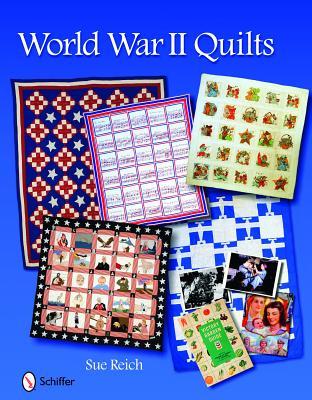
Review: World War II Quilts, Sue ReichWorld War II Quilts by Sue Reich
Published by Schiffer on May 28, 2010
Genres: Craft, History
Pages: 192
Format: Hardcover
Source: Library
Buy on AmazonBuy on Bookshop

This post contains affiliate links you can use to purchase the book. If you buy the book using that link, I will receive a small commission from the sale.

Goodreads
four-stars

Many American women made warm and attractive quilts to honor and benefit US soldiers during the period 1940-1945, either as outright gifts or as raffle items to raise money for the war effort. This book reflects extensive original research of newspaper and magazine articles of the era, and authenticates the patterns and designs available to quiltmakers, anchoring the quilts historically in time. Color photos and descriptive text identify many patriotic quilts made for donation to the Red Cross and organizations such as Bundles for Britain. When possible, original patterns and designs that inspired the quilts are included. The quilts can now be interpreted from factual and objective perspectives, enhancing their historic and emotional importance.

This book was fascinating and featured many great photographs. Before reading this book, I didn’t know about the Changi Prison, described by Mary Thomas, a British woman imprisoned there and quoted in this book:

At last the grey walls and roofs of the prison appeared on a small hill to our right. We were hot and tired and glad to see them. As we drew near, some of the women felt a gesture of defiance was needed and they began to sing. We had left Katon singing Tipperary and we walked into Changi singing There’ll always be an England… (146).

I loved the story of these spirited women creating a quilt to document their experience. Learning about the patterns and fabrics was also interesting. There was a short piece in the book about the feuding Hatfield and McCoy families uniting for a quilting bee. I loved seeing the creativity of these women on full display in these pages.

On the other hand, I caught a few typos or proofreading errors, and I question whether including any of the truly terrible poetry written by amateur poets during the War added much of anything to the book.

It was a worthwhile read, thanks to the well-researched information and photographs.


four-stars

Review: The Winding Ways Quilt, Jennifer Chiaverini

Review: The Winding Ways Quilt, Jennifer ChiaveriniThe Winding Ways Quilt by Jennifer Chiaverini
Series: Elm Creek Quilts #12
Published by Simon & Schuster on January 1, 2008
Genres: Contemporary Fiction
Pages: 310
Format: Hardcover
Source: Library
Buy on AmazonBuy on Bookshop

This post contains affiliate links you can use to purchase the book. If you buy the book using that link, I will receive a small commission from the sale.

Goodreads
four-half-stars

Jennifer Chiaverini's bestselling Elm Creek Quilts series continues with The Winding Ways Quilt, in which the arrival of newcomers into the circle of quilters heralds unexpected journeys down pathways near and far.

Quilters have flocked to Elm Creek Manor to learn from Master Quilter Sylvia Compson and her expert colleagues. There's Sarah, Sylvia's onetime apprentice who's paired her quilting accomplishments with a mind for running the business of Elm Creek Quilts; Agnes, who has a gift for appliqué; Gwen, who stitches innovative art quilts; Diane, a whiz at the technicalities of quick-piecing; and Bonnie, with her encyclopedic knowledge of folk art patterns. But with Judy and Summer, two other founding members of the Elm Creek Quilters, departing to pursue other opportunities, will the new teachers be able to fill in the gaps created by the loss of their expertise—and more important, their friendship?

"When I think of all the different paths I could have followed in my life, all the twists and turns that could have led me anywhere," muses incoming teacher Gretchen, "it's something of a miracle that I ended up here, surrounded by loving friends."

But what of friends departed? As Sylvia contemplates a tribute to the partnership of the Elm Creek Quilters, she is reminded of a traditional quilt pattern whose curved pieces symbolize a journey. Winding Ways, a mosaic of overlapping circles and intertwining curves, would capture the spirit of their friendship at the moment of its transformation.

Will Sylvia's choice inspire the founding members to remember that each is a unique part of a magnificent whole? Will the newcomers find ways to contribute, and to earn their place? The Winding Ways Quilt considers the complicated, often hidden meanings of presence and absence, and what change can mean for those who have come to rely upon one another.

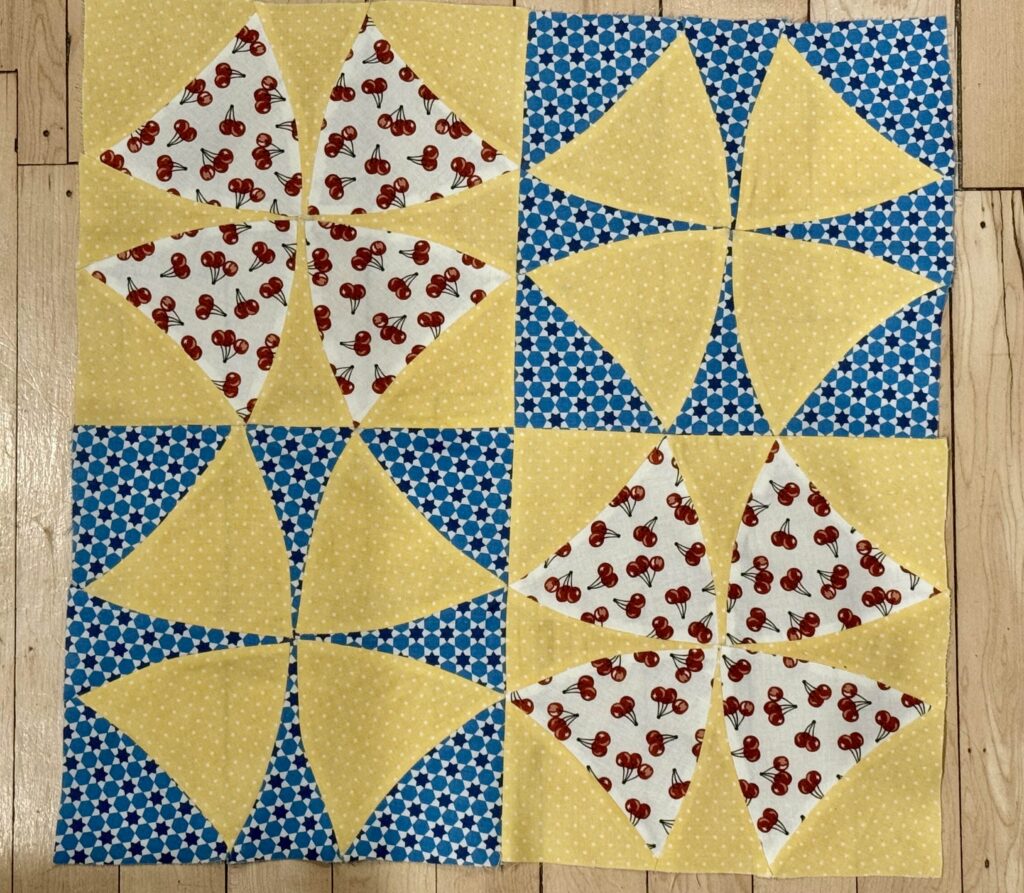
I discovered the Elm Creek Quilts series from fellow quilters in a Facebook Block of the Month group I’m participating in. The block for May was a Winding Ways block, which inspired the story in this novel. It was fun to read the book at the same time as I made my own Winding Ways block.

It seems that this novel doesn’t appeal to all fans of the series, and I can understand why. It’s different from the other two books I’ve read in that it’s not a story so much as a series of backstories about each of the Elm Creek Quilters. I liked that aspect of it. I don’t necessarily think there is a lot of action in these books, but they’re fun to read because I actually learn a little bit more about quilting with each one, and the characters are fully realized and feel a bit like friends. I enjoyed the metaphor of the Winding Ways block, which connects all the quilters.

I enjoyed making my own Winding Ways block as well. This block is so interesting in that when you make a larger quilt, you start to see circular patterns emerge. You can see parts of the circles emerging in my Winding Ways block below. I was inspired by the colors in the Rosie the Riveter poster, as the theme for this Block of the Month focuses on quilting and history for a different decade each month, starting with the 1930s and ending with the 2010s. The Winding Ways block is the 1940s block, so the fabrics I chose evoke the 1940s era.

Winding Ways four-block quilt made with white fabric with cherry designs, yellow fabric with white polka dots, and blue fabric with star designs.

four-half-stars

Review: Time is a Mother, Ocean Vuong

Review: Time is a Mother, Ocean VuongTime Is a Mother by Ocean Vuong
Published by Penguin Press on April 5, 2022
Genres: Poetry
Pages: 114
Format: Hardcover
Source: Library
Buy on AmazonBuy on Bookshop

This post contains affiliate links you can use to purchase the book. If you buy the book using that link, I will receive a small commission from the sale.

Goodreads
three-stars

In this deeply intimate second poetry collection, Ocean Vuong searches for life among the aftershocks of his mother's death, embodying the paradox of sitting within grief while being determined to survive beyond it. Shifting through memory, and in concert with the themes of his novel On Earth We're Briefly Gorgeous, Vuong contends with personal loss, the meaning of family, and the cost of being the product of an American war in America. At once vivid, brave, and propulsive, Vuong's poems circle fragmented lives to find both restoration as well as the epicenter of the break.

The author of the critically acclaimed poetry collection Night Sky With Exit Wounds, winner of the 2016 Whiting Award, the 2017 T.S. Eliot Prize, and a 2019 MacArthur fellow, Vuong writes directly to our humanity without losing sight of the current moment. These poems represent a more innovative and daring experimentation with language and form, illuminating how the themes we perennially live in and question are truly inexhaustible. Bold and prescient, and a testament to tenderness in the face of violence, Time Is a Mother is a return and a forging forth all at once.

I borrowed this collection from the library after encountering a poem from the collection, “Amazon History of a Former Nail Salon Worker.” After reading the collection, I still think that poem is the best in the collection. It’s a found/catalog poem that asks the reader to sift through purchases to assemble an entire life. It tells a fascinating story, and I think I’d like to share it with my students.

There were some other gems in the collection, including “Dear Rose,” “The Punctum,” “Toy Boat,” “Reasons for Staying,” and “Küntslerroman.” The imagery is strong, and I appreciated Vuong’s diction and structure. Overall, I would not say this collection is one of my favorites, but it was well worth a read.

three-stars

Related posts:

Review: Daughter Dalloway, Emily France

Review: Daughter Dalloway, Emily FranceDaughter Dalloway by Emily France
Published by Blackstone Publishing on March 14, 2023
Genres: Historical Fiction
Pages: 350
Format: Hardcover
Source: Library
Buy on AmazonBuy on Bookshop

This post contains affiliate links you can use to purchase the book. If you buy the book using that link, I will receive a small commission from the sale.

Goodreads
four-stars

A retelling of Virginia Woolf's classic Mrs. Dalloway, from the point of view of the famous socialite's only child, Elizabeth.

It is 1952 and forty-six-year-old Elizabeth Dalloway—arguably the most inept socialite in all of London—is fresh off yet another of her awkward parties. She feels she has failed at most everything in life, especially living up to her perfect mother—the elegant Mrs. Dalloway, the woman who never made a misstep, the woman who never arrived for her very own party at the end of the 1923 Season. And hasn't been heard from since.

Elizabeth has given up ever finding out what really happened that summer until she comes across a WWI medal inscribed with a mysterious message from her mother to a soldier, Septimus Warren Smith. Elizabeth sets out to find a member of his family in the hopes she will finally learn her mother's fate. Her journey takes her across London as she pieces together that last summer of 1923 when Elizabeth was a seventeen-year-old girl who escaped her mother's watchful eye and rebelled against the staid social rules of prewar England. A girl who caroused with the Prince of Wales and sons of American iron barons, a girl determined to do it all differently than her mother. A girl who didn't yet feel like a failure.

Faithful to the original yet fully standing alone, Daughter, Dalloway follows Elizabeth as she discovers the truth: though decades have passed and opportunities for women have changed, expectations haven't: to be it all, whatever the costs. And that she shares much more with her mother than she ever knew.

I finished this book a few days ago and had to think about how to rate it. Any author who takes up Virginia Woolf’s mantle is bound to pale in comparison. She’s one of the greatest writers to have lived, and some consider Mrs. Dalloway to be her masterpiece. It’s a book I love, and I love teaching it. On the other hand, this book has some great moments and is well-researched. While Elizabeth Dalloway is Woolf’s creation, Septimus Warren Smith’s sister Octavia is France’s invention, and I enjoyed her character. I didn’t enjoy her companions Redvers and his brother George—they were stock street urchin characters, and they didn’t seem as realistic to me as the other characters France invented. I thought it was far-fetched that Clarissa would commission a medal for Septimus, and her fate, which is a bit spoilery, also struck me as a stretch given what I know of Woolf’s thinking about her characters.

However, I admit France made me think about the concept of the stream of consciousness in a new way, and I plan to share this idea with my students. Typically, I teach stream of consciousness as the way our thoughts flow from one to another, and France also adheres to this definition, but she also conceives of the stream of consciousness as the thread that joins all of us together. This idea resembles Ralph Waldo Emerson’s concept of the Over-Soul more than it resembles the traditional conception of stream of consciousness, but I liked it. In his essay on the Over-Soul, Emerson quotes Byron in arguing that the soul “Can crowd eternity into an hour, / Or stretch an hour to eternity.” One could argue Woolf was trying to do both with Mrs. Dalloway.

Reading this book has given me some ideas for teaching Mrs. Dalloway, and it’s better than average historical fiction. Compared to its source material, it can’t help but suffer—it does not quite pull off the same feat as The Hours—but it was pretty good.

four-stars

Related posts:

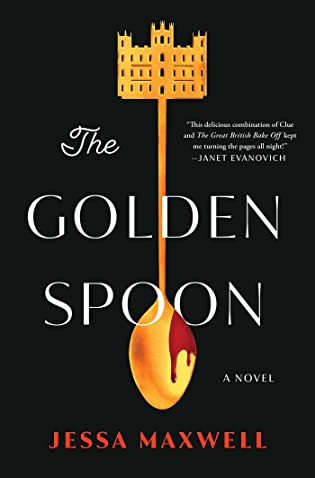
Review: The Golden Spoon, Jessa Maxwell

Review: The Golden Spoon, Jessa MaxwellThe Golden Spoon by Jessa Maxwell
Published by Atria Books on March 7, 2023
Genres: Contemporary Fiction, Mystery
Pages: 269
Format: Hardcover
Source: Library
Buy on AmazonBuy on Bookshop

This post contains affiliate links you can use to purchase the book. If you buy the book using that link, I will receive a small commission from the sale.

Goodreads
four-half-stars

For six amateur bakers, competing in Bake Week is a dream come true.
When they arrive at Grafton Manor to compete, they're ready to do whatever it takes to win the ultimate The Golden Spoon.

But for the show's famous host, Betsy Martin, Bake Week is more than just a competition. Grafton Manor is her family's home and legacy—and Bake Week is her life's work. It's imperative that both continue to succeed.

But as the competition commences, things begin to go awry. At first, it's small acts of sabotage. Someone switching sugar for salt. A hob turned far too high.

But when a body is discovered, it's clear that for someone in the competition, The Golden Spoon is a prize worth killing for...

This book was a lot of fun, and the mysteries (plural!) kept me turning the pages. On the jacket, Janet Evanovich’s blurb describes it as a “delicious combination of Clue and The Great British Bake Off,” and I could think of a better way to sum it up.

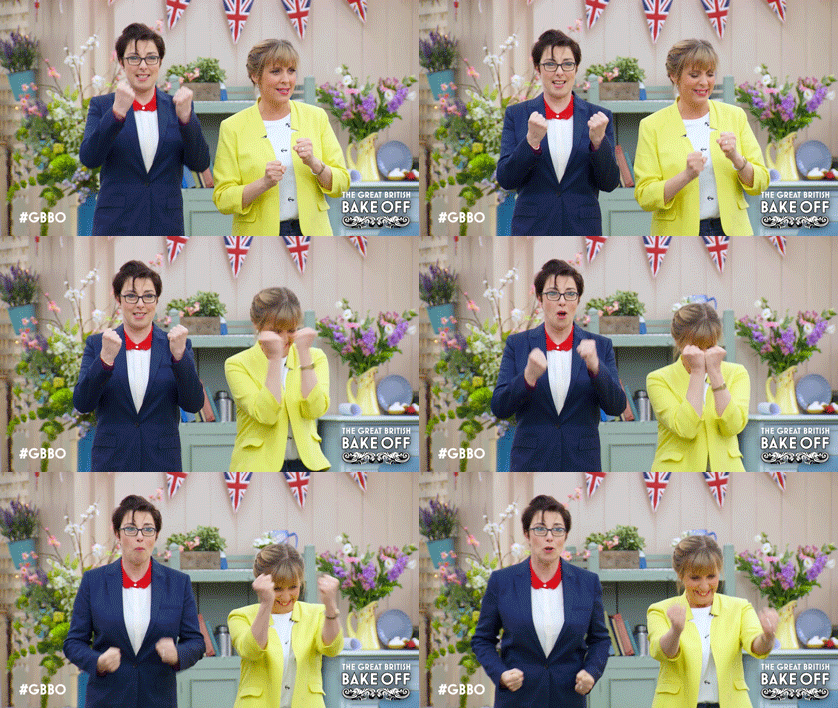
Hosts of Great British Bake Off cheering

It’s clear that Jessa Maxwell is a fan of The Great British Bake Off,  though she chose to set her book in Grafton, Vermont, with American characters. In a way, that decision makes a lot of sense, as Americans would be much more horrible and ruthless, and it’s entirely believable that acts of sabotage would cloud the competition from the start. I think The Great British Bake Off has a lot of fans precisely because it’s so wholesome—the contestants hardly seem to be competing against each other.

Bake Off Finalists hugging each other

Maxwell has identified a few “types” of Bake Off contestants and included them in her novel: the grandmotherly type who has been baking for her family for decades; the young baker who started baking less than a year ago; the precise engineer/scientist. Archie and Betsy bear a small resemblance to Paul Hollywood and Mary Berry, respectively.

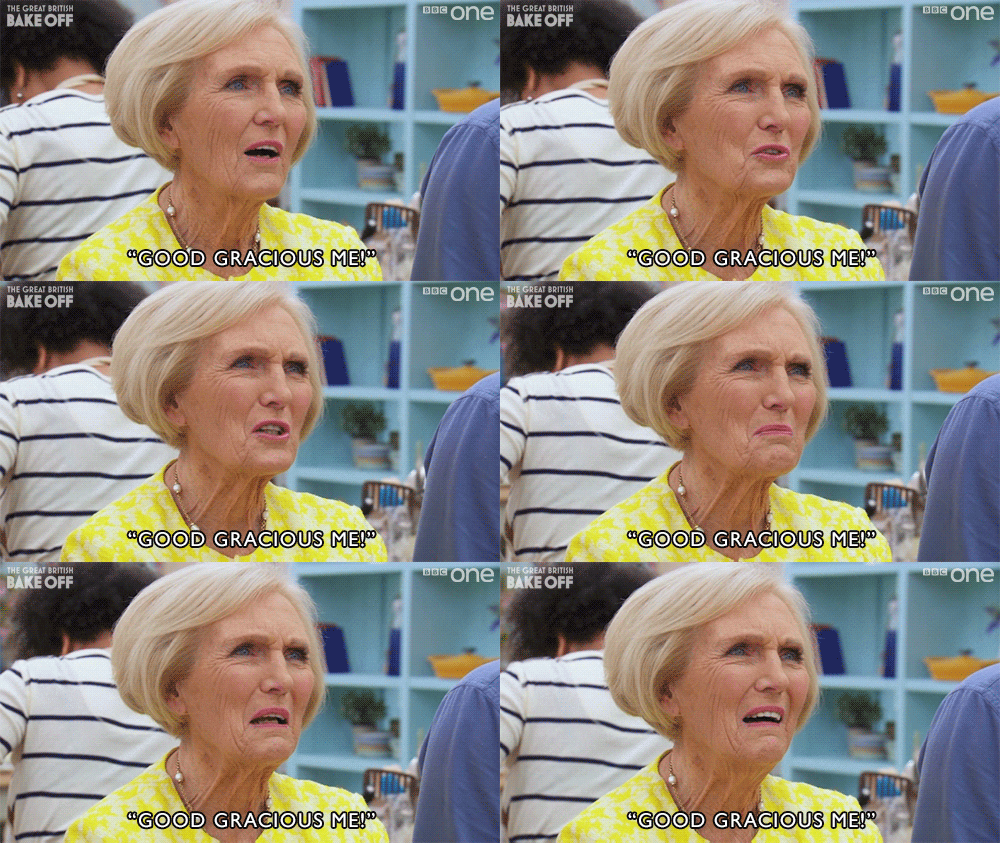
Gif image of Mary Berry saying,

I loved the idea for the book. It works as a mystery, and Maxwell drew an appropriate atmosphere for the book. I did think some of the characters were over-the-top and hard to believe as actual human beings. Melanie, Betsy’s assistant, and the apparent showrunner and camera crewman Graham are just… weird.

Great British Bake Off contestant saying,

I noted several annoying typos in the book; they might be the fault of the copyeditor.

Mary Berry saying,

However, the net result is that I still devoured the book in a few big gulps this week. I highly recommend it to anyone who likes Bake Off and enjoys a good cozy mystery.

Bake Off hosts saying, "On your marks, get set, bake."

four-half-stars

Related posts:

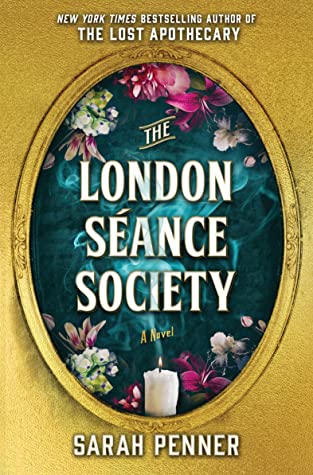
Review: The London Séance Society, Sarah Penner

Review: The London Séance Society, Sarah PennerThe London Séance Society by Sarah Penner
Published by Park Row on March 7, 2023
Genres: Historical Fiction
Pages: 352
Format: Hardcover
Source: Library
Buy on AmazonBuy on Bookshop

This post contains affiliate links you can use to purchase the book. If you buy the book using that link, I will receive a small commission from the sale.

Goodreads
three-stars

A spellbinding tale about two daring women who hunt for truth and justice in the perilous art of conjuring the dead.

1873. At an abandoned château on the outskirts of Paris, a dark séance is about to take place, led by acclaimed spiritualist Vaudeline D’Allaire. Known worldwide for her talent in conjuring the spirits of murder victims to ascertain the identities of the people who killed them, she is highly sought after by widows and investigators alike.

Lenna Wickes has come to Paris to find answers about her sister’s death, but to do so, she must embrace the unknown and overcome her own logic-driven bias against the occult. When Vaudeline is beckoned to England to solve a high-profile murder, Lenna accompanies her as an understudy. But as the women team up with the powerful men of London’s exclusive Séance Society to solve the mystery, they begin to suspect that they are not merely out to solve a crime, but perhaps entangled in one themselves…

I did not enjoy this book as much as Sarah Penner’s first book, The Lost Apothecary. The story was not as compelling to me. The ending held some surprises, and I liked the scripted process Penner created for the séance. I also appreciated the fact that Penner created a plausible Victorian lesbian romance—it didn’t feel tacked on, but I think Lenna thought about her attraction to Vaudeline at weird times—like when she was angry with her. Vaudeline, the medium, was an interesting character. I didn’t find Lenna or her deceased sister Evie compelling, and Mr. Morley was a cartoonish Snidely Whiplash type.

Too much of a caricature. I also wanted a bit more of a feel for the setting, which is something I got from The Lost Apothecary. There was a bit of a feel for the setting, but not much. I saw a Goodreads reviewer describe this book as a “great concept, average execution.” That’s exactly the way I felt.

three-stars

Related posts: