R.I.P. Challenge

And Then There Were None, Agatha Christie

[amazon_image id=”0062073486″ link=”true” target=”_blank” size=”medium” class=”alignleft” ]And Then There Were None[/amazon_image]I had to give up on Neil Gaiman’s [amazon_link id=”0060557818″ target=”_blank” ]Neverwhere[/amazon_link]. I gave it longer than I typically would, but I kept finding excuses not to read it. For whatever reason, it just wasn’t doing it for me, and I love him as a writer. I am typically unable to put his books down. One of the excuses I made to put down Neverwhere was that I wanted to read Agatha Christie’s [amazon_link id=”0062073486″ target=”_blank” ]And Then There Were None[/amazon_link] after seeing the Doctor Who episode featuring Agatha Christie.

If you are not familiar with the book, it is the story of ten strangers, all lured to Indian Island under different pretenses. Once they arrive, they find their host has been delayed. They also find a nursery rhyme “Ten Little Indians” framed in their room. After their evening meal, Mr. Rogers, the butler, plays a recording, as he has been instructed to do by his employer. The recording accuses each of the ten visitors, including Mr. and Mrs. Rogers, of murder. In each case, the accused was able to wriggle out of a murder charge. One by one, the guests are murdered in a fashion that eerily resembles the disappearance of each Indian in the nursery rhyme. Each time one of them is murdered, one of the little ceramic Indians decorating the dining room table is smashed or disappears.

First, I managed to avoid spoilers for this book, so I really didn’t know how it went and thus was completely surprised. I thought I had figured out what was going on, but I was wrong. I have to give Agatha Christie respect for a tightly plotted mystery. Where the novel falls short, however, is characterization. I didn’t feel I knew any of the characters, and in the beginning, I had trouble keeping them straight. They were not distinct enough. I would have liked the opportunity to get to know them a bit better. The lack of characterization makes the characters feel more like chess pawns than human beings. I didn’t feel anything when one of them died; rather, I kept turning pages to see who would go next and how the rhyme would be interpreted in their death.

Rating: ★★★☆☆

R.I.P. Challenge

The True Confessions of Charlotte Doyle, Avi

[amazon_image id=”0545477115″ link=”true” target=”_blank” size=”medium” class=”alignleft” ]The True Confessions of Charlotte Doyle[/amazon_image]I realize that [amazon_link id=”0545477115″ target=”_blank” ]The True Confessions of Charlotte Doyle[/amazon_link] has been around for a while, and it’s been on my list, but I didn’t actually read it until my daughter chose it for one of her summer reading books. She said she had read and excerpt of it in school and thought it sounded good.

The True Confessions of Charlotte Doyle is the story of thirteen-year-old Charlotte Doyle, who has been away at school in England and is returning home to Providence, Rhode Island aboard the Seahawk. Through a confluence of events, she winds up being the ship’s only passenger, a fact which makes her very uncomfortable. Both the cook, Zachariah, an older sailor from Africa, and Captain Jaggery, the ship’s master, try to befriend Charlotte, but she doesn’t know who to trust. When the crew rises up against Captain Jaggery’s cruelty, Charlotte is even more confused about her place and winds up getting herself into a heap of trouble.

I have to admit it starts slow. I really wondered if Charlotte was going to become likeable and get some sense. She eventually does become likeable, but I think sense is a hopeless case. Once the book gets going, it’s pretty good. I think Avi was attempting to create a 19th century cadence through the first-person narration of Charlotte, but some of the sentences were awkwardly constructed, and I had to read them a couple of times to get them sorted out right. There is quite a lot of naval terminology, but the book has a helpful diagram of a ship and a glossary in the appendix. My daughter gave it two thumbs up. I’m glad she liked it. We read it together, and it was really nice to hear her say she didn’t want to stop at just two chapters once we reached the end of the book. This from a girl who says she doesn’t like reading. So that has to count for something.

If my daughter hadn’t chosen it for summer reading, I might not have gone past the slow start, but I did like it more once the action started, and towards the end, it was a regular page turner. Avi’s characterization brings all the players to life, and he has a true knack for setting, though I think he over-describes a bit. I don’t need to see “everything.” Then again, he is writing for children and may feel he needs to describe a bit more. I don’t know.

It’s a solid YA story, and I’m very glad my daughter liked it.

Rating: ★★★½☆

How to Read Novels Like a Professor, Thomas C. Foster

[amazon_image id=”0061340405″ link=”true” target=”_blank” size=”medium” class=”alignleft”]How to Read Novels Like a Professor: A Jaunty Exploration of the World’s Favorite Literary Form[/amazon_image] Thomas C. Foster’s excellent book  [amazon_link id=”006000942X” target=”_blank” ]How to Read Literature Like a Professor: A Lively and Entertaining Guide to Reading Between the Lines[/amazon_link] elucidates literary analysis like no other text I have read. It clarifies the sometimes difficult task of interpretation and making meaning. It has an excellent recommended reading list, and it is indispensable for English teachers. I absolutely loved it. I didn’t enjoy its “sequel,” [amazon_link id=”0061340405″ target=”_blank” ]How to Read Novels Like a Professor: A Jaunty Exploration of the World’s Favorite Literary Form[/amazon_link] nearly as much.

Let’s start with what I liked:

  • The motif, which runs throughout the book, of the reader as creator. Reading is a creative act. Books demand that we have an imagination. It reminds me very much of something I heard Jasper Fforde say about reading when I went to a book signing. Foster says, “readers are the ultimate arbiters of meaning in a work” (126). I agree with him, and it’s one of the things that can be difficult about teaching English. English teachers are often experienced readers who understand the ways in which texts talk to one another and speak the language of symbolism and metaphor. Students, who are less experienced, often become infuriated when a teacher makes a connection or interpretation that the student didn’t make, and English teachers are often wrongly accused of inventing intentions the author never had. The author’s intentions do not matter once the reader reads the books. We readers bring so much experience, prior reading, belief, opinion, and knowledge to everything we read, that no two readers read the same book, and no reader reads the same book the author wrote. I really like it that Foster explained the importance of the reader so clearly because it is a real issue whenever two readers disagree about a book.
  • I like Foster’s breakdown of 18 things we can tell about a book on the first page. It is a great guide for students who struggle with annotation. If you can point students to look for style, tone, mood, diction, point of view, narrative presence, narrative attitude, time frame, time management, place, motif, theme, irony, rhythm, pace, expectations, character, and instructions on how to read the novel (whew!), then you will have paved the way for them to better understand the novel and help them figure out what to look for when they read. Eighteen is a bit much, but I found as I scanned the list that I agreed that most, if not all, of these elements can be determined to some degree on the first page of the novel.
  • I am fond of telling students that literature is the mirror that we hold up to examine our world and to ourselves. It tells us who we are and what we want. Foster expresses a similar sentiment: “So almost any novel can teach us, and the novel has one big lesson that lies at its very root: we matter. A human life has value not because it belongs to an owner, a ruler, a collective, or a political party, but because it exists as itself” (115). As such, characters in novels matter because they are us. We see ourselves in them. We see our humanity in their humanity.

Now to what I didn’t like:

  • The book is repetitive. Foster discusses the same books, pretty much over and over, and if, for some reason, you are unfamiliar with one of his pet texts or if you didn’t like it for some reason, it’s hard to connect to what Foster is saying—or it was for me. Your mileage may vary. I don’t much like Joyce. There, I said it. I did give him a try. I guess I prefer my novels to be more like the great Victorian novels Foster describes. I am not opposed to Postmodernism here or there, and I don’t have to travel with the characters in a straight line. But Joyce doesn’t do it for me. I like it that Foster acknowledges we have different reactions to novels. Towards the end of the book, he describes a discussion with a high school English class in which one lone dissenter admitted he didn’t like [amazon_link id=”0486415864″ target=”_blank” ]Great Expectations[/amazon_link]. Of this student, Foster says, “It takes courage, to say you’re in AP English and aren’t wild about one of the established classics. For one thing, there’s the weight of more than a century of received opinion going against you” (292-293). Yes. True. I do not like [amazon_link id=”1840226358″ target=”_blank” ]Ulysses[/amazon_link]. I tried to read it. I was grossed out on page one. I gave it up. And that is OK, though the “weight of [nearly] a century of received opinion” is going against me. But he’s a favorite of Foster’s (not surprising, as he seems to be a favorite of many college profs), and he is used as an example over and over and over. And since I didn’t grok Ulysses, I didn’t find myself connecting to those examples very well.
  • I think Foster’s definition of theme is off, and I wouldn’t recommend sharing it verbatim with students. Foster defines it as “the idea content of the novel” (30). When I teach it, I tend to take it further than that. What message did you get from the novel? Deeper than what it is about—why did the author write it? We can’t know that, of course, but we can extrapolate. Did F. Scott Fitzgerald write [amazon_link id=”0743273567″ target=”_blank” ]The Great Gatsby[/amazon_link] because he wanted to comment on how the American Dream is not achievable by all, and maybe that it is even dead or never existed in the first place? I don’t know, but that is a message I receive from it when I read it. Certainly different readers will see different themes. But I don’t find the definition “idea content” to be all that helpful.
  • Likewise, Foster describes different kinds of narration on pp. 46-47. I teach students first person, third person omniscient, and third person limited. I mention second person as a type of narration they will rarely encounter. That’s it. And I discovered that there are these other types called third person objective, first person central, and first person secondary, which, as Foster describes them, seem like splitting hairs unnecessarily. He also puts stream of consciousness in there, which is not a type of narration, but a narrative technique. And he even says it’s not a kind of narrator, so I find it confusing that he puts it in this list at all. It doesn’t belong there.
  • The book has no index. How to Read Literature Like a Professor has a great index. It made finding information so much easier.
  • The book doesn’t have a recommended reading list. There is a list of other literary criticism to read, but in How to Read Literature Like a Professor, Foster shared a list of great literary works to read. I liked it. I suppose he figured the list of all the novels he mentioned in the book should do, but I liked the list in the other book.
  • Foster’s appeal lies to a great degree in his entertaining style. He cracks jokes. He’s snarky. For some reason, it was fun in How to Read Literature Like a Professor. In How to Read Novels like a Professor, I found it less appealing, and occasionally off-putting.

This book is worth it for the discussion of reading as a creative act and intertextuality, but aside from that, it doesn’t bring much to the table that wasn’t captured better in How to Read Literature Like a Professor. I highly recommend that book, and I would recommend it far above How to Read Novels Like a Professor.

Rating: ★★★☆☆

Heart of Darkness, Joseph Conrad, Kenneth Branagh

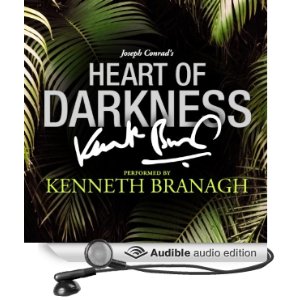
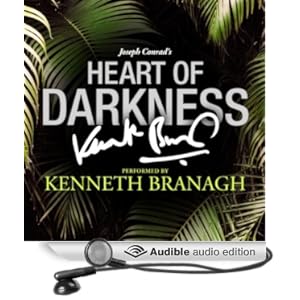
Heart of DarknessKenneth Branagh should read all the audio books.

Well, maybe not all.

He is probably the best narrator I’ve ever listened to, however. Of course, I’m also about to listen to Ian McKellen do Fagles’s translation of The Odyssey, so I may stand corrected shortly.

If you haven’t read Heart of Darkness before, I can’t think of a better way to do it than listening to Audible’s version. After all, Marlow tells the entire story to a crew of sailors on the Thames River, and Branagh perfectly embodies not just Marlow, but all the characters, from the Russian protege to Kurtz to the native man who says, “Mistah Kurtz, he dead” to Kurtz’s “intended.” In fact, I dare you not to get a chill when he reads Kurtz. He almost makes you understand why Kurtz has so captivated everyone in the novel. Almost.

I think the reason this novel is still relevant is that it speaks to our infinite capacity for evil. All of us have it inside us, and “the horror” is realizing that fact. I think Chinua Achebe’s criticism of the novel is valid. It is racist. (It’s sexist, too, but that fact often goes uncommented upon.) The African characters are only so much scenery, and their culture is dehumanized. They are depicted like animals, slavish in their devotion to and fear of Kurtz. There is no getting around it. At the same time, you can look at Marlow as narrator. Who is he but a perfect product of his times? Of course he believes Africans to be subhuman. Conrad probably thought so, too, but it is Marlow who tells the story, so who can say? There probably is no such thing as a completely reliable narrator.

You might like this Book Drum profile of the novel. I found the section on the history of the Congo very interesting (and very tragic, as is the case in so many places colonized by Europe).

Many years ago, I went to an English teachers’ conference, and one session I attended discussed how you can engage students in the reading of literature and help them make thematic connections by asking them to choose modern songs that have a story, theme, or message similar to a work of literature they have studied. One of the presenter’s students connected Conrad’s Heart of Darkness to Nine Inch Nails’ song “Head Like a Hole.”

After listening to it with that connection in mind, I had to agree that the song and the novel shared such a close connection that I have wondered for years if Trent Reznor was thinking of Heart of Darkness when he wrote it. Connect Reznor’s last line “You know who you are” with Kurtz’s last words “The horror, the horror,” and it’s just plain spooky. And I know I make that connection every time I talk about the novel now. I did it in my previous review of Heart of Darkness. This is the third time I’ve read the novel—once in college, once a few years ago.

And I’d be remiss if I didn’t share this mashup of “Head Like a Hole” and “Call Me, Maybe.”

You can’t unhear it. Sorry. Not really.

Rating: ★★★★★

The Namesake, Jhumpa Lahiri

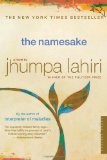
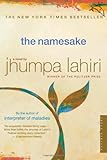
The Namesake: A NovelHow strange it is after such a long reading dry spell, I’ve been whipping through books again. I finished Jhumpa Lahiri’s novel The Namesake in the matter of a couple of days. I think I may have started reading it Saturday.

The Namesake is the story of Gogol Ganguli, named for his father’s favorite writer, Nikolai Gogol. His father, saved when his copy of Gogol’s short stories is noticed in the rubble following a train wreck, must give his son a name before he will be released from the hospital. Since his wife’s grandmother has been given the honor of choosing his “good name,” the family settles on Gogol, thinking later they can change it.

Each chapter is a vignette in the lives of Gogol and his family, from his parents’ arranged marriage to Gogol’s rediscovery, at the age of 32, of a copy of Gogol’s short stories that his father gave him when he was a teenager who hated his name. Gogol, born in America, straddles two cultures all of his life, never seeming to feel completely comfortable in one or the other. In one poignant passage, his father finally tells Gogol the true story of how he got his name, and Gogol is moved:

And suddenly, the sound of his pet name, uttered by his father as he has been accustomed to hearing it all his life, means something completely new, bound up with a catastrophe he has unwittingly embodied for years. “Is that what you think of when you think of me?” Gogol asks him. “Do I remind you of that night?”

“Not at all,” his father says eventually, one hand going to his ribs, a habitual gesture that has baffled Gogol until now. “You remind me of everything that followed.”

The one thread that runs through this novel is the importance of looking forward instead of looking back. One of the interesting things about this book is that it is not a grand adventure. It’s the story of an ordinary life. In part, it is a coming of age story. It’s engaging, nevertheless, and Gogol becomes a sympathetic character that I rooted for and hated to see disappointed. He became very real, and by the end of the book, I felt I knew him. I wondered what happened to him on 9/11. I wondered if he found happiness. If he had children. If he went to visit his mother in India.

The lush descriptions of food were one of my favorite parts of the novel. Whether it is home-cooked Indian food or dinner at a restaurant, meals are central to this novel—they bring the characters together. They are the agents of assimilation (Thanksgiving turkey), and they are the vestiges of a home left behind.

My own family has lived in America for hundreds of years. I don’t have any idea what the immigrant experience is like. Sure, I have moved to new places, but the culture in each place I have lived is more or less the same, and if I have to do without restaurants that have become favorites, it’s no small price to pay when I find new favorites and quickly assimilate to the new place. I can’t imagine what it must be like to move thousands of miles away to a completely different culture, where I am unsure of the language and customs. However, I feel like I caught a glimpse of what such an undertaking must be like after reading this book, and it made me admire immigrants for what they are willing to do in order to build a life for themselves. More Americans should read this book. I was moved by a passage near the end, as Gogol reflects on the fact that his mother is selling the house he grew up in so that she can go to India:

And then the house will be occupied by strangers, and there will be no trace that they were ever there, no house to enter, no name in the telephone directory. Nothing to signify the years his family has lived here, no evidence of the effort, the achievement it had been.

On a lark, I searched through census records to see who had lived in my current house. The names changed each decade. In 1910, the Anderson family, Swedish immigrants whose children had been born here in Massachusetts, lived in my house. Arthur Anderson was a carpenter. I wonder if any of his work survives. My husband often says this house was built like a ship. In 1920, the French Canadian Cartier family lived in my house. Frederick Cartier owned a shop, but the census doesn’t say what kind. His three children, all teenagers between 14 and 18 years old, worked—the two girls in a corset factory and the boy in a cotton mill. In 1930, Albert Dupont, a carpenter who had been born in Massachusetts to French Canadian parents, lived here with his family. In 1940, the O’Briens lived in my house. John O’Brien was a salesman. The names change every ten years, and but for a whim, they would have been completely forgotten. I was fascinated to discover a few scant facts about each family. Worcester is a city with a strong immigrant population, even up to the present. It’s one of the things that makes this city interesting. In fact, it’s one of the things that makes Massachusetts interesting. It makes a great deal of sense to me that Jhumpa Lahiri brought the Ganguli family from Calcutta to Boston. Something about this state has attracted people who have set off thousands of miles away from home to build a new life, from 1620 when the Pilgrims sailed The Mayflower and landed at Plymouth to the present day.

Rating: ★★★★★

The Return of the King, J.R.R. Tolkien, Robert Inglis

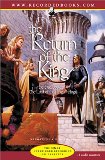
The Return of the King (The Lord of the Rings, Book 3)What can one say about J.R.R. Tolkien’s The Return of the King? It’s the long denouement of Tolkien’s epic saga The Lord of the Rings. I hadn’t read it in over 20 years, so I had forgotten just how long the ending is. I think Gollum actually falls into the crack of Mount Doom clutching the Ring, Frodo’s finger still attached, around the middle of the book. The rest of it is setting things to rights and putting a nice bow on the whole story. Of course, my perception may be off because this time I was listening to the books instead of reading the print versions.

As with [amazon_link id=”0788789821″ target=”_blank” ]The Hobbit[/amazon_link], [amazon_link id=”B00BR9WMW2″ target=”_blank” ]The Fellowship of the Ring[/amazon_link], and [amazon_link id=”078878983X” target=”_blank” ]The Two Towers[/amazon_link], Rob Inglis narrated The Return of the Ring superbly. His characterization once again impresses, and he handles the scene between Frodo, Sam, and Gollum at Mount Doom particularly well. I can’t think of a finer reader for the series. Nothing about his reading disappointed me.

I noticed a propensity for Tolkien to tell a little more than show in this volume, and I don’t recall noticing this issue the first time I read the books. In particular, the Battle of Pelennor Fields seems to be related mostly second hand and after the fact, which is a little disappointing. All of the action in this battle is shown in the [amazon_link id=”B0037WTD5G” target=”_blank” ]Peter Jackson film of the same title[/amazon_link], so perhaps that interpretation interfered with my memory.

One of the ways in which I feel Jackson erred with the movies was to give the Shire the short shrift. It’s a lovely country, and Tolkien brings it to vivid life in his books, but Jackson omits the entire section of the novel in which the Scouring of the Shire sets the hobbits free from the yoke of the wizard Saruman and his band of ruffians, and in which Merry, Pippin, and Sam become heroes in the Shire (Frodo’s role in saving Middle Earth is largely overlooked at home—the great ones are never really appreciated at home).

At the end of the film version of The Return of the King, there is a scene which always makes me cry when I watch it. Frodo, Sam, Pippin, and Merry, are bowing to Aragorn, and he says, “My friends, you bow to no one.” And then he bows to them. It’s just such a wonderful acknowledgement of everything they did to save the entire world, and the fact that the king humbles himself before these little folks that people forget about (Treebeard himself needs to add them to the list of the world’s creatures)—it’s just an amazing moment. I didn’t remember it happened in the book, but it does (sort of, words and things are changed), and it’s even grander.

I have to admit my favorite character for years was Gandalf, but as time has worn on, I have come to appreciate Samwise Gamgee, and I think he’s my favorite now. He is the steadfast, loyal friend—even as Frodo begins to succumb to the Ring, Sam remains by his side. His sadness when Frodo departs for the Grey Havens is pitiful. And he is the guy who winds up getting married and having a bunch of little hairy-toed hobbit babies. I just love him. I know a lot of Tolkien’s fans go in more for the elves, but I have to say the hobbits are my favorite.

Incidentally, I made a soap called Hobbit’s Garden that smells like apples, oak, English ivy, and rain. It’s available from my Etsy store, where you can find some other nice soaps I made as well. I have one bar available to ship right now, and the other batch I made will be ready July 6.

It feels almost sacrilegious to do so, but I am knocking half a star off my rating for this book for the excess of telling versus showing, but I am of the opinion that the series should be taken as a whole, and if so, then it’s a five-star read all the way.

Rating: ★★★★½

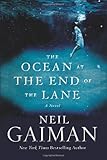
The Ocean at the End of the Lane, Neil Gaiman

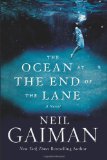
The Ocean at the End of the Lane: A NovelWhat  I love best about Neil Gaiman books is that I know they will touch me and make me laugh, have moments of sparkling philosophy alongside excellent descriptions, and have unforgettable characters and places. His latest novel [amazon_link id=”0062255657″ target=”_blank” ]The Ocean at the End of the Lane[/amazon_link] is no exception. Many critics are calling this novel Gaiman’s finest, and I have to admit I haven’t read him widely enough to agree unequivocally. I will let you know what I think after I’ve read a few more.

We meet the narrator in his late 40’s after he has just attended a funeral and has come back to the place where he lived as a seven-year-old boy. Sitting by a duck pond on the Hempstock farm, he suddenly remembers Lettie Hempstock and how she used to call the pond, her “ocean.” As he remembers this detail, he starts to remember the rest of the story—how Something dark and otherworldly was awakened when the opal miner who rented a room in the protagonist’s house stole the family car and committed suicide inside it and everything that came after. Did it really happen?

Childhood memories are sometimes covered and obscured beneath the things that come later, like childhood toys forgotten at the bottom of a crammed adult closet, but they are never lost for good.

The Ocean at the End of the Lane is about a lot of things. It’s about the differences between children and adults. It’s about the fuzziness of memory and what’s really real. It’s about nightmares and other worlds. It’s about sacrifice and loss. It’s about friendship. The NY Times review of the novel says “Gaiman helps us remember the wonder and terror and powerlessness that owned us as children.” I think that is an apt assessment, and I think somewhere inside, we all remember those feelings of wonder, terror, and powerlessness. My favorite thing this book is about, however, is books. Gaiman’s protagonist, whom I cannot recall was ever named, is a lover of books, and he makes some very astute observations about them, this observation being my favorite:

I liked myths. They weren’t adult stories and they weren’t children’s stories. They were better than that. They just were.

Adult stories never made sense, and they were so slow to start. They made me feel like there were secrets, Masonic, mythic secrets, to adulthood. Why didn’t adults want to read about Narnia, about secret islands and smugglers and dangerous fairies?

He makes this observation after he describes retreating into books to escape his fear. “I was not scared of anything when I read my book.” Since I was the kind of child who read constantly, and since I’m the kind of adult who loves myths, too (including the odd dangerous fairy), I found myself in the seven-year-old protagonist of this novel.

Neil Gaiman has a gift with language. He weaves beautiful sentences together, and I always find myself highlighting more when I read his books than I typically do. He also knows how to create villains right out of your nightmares. But after reading [amazon_link id=”0380807343″ target=”_blank” ]Coraline[/amazon_link], [amazon_link id=”0060530944″ target=”_blank” ]The Graveyard Book[/amazon_link], and now The Ocean at the End of the Lane, I think what Gaiman is best at is capturing that feeling of what it is like to be a child and to be a child who is scared and alone.

Rating: ★★★★★

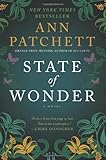
State of Wonder, Ann Patchett

State of Wonder: A Novel (P.S.)Ann Patchett’s novel State of Wonder is my school’s upper school summer read. I am not sure I would have thought to pick it up otherwise, as I haven’t read Patchett before, and I have a list of books I want to read a mile long. However, I found it a compelling and fascinating book, and it far outstrips most of the other books I have read this year (and even the previous year) so far.

I don’t typically include the book synopsis in my reviews, but it seems appropriate for this novel.

In a narrative replete with poison arrows, devouring snakes, scientific miracles, and spiritual transformations, State of Wonder presents a world of stunning surprise and danger, rich in emotional resonance and moral complexity.

As Dr. Marina Singh embarks upon an uncertain odyssey into the insect-infested Amazon, she will be forced to surrender herself to the lush but forbidding world that awaits within the jungle. Charged with finding her former mentor Dr. Annick Swenson, a researcher who has disappeared while working on a valuable new drug, she will have to confront her own memories of tragedy and sacrifice as she journeys into the unforgiving heart of darkness. Stirring and luminous, State of Wonder is a world unto itself, where unlikely beauty stands beside unimaginable loss beneath the rain forest’s jeweled canopy.

The reference to Heart of Darkness is not incidental, but State of Wonder updates Conrad’s classic with ethical questions for our own times. How far should science to go to improve on nature? Why do we develop certain drugs over others? What impact could such scientific research have on native populations? Should we care about that impact, or should we care more about “the greater good”? What happens when, to paraphrase Dr. Swenson, we allow ourselves to lose focus on the things we are looking for so that we don’t overlook the things we find?

Marina’s journey into the jungle reminded me of some of the ancient mythological heroic quests to go into the unknown and come back again. The hero is often never the same, and even Dr. Swenson warns Marina about this transformation. Dr. Swenson is Patchett’s own Kurtz, a formidable and ruthless woman committed to her research, even at the expense of her supposed commitment to her Hippocratic Oath as a doctor. Marina’s confrontation of her former teacher, a woman who has loomed like specter over Marina’s life and informed some of her most important life decisions, is the central story of the novel, and it is fascinating to watch their relationship unfold. Dr. Swenson is at the center of everything, and it is her choices and decisions that the novel revolves around, in the end.

Laura Ciolkowski says in her review of the novel for The Chicago Tribune that State of Wonder is “Part scientific thriller, part engaging personal odyssey,” and “a suspenseful jungle adventure with an unexpected ending and other assorted surprises.” That would be my assessment as well.

I would recommend this novel to anyone who has read Heart of Darkness, but thought it seemed dated. It will change your mind. But I would also recommend it to readers who liked The Poisonwood Bible by Barbara Kingsolver. All three novels explore the Western exploitation of indigenous people, simultaneously unmasking the horrors of colonialism as well as the terrible beauty of the jungle.

Rating: ★★★★★

The Bookman’s Tale, Charlie Lovett

[amazon_image id=”0670026476″ link=”true” target=”_blank” size=”medium” class=”alignleft”]The Bookman’s Tale: A Novel of Obsession[/amazon_image]Charlie Lovett’s novel [amazon_link id=”0670026476″ target=”_blank” ]The Bookman’s Tale: A Novel of Obsession[/amazon_link] is the story of Peter Byerly, antiquarian bookseller and restorer, recently widowed and at a loss as to how to move on with his life without his wife Amanda by his side. When Peter goes to a bookshop in Hay-on-Wye and discovers a watercolor of a woman who bears a stunning resemblance to his late wife tucked in a book, he begins a quest to discover the origin of the mysterious watercolor. He enlists the help of Liz Sutcliffe, an editor of art history books, who tells him B.B. is at the center of a mysterious scandal. Peter is hired to look through the book collection of John Alderson, a local man who lives in a sprawling mansion and whose family has an “ancient grudge” with the Gardner family across the river. In a box labeled “Never to be sold,” Peter finds the Holy Grail—proof that William Shakespeare of Stratford was the true author of the plays attributed to him. But is it real? Or a forgery?

The novel travels back and forth among two distinct periods in Peter’s life: his time with Amanda and the novel’s present in 1995. In addition, the reader is taken back to several points in the history of the copy of Pandosto by Robert Greene that supposedly has Shakespeare’s annotations in it. Greene is the playwright who famously referred to Shakespeare as an “upstart crow, beautified with our feathers” who believed himself to be the “only Shake-scene in a country.” Pandosto is itself a very rare book and is the source material for Shakespeare’s play [amazon_link id=”B00762VENM” target=”_blank” ]The Winter’s Tale[/amazon_link].

The novel was an entertaining mystery, and I found I liked and sympathized with Peter as he struggled to move on with his life and then as he found himself embroiled in a mystery. However, coincidences strained credulity and I found the plot somewhat predictable. I would recommend it to folks looking for a page-turner à la [amazon_link id=”0307474275″ target=”_blank” ]The Da Vinci Code[/amazon_link], but better written and with more book nerdiness, but don’t look for the next [amazon_link id=”0679735909″ target=”_blank” ]Possession[/amazon_link]  or [amazon_link id=”1400031702″ target=”_blank” ]The Secret History[/amazon_link].

Rating: ★★★½☆

The Two Towers, J.R.R. Tolkien, Rob Inglis

[amazon_image id=”078878983X” link=”true” target=”_blank” size=”medium” class=”alignleft”]The Two Towers (The Lord of the Rings, Book 2)[/amazon_image]I have been listening to J.R.R. Tolkien’s novel [amazon_link id=”078878983X” target=”_blank” ]The Two Towers (The Lord of the Rings, Book 2)[/amazon_link] as narrated by Rob Inglis while making soap and taking walks (trying to drop a few pounds). The first time I read this series, I whipped right through all three books, unable to put them down. The next time I tried a re-read, and the time after that, I wound up bogged down in The Two Towers. I told myself it must be that there was a lull in the pace, but now that I’ve listened to it (and finished it, this time), I think it was just me because there is a lot going on in that book.

For those of you who have only seen the movie, the book is different. In the movie, the action involving Merry, Pippin, Legolas, Gimli, and Aragorn flips back and forth with the action involving Frodo and Sam. Not so in the novel. The first half of the novel finds Boromir falling at the hands of orcs who kidnap Merry and Pippin to take them to Isengard. Legolas, Gimli, and Aragorn give Boromir a funeral and go in search of the hobbits. On the way, they meet Éomer, nephew of King Theoden of Rohan. They join the Rohirrim to defend Helm’s Deep against the onslaught of orcs, then head to Isengard, where they finally find Merry and Pippin, well and safe and rescued by Treebeard. The Ents have risen against Saruman. Meanwhile, Gandalf has seemingly come back from the grave and taken Saruman’s spot on the White Council. He drives Saruman out of the White Council and breaks his staff.

The second half of the novel concerns Frodo and Sam’s descent into Mordor, during which they meet up with Gollum, who becomes their unlikely guide, and Faramir, who allows Frodo go free and even spares Gollum at Frodo’s request. Gollum leads Frodo and Sam into the lair of the great spider, Shelob, and in that darkest hour, all hope seems lost.

At this point in the hero’s journey that is The Lord of the Rings, Frodo is in what Joseph Campbell called “the belly of the whale.” It is the bleakest hour, when his quest seems doomed to failure, and his life is in its greatest peril. He has come all the way to Mordor, only to be ensnared by an ancient, evil beast. Even good old Samwise thinks his master is gone until he overhears orcs saying Frodo is still alive.

I was struck again, as I always seem to be when I watch the movies and as I was the last time I read The Two Towers that Faramir is a much better man than Boromir. He is one of the few characters in the novel not to be tempted by the power of the Ring, even when it is within his power to take it and use it as he would. He is truly a brave and noble man and one of my favorite characters.

I was struck listening to Sam talk about how the story of the destruction of the Ring might be told one day.

The brave things in the old tales and songs, Mr. Frodo: adventures, as I used to call them. I used to think that they were things the wonderful folk of the stories went out and looked for, because they wanted them, because they were exciting and life was a bit dull, a kind of a sport, as you might say. But that’s not the way of it with the tales that really mattered, or the ones that stay in the mind. Folk seem to have been just landed in them, usually—their paths were laid that way, as you put it. But I expect they had lots of chances, like us, of turning back, only they didn’t. And if they had, we shouldn’t know, because they’d have been forgotten. We hear about those as just went on—and not all to a good end, mind you, at least not to what folk inside a story and not outside it call a good end. You know, coming home, and find things all right, thought not quite the same—like old Mr. Bilbo. But those aren’t always the best tales to hear, though they may be the best tales to get landed in!

What a spectacular comment on why we tell stories and why the hero’s journey, in particular, continues to speak to us. And of course, Tolkien always understood that about stories, and that he put that wisdom in the mouth of Samwise Gamgee makes me love both Tolkien and Samwise even more. Sam even has a little bit of insight into the villain’s role in the story. Gollum is arguably more pitiful than villainous, but he does betray the hobbits, and Sam was always right to be wary of him. Sam said:

Even Gollum might be good in a tale, better than he is to have by you, anyway. And he used to like tales himself once, by his own account. I wonder if he thinks he’s the hero or the villain?

Same shows a great deal of insight into the nature of what Tolkien would call fairy stories. The villains are as important as the heroes to a good yarn, even if they are not much fun to be around in real life.

Rob Inglis is an excellent narrator, and he does a particularly brilliant characterization of Gollum. He manages to distinguish most of the characters from one another. In addition to Gollum, his Samwise, Merry, and Pippin are all excellent as well. Gandalf and Aragorn sound like they should. No voice is out of place. His dramatic reading of the plot brings the story to life, and I thoroughly enjoy listening to it so much that I found myself making excuses to plug the audio book in and listen.

If you haven’t re-read [amazon_link id=”0788789821″ target=”_blank” ]The Hobbit[/amazon_link] or The Lord of the Rings in a while, I encourage you to give Rob Inglis’s narration a try. He’s an excellent reader of a rather ripping good tale.

Rating: ★★★★★