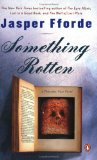
Something Rotten

Jasper Fforde’s novel Something Rotten is the fourth in his Thursday Next series. Famed Literary Detective and Head of Jurisfiction Thursday Next misses the real world and decides to leave fiction to see what she can do about uneradicating her husband, Landen Parke-Laine. Thursday learns in this installment that things are indeed much weirder than we can know.

While I have enjoyed the entire series, I found this book more confusing than the others. The various threads of the story don’t intertwine until the end, and by that time, I had forgotten enough of the details that I was still confused. Of course, I’m a slow reader, and it’s partly because of that fact that I had difficulty putting the ending together. A reader who finishes more quickly than I might fare better. Fforde is a book nerd’s writer. His allusions to literature and history and enjoyable and entertaining. I liked the book enough that I’ll continue to read more Fforde books, but I’m going to take a break from Fforde for a while and read something else.

My next book will be Francine Prose’s Reading Like a Writer: A Guide for People Who Love Books and for Those Who Want to Write Them. Of course, I’m still working on Wilkie Collins’s novel The Woman in White on my iPhone. Because Francine Prose autographed my copy of this book, I don’t want to write in it, so I’ll post my reflections as I read here.
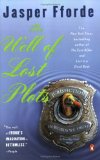
The Well of Lost Plots

Jasper Fforde’s novel The Well of Lost Plots is the third installment of his Thursday Next series. Thursday winds up in the Well of Lost Plots at the end of Lost in a Good Book after her husband has been eradicated by the ChronoGuard. She is taking a well-earned break inside the pages of the novel Caversham Heights. Thursday becomes a JurisFiction agent and continues her apprenticeship with Miss Havisham of Great Expectations. Thursday soon learns that life inside books is as fraught with danger as life in the Outland, and she must look out for attacks on her memory, the Mispeling Vyrus, and a pagerunning minotaur on the loose.

Thursday’s problems are not resolved at the end of The Well of Lost Plots; in fact, if you’ll pardon the pun, the plot only thickens. I felt the storyline in this book jumped around a bit, but it has some genuinely funny moments. A reviewer on Goodreads described these books as beach books for book nerds, and now that I’m trying to find that review, I can’t; however, the reviewer was correct. Book lovers will enjoy all the inside jokes, but even readers who have not read the works of literature alluded to in this series will enjoy it. It’s wildly hilarious fun, and a good “what-if” alternate history story.

I am picking up the next book in this series, Something Rotten, as my new read.

Persuasion

I need to begin this review by stating that I love Jane Austen. I had tried to read Persuasion twice before this final successful attempt. I think perhaps some books are suited to digesting in small bites. I admit when I feel I’m not making progress in a book, I sometimes put it aside for books that I think I might tear through. It doesn’t necessarily mean I am not enjoying the book so much as that I feel I’m not reading it quickly enough. This problem may be unique to me, but the solution has been to read the types of books I need to read slowly either in DailyLit or my iPhone.

I had stalled in Persuasion yet again some months back right about chapter 19. I liked it, and I really wanted to finish it. I recently decided to download it to my iPhone and read it in Stanza. Being able to read it in the dark and in bits on my iPhone enabled me to finish this book at last. I had already seen the movie, so I knew how things would end for Anne and Captain Wentworth. I enjoyed the penultimate chapter in which Captain Wentworth gives Anne the famous letter. The scene as acted in the 1995 production of Persuasion is what influenced me to pick up the book in the first place.

Anne is an excellent heroine: smart, kind, and thoughtful. I liked her much better than Emma or even Catherine Morland. I also liked the book’s message that true love lasts, and we can have second chances at happiness. I liked the other characters, too. Jane Austen is a deft skewer of social pretentiousness, and her Sir Walter Elliot was an excellent example of that sort who lives above his means and thinks he’s more important than he is.

This novel also highlights options available to women in the early nineteenth century. If Anne had remained unmarried, she would have been bound to spend the rest her of life with her family, who didn’t value her and whose company she tolerated rather than enjoyed. Certainly women who remained unmarried during this time had few options. Austen even insinuates that Anne might not have much choice but to marry her cousin, William Elliot, should her family wish it.  Anne struggles to say apart from William Elliot towards the end of the novel in order to avoid a marriage with him.

One thing I’ve always admired about Jane Austen novels is that she gives the reader a satisfying ending, making her characters happy. It feels good to close a Jane Austen novel because one can rest in the knowledge that the characters lived on and were happy. I suppose some might believe that’s unrealistic or trite, but it feels wonderful to escape into that world, which ultimately is one of the reasons I read books.

Company of Liars

Karen Maitland’s novel A Company of Liars is frequently compared to The Canterbury Tales. I think it’s an unfair comparison and one that almost made me put down the book. I think perhaps the only similarities the two works share are that Maitland’s travelers are also a ragtag group thrown together on a voyage (some of whom tell stories) and that they are set in roughly the same time period.

It is 1348 and England is gripped by the Plague. Nine travelers are thrown together on the road as they are escaping the dreaded disease. Each traveler has a secret and lives in fear that others will discover it. Meanwhile, they are pursued by bad luck, disease, and possibly even authorities as they make their way across England.

This book became an engaging read, but I will admit it took me a while to get into the book. I felt encouraged by some of the positive reviews I read and expected a real surprise ending; however, Maitland is careful to plant clues to enable careful readers to predict each traveler’s secret, and I was able to deduce that of the narrator, possibly preventing some of the surprise the other reviewers mentioned. It could be that I was reading The Hound of the Baskervilles at the same time and was primed for clues, but it seemed fairly easy, for the most part, for a careful reader to guess each traveler’s secret—even that of Narigorm, the creepy child who casts runes to tell the fortunes and seems to hold everyone in her thrall with the exception of the narrator, Camelot, who understands who the child is when the others refuse to see.

I would recommend the book only to readers who have a substantial interest in the Middle Ages; otherwise, the bleakness of the novel might prevent the reader from enjoying it. I didn’t catch any glaring historical errors, and Maitland helpfully provides a Historical Note and Glossary to help readers. I do have a quibble with a mythological element Maitland used, but I don’t want to give the problem away for readers who wish to read the book. If you wish to know, you can select the area that appears between the arrows in the following paragraph, and the text will be revealed.

>>The Morrigan had different guises and forms depending on the literature one reads, but she is associated with death at war, and I didn’t find her association with the deaths of the travelers to be congruent with my understanding of her function in mythology.<<

Aside from this quibble, I enjoyed the book, which became more engaging as I continued to read.

The Last Dickens

Charles Dickens’s last novel The Mystery of Edwin Drood was incomplete at the time of Dickens’s death in 1870.  In fact, he had finished half the book, which had been published in installments, a common practice with Dickens novels.  When I heard Matthew Pearl’s lecture on this novel at the Margaret Mitchell House here in Atlanta last Monday, Pearl mentioned that reading books in installments is not something we as a reading public really understand.  Sure, we have to wait for a television series like Lost to enfold in installments, but books are published whole and entire nowadays, and the thrill of reading the book as the writer is actually finishing it — that there is the chance no one yet knows how it will all turn out — is not available to us as readers as it was in Dickens’s time.  To think — we will never know how his last novel turned out because no record of Dickens’s intentions with the novel has ever been found.  We have the gift and frustration of creating our own ending.  Perhaps it is for that reason, no matter how intrigued I was by the book based on reading Pearl’s novel, that I’m not sure I’ll ever be able to pick up The Mystery of Edwin Drood.  I do think not knowing would drive me crazy.

The hero of Pearl’s novel is James R. Osgood, one half of the publishing firm of Fields & Osgood, the Boston publishers of such luminaries as Longfellow, Lowell, Holmes, Emerson, and just about every other American writer of note at the time.  This novel completes what Pearl thinks of as a literary set: the heroes of his first novel, The Dante Club, were the writers themselves; the hero of his second, The Poe Shadow, an admiring reader of Poe’s; The Last Dickens completes the reading trinity with a publisher.   Pearl’s Osgood is a likeable fellow — a true champion of books, authors, and the reading public.  He travels to England following Dickens’s death in the hopes that he can discover something, anything about Dickens’s intentions regarding the ending of Drood, only to find himself embroiled in Dickens family drama and the the seedy underbelly of the opium trade.  Mysterious forces seem intent on discovering the ending of the novel for themselves either to pervert it toward their own ends or to destroy it.

Readers interested in learning more about Dickens, particularly the cult of celebrity surrounding his work, will enjoy this novel.  The glimpses into the reality of life in Victorian England and Boston are interesting as well.  Pearl’s characters seem so real that it may surprise you to read the historical note and discover several are invented for the book.  I know I had to use my Ancestry.com membership to look up James R. Osgood in the census and find out if he was ever able to marry Rebecca Sand.  One person asked Matthew Pearl about Dan Simmons’s new novel Drood, a thriller also inspired by Dickens’s last novel.  The question revolved around the interest in The Mystery of Edwin Drood as inspiration, which Pearl explained as the fact that it remains unfinished and was the last Dickens novel.  I wondered myself how both Pearl and Simmons felt upon arriving at such similar subject matter at the same time.  It is my hope that the two novels will help each other rather than serve as competition.  I know I am interested in reading Simmons’s novel now, and I’m not sure I would have been if Pearl hadn’t written The Last Dickens.

One thing I can say about Matthew Pearl is that he is one of the nicest and most personable writers you will ever meet.  I first crossed his path when I recommended The Dante Club to my students in a blog post.  He was appreciative and contacted me through my site, inviting me to hear his lecture upon the publication of The Poe Shadow.  He held a trivia contest at the lecture, which I won.  My prize was a manuscript page from The Dante Club (and it happened to be my favorite part of the book!).  When I reached the end of the line and was able to have my books signed, I introduced myself, to which Matthew exclaimed, “Oh, you’re Mrs. Huff!”  He signed my manuscript page, which I framed and hung on my classroom wall.  Recently, he invited me to read an advance copy of The Last Dickens, and because I’m so slow, I’m just finishing it — I had hoped to have finished it before the novel itself was actually published so I could be one of the first reviewers.  When I went to Matthew’s lecture at the Margaret Mitchell House, I was pleased that he remembered me and he asked about my students.  Not all authors are so appreciative of their fans.  I would read anything Matthew wrote, but truthfully, The Last Dickens is a good read that will appeal especially to book lovers.

Coming Up for Air

Last night I finished reading George Orwell’s novel Coming Up for Air, which was a book club selection for our faculty book club longer ago than I’m going to admit.  I had to set it aside for a while, but I always intended to finish it – I’d read too much not to, but in all honestly, I was also enjoying it.  This book is the first book I read using Stanza, the free reading device on my iPhone.  I originally downloaded it on my iPod Touch (which was free with the purchase of my Mac back in August), but I had a great deal of difficulty getting it onto my iPhone later, and suffice it to say, I didn’t pick up the book again for a while.

The novel is the story of George Bowling, who wonders one day if you indeed can go home again and takes a trip to his hometown of Lower Binfield.  George’s voice is engaging – he is the sort of everyman who is easy to relate to even if you despise him at the same time, for he’s not a particularly likeable character.  When he sneaks off to his hometown, lying about his destination to a wife whom he feels will not understand his need to go back, he is confronted with one harsh change after another.  It becomes clear to the reader long before it becomes clear to George that his hometown as he knew it doesn’t exist anymore.

I think most readers are more familar with Orwell’s other books: 1984 and Animal Farm, but when the member of my book club selected this book, he said that sometimes it’s good to look at a writer’s lesser known works, and I agree this is the case with Coming Up for Air.  Writing the novel before World War II, Orwell is once again oddly prescient about the coming war and its impact on Britain.  It is perhaps the impending changes George senses on the horizon that drive him to see if there is one place in the world that hasn’t changed.  Though the reader can predict what George will find when he takes his journey, it is the journey that interests us.  How will George react to what he finds?  How will he change?  Interestingly enough, the answers to those questions are, at least in part, left unresolved.

I would recommend this book, but prepare yourself not to admire George much.  If liking the characters is important to your enjoyment of the book, you might steer clear of this one.  I will say, however, that even in disliking George for the most part, I did sympathize with him.  His feelings of powerlessness in a world careening into a different direction from that world of his youth are feelings I think most of us can recognize in ourselves.

The Eyre Affair

The first novel in Jasper Fforde’s Thursday Next series, The Eyre Affair, is a lot of fun for book lovers, particularly those fond of British literature.  The novel is set in Britain in 1985 in an alternative timeline in which England is still fighting with Russia over the Crimea, Wales is a communist state, and dodos are popular household pets thanks to some fancy DNA resurrection.  Thursday Next, the the novel’s protagonist, is a Special Operations Literature Detective and a veteran of the Crimea.  Her life and career is turned upside down when she encounters the dangerous villain, Acheron Hades, who holds some of literature’s most popular characters for ransom and threatens their very existence.

The novel is a lot of fun, and I think fans of Dickens (whose novel Martin Chuzzlewit is first to be threatened) and Jane Eyre will enjoy the book.  It’s rife with literary in-jokes and allusions.  It’s also an action-adventure full of twists and turns.  A couple of dropped threads prevented me from feeling completely satisfied with the book, but it could be that Fforde ties those ends up in future books in the series.  At any rate, I enjoyed it enough that I ran right out and picked up the sequel, Lost in a Good Book, which will be my next book.

Stardust and the Rest of the Year’s Best

I finished reading Neil Gaiman’s Stardust just in time for the end of the year.  After finishing this book, I can say I read 23 books this year, which is nearly 2 a month — not too shabby.

Stardust is the story of Tristran Thorn, the child of a Dunstan Thorn of Wall, a Victorian village in England that just happens to border the realm of Faerie, where Tristran journeys to retrieve a falling star to win the love of Victoria Forrester.  Along the way, he meets many other interesting characters, some of whom are in search of the star for less noble purposes.  The star, who is called Yvaine, has a stone which can determine who will be the next Lord of Stormhold and a heart that will provide the Lilim, three witch sisters, with enough years to help them survive into the next age.

I enjoyed this book, but it has some fairly significant differences from the movie, which I also liked.  For one thing, the ending was much more dramatic in the movie, although I liked the last conversation between Yvaine and the Witch Queen in the book; I don’t believe this conversation takes place in the movie.  I really do like Gaiman’s writing style, which is humorous and whimsical and reminds me very much of J.K. Rowling’s style, which I hope he would consider to be a compliment.

I posted a list of the books I have read and linked them to my reviews in a previous post.  Of those books, the ones I enjoyed most were the following:

My first book of the new year will be The Eyre Affair by Jasper Fforde.

The Graveyard Book

I finished listening to Neil Gaiman’s latest novel, The Graveyard Book, at Neil Gaiman’s official site for young readers.  On his recent book tour, Gaiman read a chapter (or in the case of chapter 7, a half a chapter) at each stop on his tour.  Videos of his readings were posted on the site.  I’m not sure how much longer they are available, or if they are permanent, but do yourself a favor and enjoy Gaiman reading his work.  He does it very well, and it’s a gift not all authors have.  For instance, I have heard J.K. Rowling read her work on video, and while she wasn’t bad, she wasn’t a particularly good oral interpreter.  Gaiman changes voices for his characters, giving them different dialects and accents, and his emphasis in the right places draws out much of the humor of the book.  And there is quite a bit of humor in the book.  He’s a wonderful reader.

The Graveyard Book is the story of Nobody Owens — called Bod for short, a young boy who wanders into a nearby graveyard after his parents are murdered and is raised by the spirits who inhabit the graveyard.  We should all have such an education!  As Silas, Bod’s guardian says, “It is going to take more than just a couple of good-hearted souls to raise this child. It will … take a graveyard.”  Gaiman’s novel is a nod to Rudyard Kipling’s The Jungle Book.  Bod is given the freedom of the graveyard by the spirits, and until he is grown, they promise to look after him, for the man who killed his family is still out there, waiting.

The book was a pleasure from start to finish, and more so as a result of Neil Gaiman’s superb oral storytelling skills.  I plan to purchase a copy for my classroom library and will recommend the book to my students.  I think it very generous of Neil Gaiman to share his book in this manner, and I am grateful for the experience of hearing him read the book, which I thoroughly enjoyed.

The Guernsey Literary and Potato Peel Pie Society

First, the good news is that I was able to generate quite a lot of interest in a book club among the teachers at my school.  They graciously allowed me to select our first book, and I chose Mary Ann Shaffer and Annie Barrows’s The Guernsey Literary and Potato Peel Pie Society.  It’s a perfect book for book clubs, and I believe I had read as much somewhere, but I’m not sure where.  I was taken by the title.

The book is populated with memorable characters who tell their story through letters.  As this is one of only a handful of epistolary novels I’ve read, I’ll call it a unique storytelling device that works well to reveal the plot.  Much better, in fact, than I think a straight narrative would have because it allows for the otherwise risky device of multiple narrators to work much better.  The novel is the story of a writer named Juliet Ashton, who reminded me of Dorothy Parker.  I’ll be curious to see if my book club members thought of her, too.  By chance, Dawsey Adams, a pig farmer on the Channel Island of Guernsey comes upon one of her books in a used book store, and he enjoys it so much that he writes to her.  Over time, Juliet develops friendships with Dawsey and his friends, who formed the Guernsey Literary and Potato Peel Pie Society during Germany’s occupation of the island during World War II.

Any book focused on a setting ought to leave the reading feeling a desire to visit, and that’s precisely how I felt.  I have never thought even once in my life of going to Guernsey, but just like John Berendt’s characters in Midnight in the Garden of Good and Evil bring the city of Savannah to life and have caused a cottage industry around tourism related to the book, I wouldn’t be surprised to learn something similar happens to Guernsey; however, increased tourism will likely depend on how popular the book becomes.  My favorite books — the ones I couldn’t put down even if they were not literature with a capial L — were all populated with memorable, realistic characters I wish I could know in real life, and now I have one more book to add to that list.