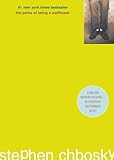
The Perks of Being a Wallflower, Stephen Chbosky

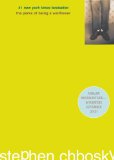
The Perks of Being a WallflowerThe book club at my school, which I advise, elected to read Stephen Chbosky’s The Perks of Being a Wallflower for its first book. We plan to go see the movie after we finish the book. I had wanted to read the book for a long time.

The Perks of Being a Wallflower is an epistolary novel about high school freshman Charlie’s adjustment to high school, including finding friends, his first crush, and dealing with some difficult issues. Early in the book, Charlie explains he is writing these letters to an anonymous reader because he heard the reader is a good person. Charlie has recently lost a good friend to suicide and is worried about high school, especially finding friends. At one of the first football games, he befriends Patrick, a boy in his shop class, and Patrick’s stepsister Sam, both of whom are seniors. As he grows closer to the two and becomes part of their circle, he learns how to stop standing on the fringes of life and “participate.”

One of the most interesting aspects of the book to me was that it was set in 1991-1992, which was my sophomore year of college, and was particularly memorable. It was my favorite year of college, and consequently, one of my favorite years of life. I was 20 for most of that school year. What a great age to be. And over half my life ago, now. 😥  I spent a lot of time that year listening to some of the new music coming out of Seattle, as well as some older (but new to me) favorites from the Pretenders, the Replacements, Tom Petty and the Heartbreakers, REM, and the Rolling Stones. One of my favorite parts of this book was the mixtape Charlie gave Patrick. I remember spending hours making mixtapes for my friends. You can make Spotify playlists in a matter of minutes. It’s not the same.

The book deals honestly with issues such as homosexuality, casual sex, drug use, suicide, abortion, and sexual abuse. In fact, if I have one criticism for the book, it’s that the entire kitchen sink of major teen issues was thrown at Charlie, and I’m not sure it’s common for most teens to experience every bad thing that can happen. However, I also admit I was sheltered. But still.

I can see why this book would appeal to teens, and I really enjoyed it myself. I found Charlie to be a likable character, though the book reminded me a great deal of The Catcher in the Rye. Charlie is not quite as friendless or annoying as Holden (though I admit I feel more empathy for Holden than annoyance with him). I have to admit I had trouble seeing him as a wallflower. It seemed to me as if he were a keen observer, but he participated plenty, in my opinion. Much more than I did as a teen—which could be why I had trouble seeing him on the sidelines of life.

I am looking forward to seeing the movie with the book club. I hope it’s good!

Rating: ★★★★☆

The Orchardist, Amanda Coplin

The Orchardist: A NovelYou belong to the earth, and the earth is hard.

I read Amanda Coplin‘s [amazon asin=006218850X&text=The Orchardist] as part of its TLC Book Tour.

Set at the turn of the twentieth century in Washington State, when the west was still a bit untamed, forbidding, and isolated from the rest of the country, The Orchardist is a novel about human connections and the interwoven nature of humanity. The orchardist of the title is William Talmadge, who lost his sister when she mysteriously disappeared and whose disappearance still haunts him. Alone in his orchards, Talmadge is a solitary man with few companions until one day two bedraggled and pregnant teenage girls show up in his orchard. Talmadge leaves food for the girls and tries to care for them. They are mistrustful of him and keep their distance. Talmadge discovers someone is looking for the girls, and after he makes a visit to the man’s house and discovers what might have prompted the girls to flee, he resolves to protect them in whatever way he can, but he quickly discovers through yet a new tragedy, that it is not in his power to protect, and he has to reconcile his feelings about this fresh new tragedy with the tragedies of his past.

I have an interesting connection to this book in that my own ancestors were apple orchardists for several generations in the twentieth century. In fact, my father is the first generation of his family not to be an orchardist. My own family lived in the Yakima Valley, which is south of the area of Washington where Coplin’s novel is set. Coplin is a Washington native, and I found the setting she described familiar. I have never actually visited Washington State myself, but I have heard it described by my father and step-grandmother. My step-grandmother frequently mentioned canning ‘cots (apricots) in her letters, and my father described the ladders in apple orchards that workers climbed. Coplin’s descriptions are lush—they place the reader in the scene and reminded me a little bit of Louise Erdrich’s novel [amazon asin=0060515139&text=The Plague of Doves] in the connection of the characters to the land and the interwoven community connected through tragedy. Coplin doesn’t use quotation marks when characters speak, which strikes me as an interesting technique in that it takes the characters out of the story a little bit. I didn’t notice the technique books that read more like journals or memoirs, but in fiction, I have to admit I’m not much of a fan; lack of quotation marks is one reason I don’t enjoy reading Cormac McCarthy’s books. However, I should say that I didn’t actually find the technique irritating in Coplin’s book, and I usually do. The Orchardist is an intriguing read and reminded me in parts of [amazon asin=0142437808&text=Ethan Frome], but I think that is because Talmadge reminded me of Ethan Frome. The two books are not that similar in plot or structure otherwise. Book clubs might find this selection an interesting novel to discuss.

TLC Book Tour for The Orchardist:

The House on Mango Street, Sandra Cisneros

The House on Mango StreetSandra Cisneros’s modern classic, [amazon asin=0679734775&text=The House on Mango Street] is a collection of vignettes in the life of Esperanza Cordero, a young Latina growing up in Chicago. She is discovering who she is as well as who she wants to be and what she wants from life. Cisneros’s background as a poet shines in some of the vignettes, which have beautiful phrasing and eloquence.

All ninth grade students and advisors at my school read this book this summer as part of our exploration of the motif of community. It is an interesting choice because Esperanza is of the community of Mango Street and while she recognizes the truth of this, she also wishes she could change it. She has dreams of having her own house, somewhere else. The 25th anniversary edition of this book has an interesting introduction written by Cisneros that offers a great deal of insight into Esperanza’s story. While it’s foolish to imagine that writers are always writing about their own lives or are allowing their protagonists to stand in for them in their stories, in the case of The House on Mango Street, it might be true, and after reading the novel, I felt especially happy for Cisneros because she describes her house near San Antonio, Texas, and I had the sense that little Esperanza, whose dreams and fears I came to care about so much, eventually got her wish. I won’t go so far as to say that everyone can relate to The House on Mango Street. I think you have to have grown up not getting everything you wanted and knowing that there was a place for you that was better and was all your own. This book does have interesting things to say about community—how it is established, what holds it together, and what it means to feel like an outsider in your community and yet still realize it’s a part of who you are.

Cisneros’s writing is gorgeous. The House on Mango Street is a quick read that many should be able to digest in one sitting. I took two mainly because I wanted to stretch it out. I think many students have begun studying this book in middle school, and perhaps that is because Esperanza is about that age, but I’m not sure middle schoolers would appreciate it. I’m not really sure high school students would. At least not all of them. I think this book is best appreciated by readers who have some distance between their current and childhood selves and can reflect on their own Mango Streets.

Rating: ★★★★★

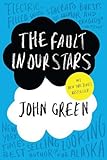
The Fault in Our Stars, John Green

The Fault in Our StarsJohn Green’s YA novel [amazon asin=0525478817&text=The Fault in Our Stars] was recently named one of the 100 Best Ever Teen Novels. The novel’s protagonist, Hazel Grace Lancaster, is a sixteen-year-old girl with an incurable cancer. She meets seventeen-year-old cancer survivor Augustus Waters at a support group for teens with cancer. Hesitant to become too close to Augustus and worried over how her death would affect him (Hazel memorably describes herself at one point in the novel as a grenade), she eventually succumbs to Augustus’s charms as they connect over Hazel’s favorite novel, An Imperial Affliction by Peter Van Houten. Augustus uses his Genie Foundation wish on a trip to Amsterdam with Hazel so that she can find out from Peter Van Houten what happens to the other characters in his novel after his protagonist, Anna, dies. The rest of the story doesn’t turn out as Hazel expected—in every single way.

Wow. John Green has to be one of the best writers of YA fiction. I can give no higher praise than that he reminds me Judy Blume in his ability to capture teenagers as they really are. Hazel and Augustus are charming and precocious, but not in an annoying way. I had the sense as I read that they had so much time to contemplate the big questions and in facing death had simply grown up more than your average teenagers. They have a rare joy for life that I would imagine only young people who have faced their own mortality might have. They are delightful, and I felt if I had been their age and known them for real, I hoped they’d have let me in their circle to be their friend. The Fault in Our Stars is a gorgeous novel, beautifully written, tightly plotted, and poignant and funny. I think its place in NPR’s list is well deserved.

You have to check out this excellent review of the book at Forever Young Adult. Posh cast it better than I could imagine, so I’ll beg off that responsibility (which I have been horrible about remembering to do, anyway).

Rating: ★★★★★

Full disclosure: I borrowed this book from my public library.

Making Soaps & Scents, Catherine Bardey

Making Soaps & Scents : Soaps, Shampoos, Perfumes & Splashes You Can Make At HomeOn my last trip to the local library, I checked out Catherine Bardey’s [amazon asin=1579120598&text=Making Soaps and Scents], thinking I could learn a few more recipes and tips for my new soap-making endeavor. The book is exactly what it advertises in the title—instructions for how to make soap and scents.

The Good: There are quite a few good ideas in this book, a helpful troubleshooting section (so if something goes wrong, you can determine what the problem is and whether you can fix it/how to fix it), a standard SAP index for figuring out how much lye and water to use depending on the oil type, and nice historical information (how well documented? not sure…). There are quite a few interesting variations, and Bardey includes recipes for shampoo bars and hair rinses—interesting idea. I love my shampoo, so I’ll have to think about it, but it could definitely be a fun gift. In addition, the scent section is interesting. I’m interested in trying solid perfumes, and she had no recipes for that, but who knew cologne could be made with vodka? Probably everyone but me, but I learned something, and that’s good. There is a healthy list of resources, but given the book is now thirteen years old, I’ll bet many of them are no longer available.

The bad: Almost all the soap recipes are based on her vegetable basic soap recipe or her animal basic soap recipe. She uses vegetable shortening in her soap, and I’ve heard of other folks using that, but what if I don’t want Crisco® in my soap? I would basically need to ditch the recipe and start with my own basic oil mixture and her additives, by which time, I may have created some sort of Frankenstein monster soap that won’t play nice with the additives (for all I know). I would have liked to have seen more variety in the recipes, and more discussion of the variety of oils. She doesn’t help out with that much aside from the SAP value chart in the back, and even then, there is no discussion of why you might use one oil over another and how that might impact your recipe. Which is huge! Another quibble I have with the book is that it is an odd size: 9.5 x 4.7 x 0.8 inches. In shape, it has roughly the same dimensions, length and width, as a standard envelope. That limited the size of the pictures. Soap-making books should have a ton of pictures, and this one has some good pictures, but not enough of them. I want to see more. A final quibble: no mention of using a stick blender to help you reach trace faster. In fact, Bardey discourages using hand mixers. Almost every website and book I’ve looked at recommends using stick blenders. I can’t believe that so many excellent soap-makers are wrong. Plus, my own experience is that it worked great. I can’t see why she discourages the use of anything but a wooden or stainless steel spoon. Seems odd to me, and I’d hate for a beginner to be put off soap-making by following that recommendation and finding the process more difficult and perhaps giving up. I know I wouldn’t want to be stirring the soap forever before something happened. Screw that.

The Verdict: This book has some good information, but it’s not for beginners, and is really not diverse enough to be worth hunting down to add to your collection. I found Basic Soap Making by Elizabeth Letcavage and Patsy Buck much more helpful for beginners as well as as a great addition to a more experienced soap-maker’s library. It has more variety in terms of recipes and more helpful information and pictures. I still learned some interesting information from Making Soaps & Scents, and for that reason, I think it’s worth checking out of the library (if your library has it), but it’s not the kind of book I’d consult more than once (well, maybe the troubleshooting section, but that’s it).

Rating: ★★★☆☆

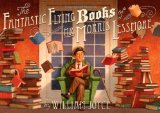
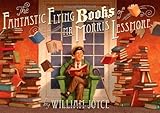
The Fantastic Flying Books of Mr. Morris Lessmore, William Joyce

The Fantastic Flying Books of Mr. Morris LessmoreOK, I admit that I did not read this book in the hardcover edition linked to the left. I first encountered the story of [amazon asin=1442457023&text=The Fantastic Flying Books of Mr. Morris Lessmore] in the form of the short film, and then downloaded the iPad app. If you have an iPad, do yourself a favor and download this wonderful multimedia children’s story, especially if you are a book nerd. You’ll love the story. It was written for you.

The story begins as Mr. Morris Lessmore is writing his story in the French Quarter of New Orleans when he is beset by a hurricane that rips the very words from his pages. Despondent, he doesn’t know where to go or what to do. Suddenly, he sees a beautiful girl being carried by flying books. Noticing Morris’s despair, she sends him her favorite book, and he follows the book to a magical library where he becomes caretaker and lends books to other folks who need them.

This is a fantastic story about the power of reading. The film is perhaps even better than the book, as it tells the story about the importance of words without using any words at all. I love the messages about how we breathe new life into old books and make them live again by reading them, and that they live in us and in turn give us life. The animation in the film is beautiful, and it reminds me of the opening story sequence in the movie Up. The digital storybook on the iPad has a narrator who reads the story, and you can interact with elements on each page. For example, on the page when Morris first enters the library, you can touch the books and hear famous lines from classic literature. You can write on Morris’s book. You can spell out words with the alphabet cereal Morris feeds the books. It’s an amazing immersive experience. My eight-year-old son loved it. We sat down and read it together this afternoon, and of course, it took him only a minute to figure out how to manipulate the book. The book is currently $4.99 in the App Store. If you have an iPad, do yourself a favor and get it.

Rating: ★★★★★

This book counts as my fantasy/sci-fi selection for the Mixing it Up Challenge.

A Moveable Feast, Ernest Hemingway

A Moveable Feast: The Restored EditionThe trouble with posthumous publication is that you never know for sure if the book is the final result of the author’s intention because he or she wasn’t around during the final stages of editing. A Moveable Feast is Ernest Hemingway’s posthumous memoir of his early writing life and first marriage to Hadley Richardson in Paris in the 1920’s. Originally edited by his fourth wife, Mary Welsh, it was published in 1964, three years after Hemingway’s death. In 1979, Hemingway’s papers were opened to the public in the JFK Library and Boston, and critics began to question whether A Moveable Feast as the author intended it had been the version that was published.

I read Paula McLain’s wonderful novel [amazon asin=1844086674&text=The Paris Wife] last year, and I had determined at that time that I needed to read Hemingway’s memoir, which was McLain’s inspiration for her novel about the Hemingways as told from Hadley’s point of view. Hemingway begins his memoir after he and Hadley have already moved to Paris. He quickly befriends the other expatriate writers and artists in France, including Gertrude Stein, F. Scott Fitzgerald, Sylvia Beach (owner of the Shakespeare & Company bookstore), Ezra Pound, and James Joyce, among others. The book is really more of a series of vignettes rather than a straight narrative with a beginning, middle, and end, but it does provide an interesting insight into the expatriate writer’s life in the 1920’s, as well as some interesting insight into the other writers he encounters.

The writer who comes off the best in Hemingway’s memoir is Ezra Pound. Hemingway describes Pound as the most generous writer he has ever known, which is interesting because Pound’s reputation now has probably sustained the most damage after his support of Mussolini and Hitler, his World War II criticism of America and Franklin Delano Roosevelt, and his ultimate mental breakdown. One has the sense that Hemingway was attempting to rescue Pound’s reputation and point out that he was a good and generous man to young Hemingway, whatever his politics later became.

Scott Fitzgerald comes off much worse. Hemingway’s Fitzgerald is drunk, tedious, insecure, and silly. Hemingway doesn’t share much about Fitzgerald that casts him in a positive light, and curiously missing from the narrative is how Fitzgerald helped Hemingway edit [amazon asin=0743297334&text=The Sun Also Rises] to make it much better book. He sharply criticizes Zelda for interfering with Scott’s ability to produce work, which is a criticism I feel is probably warranted. I do think Hemingway was probably telling the truth (mainly, as Huck would say) about Fitzgerald, but only half of the truth.

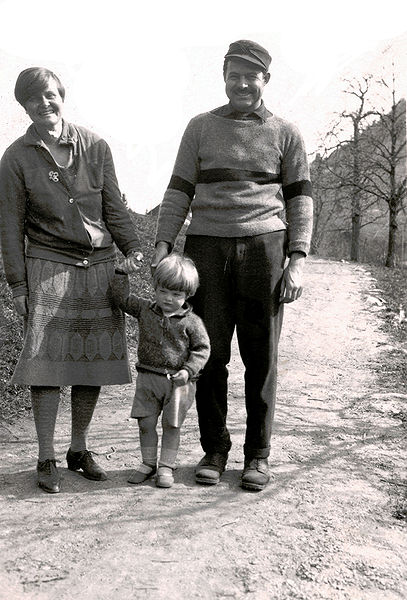
Hadley, Bumby, and Ernest Hemingway

The two standout characters in the memoir, at least to me, are Hemingway’s wife Hadley and their son Bumby (Jack Hemingway). One can’t read The Paris Wife without being angry at Hemingway for leaving Hadley for Pauline Pfeiffer, especially when Hadley loved Hemingway so much. However, in reading this memoir, I understood him a little better. He felt genuine remorse for what he had done to Hadley, and he accepted the blame, leaving some of the blame also to Pauline: “For the girl to deceive her friend was a terrible thing but it was my fault and blindness that this did not repel me” (219). Hadley, he explains, married again to “a much finer man than I ever was or ever could be” and Hemingway knew she was happy and ascribed none of the blame for their breakup to Hadley, even describing her as the heroine of A Moveable Feast and saying with confidence that Hadley wouldn’t mind the fictionalization of their time in Paris. What makes me sad is that Hadley died in 1979, so she perhaps never read the lengthy apology to her in this memoir as Mary Welsh cut it when she edited the book for publication. I think it might have made a difference to Hadley to know how Hemingway felt about what happened. He did truly love her, and one has the sense after reading A Moveable Feast that whatever happened in his love life after they divorced, he never really stopped loving Hadley.

Bumby comes across as good-natured and precocious, and I wondered if he were truly like that as a child or if Hemingway was ascribing those qualities to him as a proud father. The vignette added in this edition in which Bumby orders a beer at a café and somewhat scandalizes Scott Fitzgerald in so doing is funny and poignant. Bumby makes rather astute observations about Fitzgerald, self-control, and prostitutes that are far beyond his years to the point of being difficult to believe.

One has the sense that Hemingway chose to focus his memoir on this time in Paris because, despite the fact that he had yet to establish himself as the famous writer and persona he would later become, it was the happiest time in his life.

I haven’t read the edition edited by Mary Welsh, so all I really have to compare this memoir to is Paula McLain’s novel and the Wikipedia entry about the memoir with a list of the changes. This edition was edited by Hemingway’s grandson Seán Hemingway, son of Hemingway’s third son Gregory, with a foreword by Patrick Hemingway, Hemingway’s second and only surviving son. Seán Hemingway describes his restored edition as the original manuscript as the author intended it to be published and criticizes Mary Welsh’s editing as “changes that I strongly doubt would have been attempted by the editor had she required the author’s approval” (4) and even goes so far as to say that the “extensive edits Mary Hemingway made to this text seem to have served her own personal relationship with the writer as his fourth and final wife, rather than the interests of the book or of the author” (9), particularly with regard to his account of his breakup with Hadley and remarriage to Pauline. Seán Hemingway closes his introduction by saying,

For my grandfather, who was just starting out in those early years, Paris was simply the best place to work in the world, and it remained for him the city that he loved most. While you will not find goatherds piping their flocks through the streets of Paris anymore, if you visit the places on the Left Bank that Ernest Hemingway wrote about, or the Ritz Bar or Luxembourg Gardens, as I did with my wife recently, you can get a sense of how it must have been. You do not have to go to Paris to do this though; simply read A Moveable Feast, and it will take you there. (13)

Rating: ★★★★★


The House of Velvet and Glass, Katherine Howe

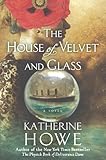
The House of Velvet and GlassKatherine Howe’s debut novel, [amazon asin=B003WUYROK&text=The Physick Book of Deliverance Dane], concerned a setting near her home in Marblehead and the Salem Witch Trials of 1692. Howe returns once again to Massachusetts of an earlier era, this time pre-WWI Boston. Sibyl Allston, daughter of a wealthy Salem sailor and a society gal, has lost her mother and younger sister in the sinking of Titanic. Her mother introduced her to the spiritualist gatherings at the home of the medium Mrs. Dee, and Sibyl continues to go in a desperate attempt to contact her mother and sister from beyond the grave. Discouraged by her inability to connect, she accepts a scrying glass from Mrs. Dee, and at first, she finds her attempts to use it unsuccessful, too. Her brother, sent home from Harvard in disgrace after he is caught in flagrante delicto with an actress in his rooms, brings his flamboyant girlfriend Dovie home, where she and Sibyl become unlikely friends. Dovie takes Sibyl to an opium den, where Sibyl is able to use her scrying glass for the first time. At first, she sees snatches of images she doesn’t understand, but once she realizes what she is able to see, Sibyl becomes desperate to know if what she sees in the scrying glass can be changed. The narrative is interspersed with flashbacks to her seventeen-year-old father’s sailing voyage to Shanghai and friendship with a young Chinese scholar and her mother and sister’s voyage on Titanic.

This book took me a while to get into, but about halfway into the book, the pace started picking up. Throughout, the descriptions are gorgeous, and I admired Howe’s ability to capture the early twentieth century well on many occasions. I liked the characters, and the setting was intriguing. The book has interesting things to say about all the what-ifs we wonder about in life, and also what our legacies might be if different choices are made. The old Calvinist thinking of early Massachusetts settlers is a surprising theme of the novel, as well. How much of our lives do we really have control over, and if we try to change events, can we really? Or is so much of what happens to us determined by Fate or God, or whatever you want to call the force of Predestination, that things will happen certain ways whether we try to intervene or not? The book does make one think about one’s place in the grand scheme of things.

Downton Abbey fans might like this book set in the same era in America. I think readers who enjoyed Howe’s first book will like this second one as well, though it is different from the first. Historical fiction fans who enjoy WWI-era novels will like it, too. Be patient with the first half, especially with the flashbacks that might not seem as if they are connected to the main narrative, as you will be rewarded once the book begins to coalesce during the second half. Enjoyable read!

Rating: ★★★★☆

Insurgent, Veronica Roth

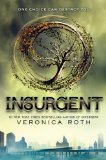
Tris Prior lives in a dystopian future Chicago divided by factions: Dauntless, who value bravery; Abnegation, who value selflessness; Erudite, who value education and intellect; Amity, who value love and friendship; and Candor, who value truth. Like other citizens in Chicago, Tris takes an aptitude test at the age of sixteen that will determine which faction she has an aptitude for. Tris’s test reveals that she is a rare individual with an equal aptitude for three factions: she is Divergent. The Divergent are considered dangerous and untrustworthy, and Tris is told to hide her test results at all costs.

Veronica Roth’s novel [amazon_link id=”0062024043″ target=”_blank” ]Insurgent[/amazon_link] is the second in a planned trilogy, the first of which, Divergent, tells the story of Tris’s decision to choose Dauntless and her initiation into her faction. I would not recommend trying to read Insurgent without reading Divergent first. Roth wastes no time catching up readers who didn’t pick up the first book and dives into the story, instead. In fact, even though I read Divergent just a few months ago, I frequently found myself trying to remember who various minor characters were and how they fit into the story. You may want to stop reading now if you haven’t read the first novel. Continue reading “Insurgent, Veronica Roth” →

Persepolis, Marjane Satrapi

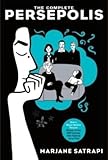
The Complete PersepolisThe first time I ever heard anything about the country of Iran was when I was in second grade. Americans had been taken hostage at the American Embassy in Tehran. We wrote letters to the hostages, and I remembered very clearly that a boy in my class wrote in his letter, “I hope you don’t get shot.” Miss Johnson, my teacher, made him change it because, she said, while she was sure they would appreciate his hoping they wouldn’t get shot, he shouldn’t remind them of the possibility in a letter. They were already scared enough. I remembered thinking that these people must be crazy to kidnap people they didn’t know for no reason I could understand. I think a lot of Americans came to view Iranians as crazy fundamentalists, and it was easy to lump the entire country together under that label. [amazon_link id=”0375714839″ target=”_blank” ]Persepolis[/amazon_link] is a memoir by Marjane Satrapi, who experienced what it was like to live in Iran during the Islamic Revolution. She paints a different image of Iran and Iranians than many Americans my age and younger grew up seeing. She describes what it was like to feel hopeful when the Shah was deposed, only to find the revolution was not what she and her family expected, and in many ways, their lives were worse. Satrapi suddenly had to wear a veil to school. Satrapi was outspoken and frequently courted trouble. When she was fourteen, her parents sent her to school in Austria. She came back to Iran at the age of eighteen confused about who she was: she didn’t feel completely Iranian because her beliefs were out of step with those of her more traditional friends, but she didn’t feel Western, either.

The version I read contains the complete graphic novel, spanning Satrapi’s life from the late 1970’s to the mid-1990’s. I liked the artwork. It was simple but effective, and I found Satrapi’s story so captivating that I read the novel in a matter of hours (although it is true that graphic novels are quicker to read). I have not read many graphic novels. In fact, this is only my second, the other being [amazon_link id=”0394747232″ target=”_blank” ]Maus I: A Survivor’s Tale: My Father Bleeds History[/amazon_link]. I didn’t like Maus all that much, and I have never been much of a comic book reader, so I think I told myself I didn’t like graphic novels. This graphic novel was excellent, though. I found Satrapi’s description of life in Iran and her parents interesting. I think growing up when I did, it was easy to see the people of Iran as “the enemy” and to forget they are not terribly different from us, and what this book does brilliantly is expose that prejudice to the reader. Reading this memoir, I do not have the sense it was written for an Iranian audience. It feels more like it was meant to educate Westerners, and it certainly changed my perspective. We have our own religious extremists here in America, but the difference is that our government allows dissent, and we’re not yet living in the Republic of Gilead.* I enjoyed the fact that the memoir was an unflinchingly honest examination of Satrapi’s coming of age, but also not without quite a fair amount of humor, even the face of difficult circumstances and devastating events. Ultimately, Satrapi’s memoir is the story of how she discovered who she is and what she wanted. I would recommend it to anyone who thinks they don’t like graphic novels. Anyone who already enjoys graphic novels will love this book.

*A reference to the government established by the Religious Right in Margaret Atwood’s novel [amazon_link id=”B003JFJHTS” target=”_blank” ]The Handmaid’s Tale[/amazon_link].

Rating: ★★★★★

I read this novel to fulfill the Graphic Novels and Manga category of the Mixing it Up Challenge.