Review: Fun Home, Alison Bechdel

I just returned from the annual National Council of Teachers of English conference. Alison Bechdel was a keynote speaker Friday morning, and she spoke about her two graphic memoirs, Fun Home: A Family Tragicomic and Are You My Mother?: A Comic Drama, as well as her other work in comics. Her parents had both been English teachers, and she had much to share with us about encouraging writers and the ways in which her own parents shaped her as a reader and a writer.

Fun Home centers on Bechdel’s relationship with her father, who likely committed suicide in 1980, right after Bechdel came out to her parents. Her father was a somewhat distant and arguably abusive man who was plagued by his own struggles with his sexual identity. Bechdel chronicles the family’s difficulties with her father, whose passion was restoration. His preoccupation with appearances profoundly affected Bechdel. She grew up in a very cold home.
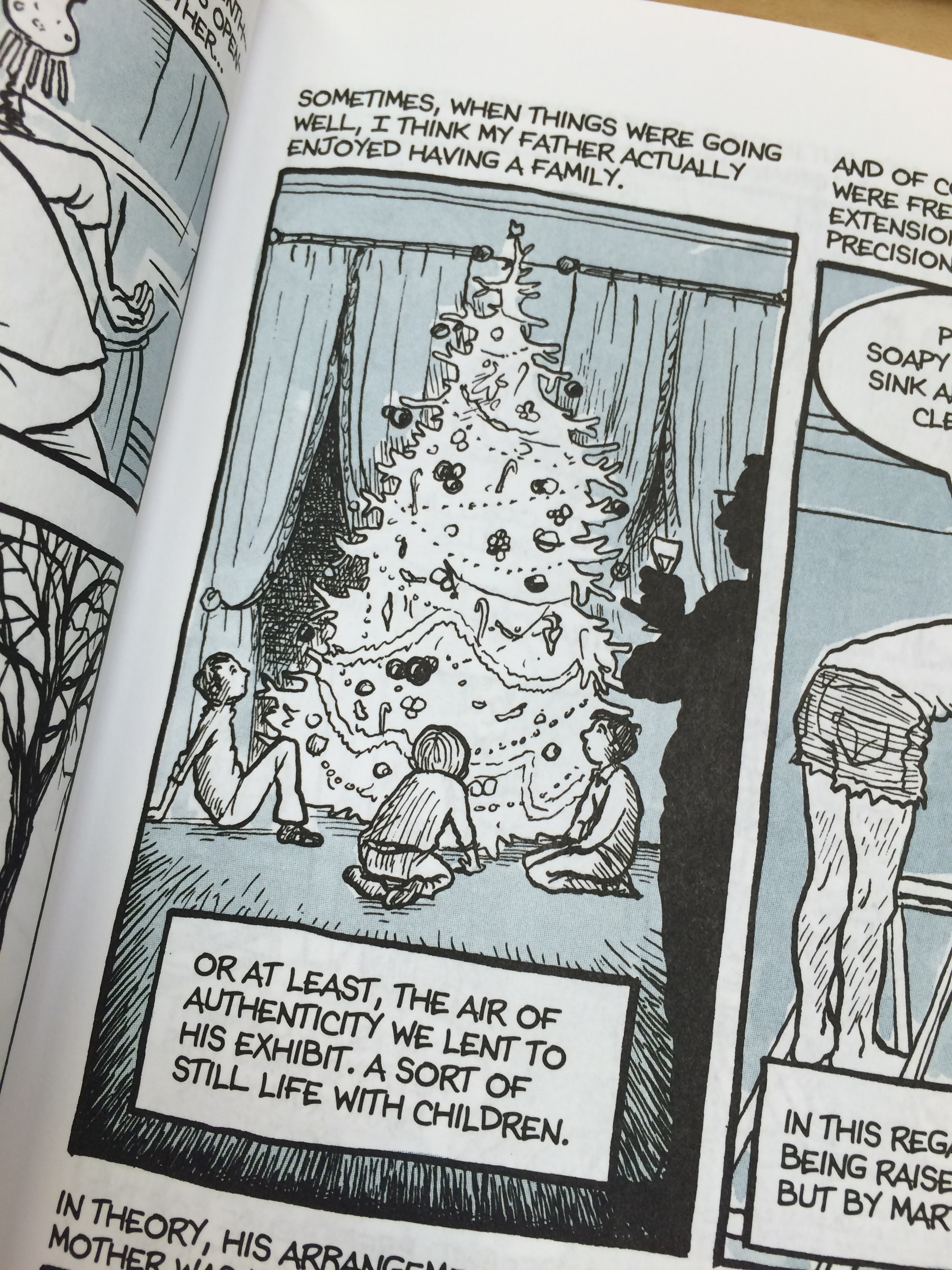
Panel from Fun Home

But Bechdel’s father influenced her as a reader and writer.
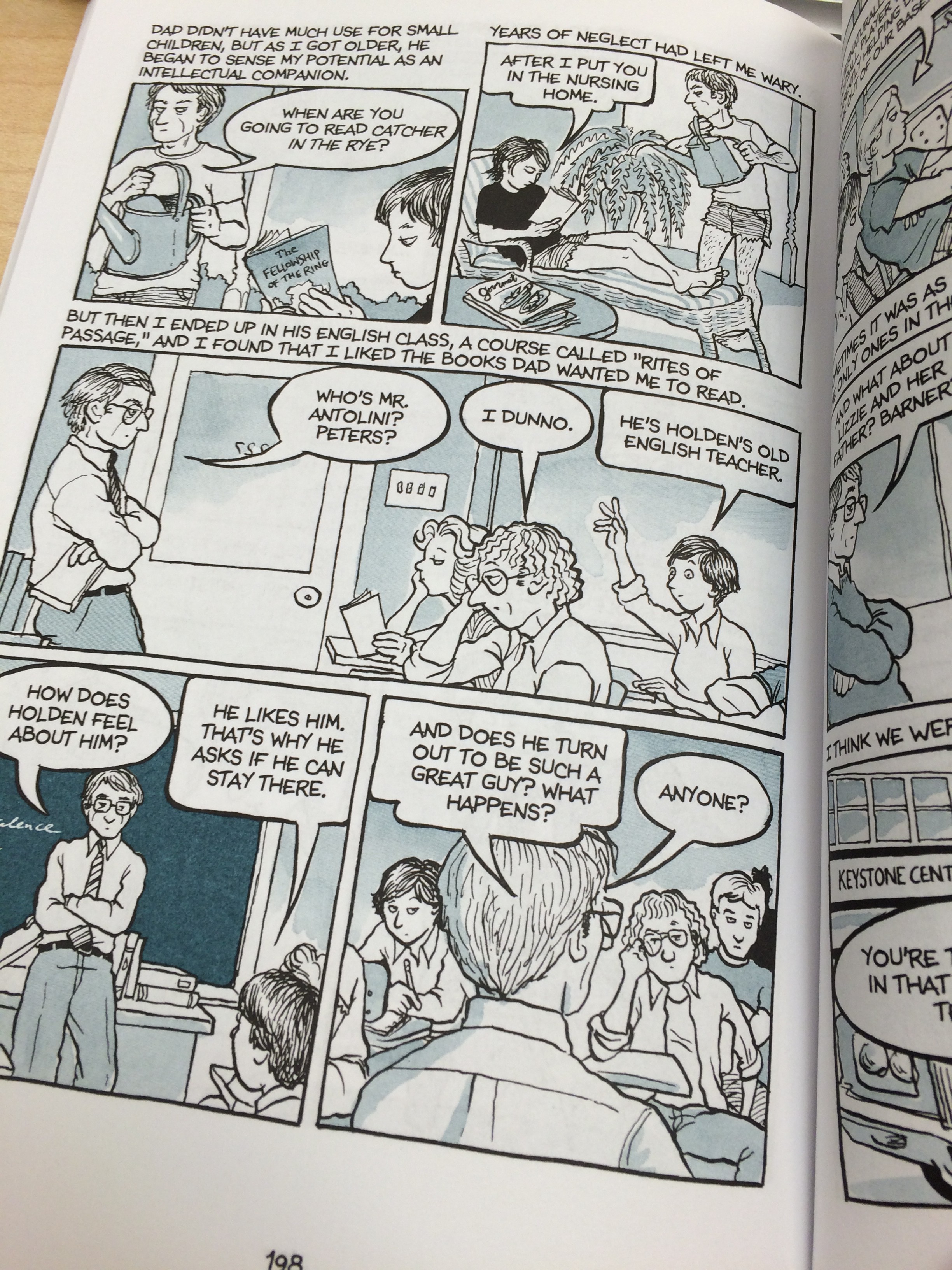
Panel from Fun HomeFun Home is packed with literary allusions, from her own identification of Bechdel’s father and herself as Daedalus and Icarus to her connection of her father to F. Scott Fitzgerald to finding herself in the writing of Collette and other LGBT writers. There is a good interview with Bechdel on NPR you might want to check out if you want to learn more about her and also about the Broadway musical adapted from this book.

I truly enjoyed this book. I read it while waiting in the airport to return home from the conference and finished it on the plane. It’s a quick read, but an absorbing and very deep read. It’s a well-written memoir on top of being poignant. There are moments of levity, even in panels in which Bechdel is dealing with her father’s death.
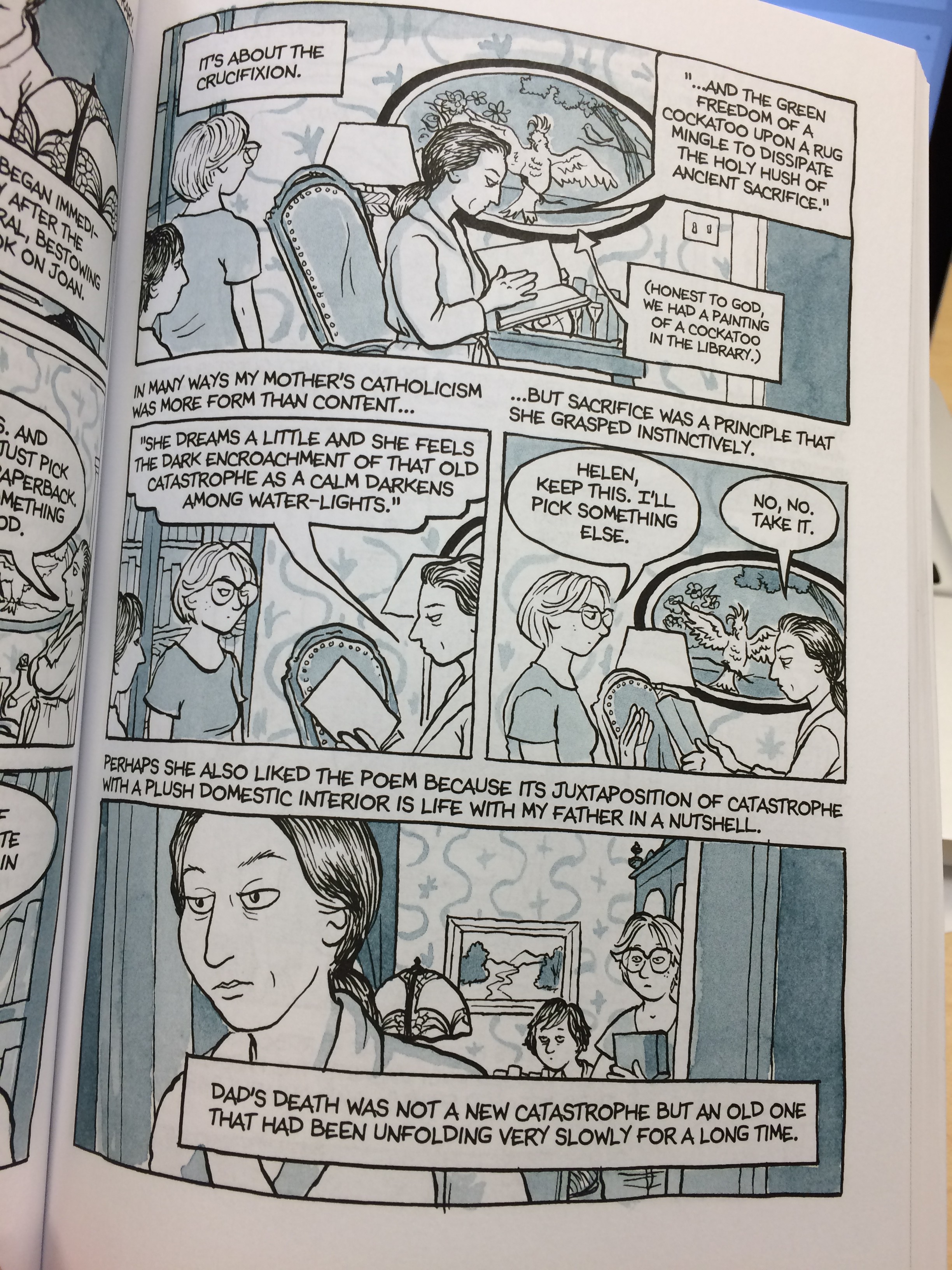
Panel from Fun Home

If you are not familiar with Bechdel’s work, you probably have at least heard of the “Bechdel Test,” which is a criterion for determining whether a movie has some consideration of women as fully realized characters to the following extent:

  1. It has to have at least two women characters
  2. Who talk to each other
  3. About something other than a man

I was fortunate to be able to meet Alison Bechdel at the conference, and she signed my copy of this book.
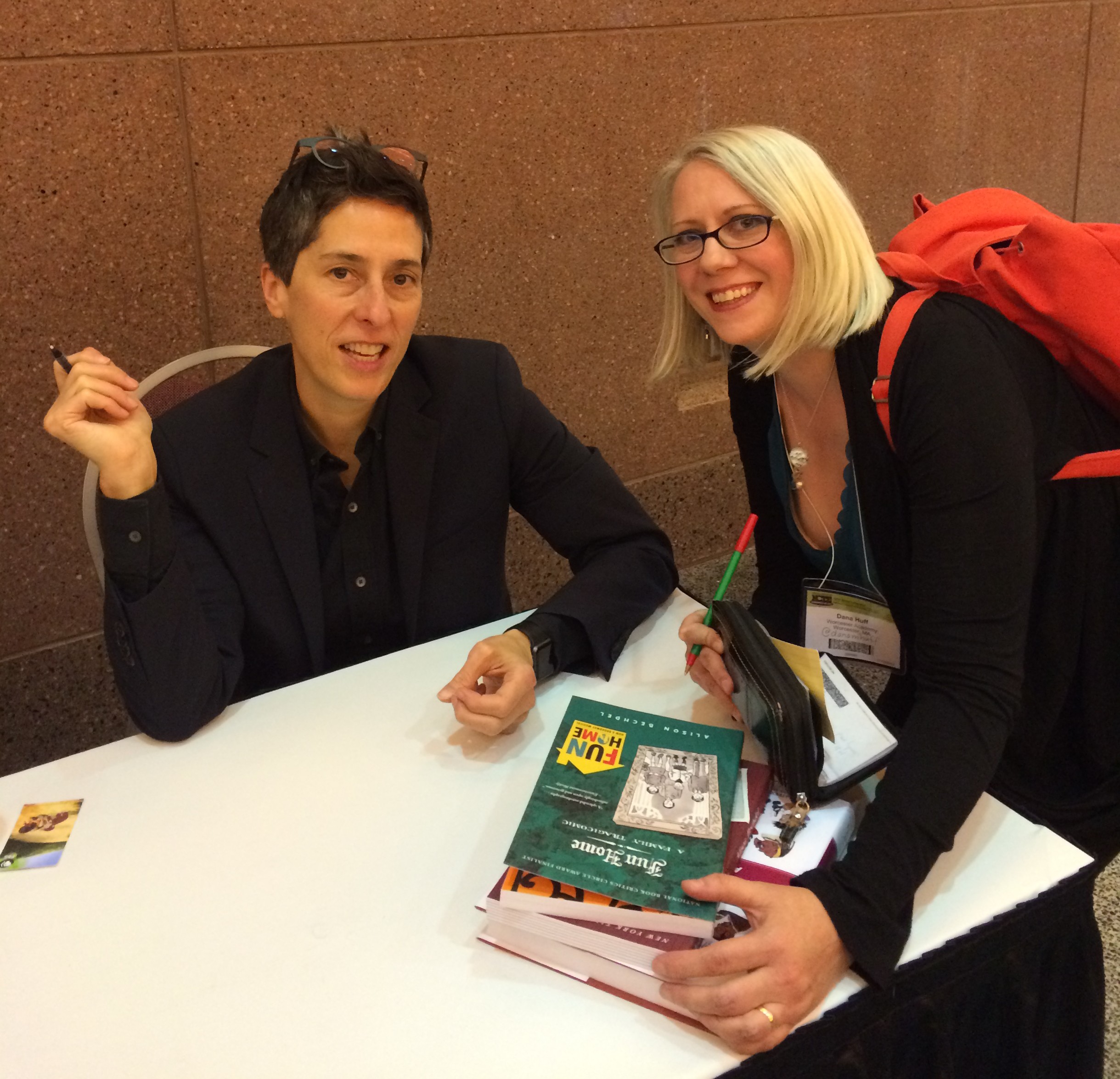
Alison Bechdel and DanaIt was wonderful to meet her and hear her speak about her reading and writing life.

Rating: ★★★★★

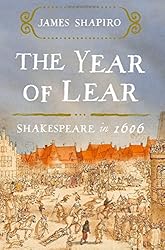
Review: The Year of Lear, James Shapiro

James Shapiro’s new book The Year of Lear: Shakespeare in 1606 explores the period in which William Shakespeare wrote three of his greatest and most well-known plays: King Lear, Macbeth, and Antony and Cleopatra. Beginning with the Gunpowder Plot’s discovery on November 5, 1605, Shapiro explores the ways in which the political events of 1606 shaped the plays that Shakespeare wrote. Shapiro has turned the microscope on a year in the life of Shakespeare in the past. His book A Year in the Life of Shakespeare: 1599 explores the year in which Shakespeare finished Henry V, and wrote Hamlet, Julius Caesar, and As You Like It. The Essex Rebellion and aging Queen Elizabeth figure large in that previous book as King James, the Gunpowder Plot, recusant Catholics, and the quest to unite the kingdoms of England and Scotland figure in this new book.

As I am currently finishing up a unit on King Lear, I was most fascinated by the connections Shapiro made between the intrigues of 1606 and that particular play, but I also gained a great deal of insight into Macbeth, a play I have taught more times than any other save perhaps Romeo and Juliet. Shapiro’s research is meticulous. When he doesn’t know or where the records are patchy, he speculates, but his educated guesses make a lot of sense in the context of the times and the plays. I haven’t actually read Antony and Cleopatra in many years, and if this book has a weakness, it is perhaps that it doesn’t explore that play in the same detail as it does the other two; however, this book is not meant to be literary criticism as much as an exploration of history’s influence on literature.

James inherited both the kingdoms of England and Scotland. Having been king of Scotland since infancy, he was eager to see his two kingdoms united and spent much of the year attempting to convince Parliament to approve the union. The division between Protestants and Catholics was at a peak, as Catholics were urged to take the Oath of Allegiance and to take communion at church. Shakespeare’s own home in Warwickshire was a hotbed of conspiracy and recusancy, and his own family was not immune. Shakespeare seemed to be at the heart of all the most important political events of the year—even a fresh outbreak of the plague touched him and influenced his plays in ways that modern audiences have difficulty appreciating.

I will read anything Shapiro writes about Shakespeare. He’s one of the most interesting Shakespearean scholars writing today. He manages to stimulate and challenge even those who think they know Shakespeare and have a thorough understanding of a given play, but he also manages to write accessibly and engagingly enough for the lay reader.

Rating: ★★★★★

Review: Fiercombe Manor, Kate Riordan

Kate Riordan’s novel Fiercombe Manor is the story of Alice Eveleigh, a naive young woman who lives in 1930’s London with her parents. Alice becomes pregnant after having a short affair with a married man. To spare her family shame, Alice’s mother sends her off to Fiercombe Manor in Gloucestershire, where Edith Jelphs, an old friend of Alice’s mother, lives. Alice’s mother tells Mrs. Jelphs that Alice’s husband has tragically been killed in an accident. She plans to collect Alice and the baby and put the baby up for adoption after it’s born (though she does not confide these plans to Mrs. Jelphs).

As Alice settles into Fiercombe Manor, she notices a sort of brooding sadness in the valley, and over time, she comes to learn about the tragic history of the Stanton family, who owns the manor. Alice is particularly transfixed by the story of Elizabeth Stanton, who had been Mrs. Jelphs’s employer when Mrs. Jelphs first came to Fiercombe as a young woman. Elizabeth’s imprint seems palpable in a strange presence Alice feels as well as a diary and a few keepsakes left behind. Alice spends the summer of her confinement wrapping herself into the mystery and wondering if her own fate might be somehow wound up in the tragedy surrounding Fiercombe Manor. She begins to wonder also if the valley isn’t cursed in some way that she will not be able to escape.

I enjoyed this book quite a bit. The house is a very real character in the book and reminded me not a little of Thornfield Hall or Manderley. Is the house haunted? Can tragedy truly linger around a place? Or is Alice just sensitive and emotional because of pregnancy hormones? She wonders all of these things herself. She also finds herself drawn to the Stanton heir, Tom, who befriends her and shares some of his own tragic secrets with her. Mrs. Jelphs and Ruck are interesting characters as well. Ruck has a little bit of old Joseph, the caretaker of Wuthering Heights, and Mrs. Jelphs might be Jane Eyre‘s Mrs. Fairfax or perhaps Rebecca‘s Mrs. Danvers. In fact, the novel manages to pay homage to these forbears without ever coming across as derivative.

Perhaps one of the most interesting aspects of the book is its exploration of women in the Victorian era. Left with few options and no rights as well as abysmal mental health care, some were forced into rest cures or sent to asylums. I thought of Charlotte Perkins Gilman’s brilliant short story “The Yellow Wallpaper” quite a few times as I read. It’s a shameful and shocking part of women’s history.

In the end, the setting is the star, and if Alice is a little bit stupid at the beginning, we can forgive her, as she manages to redeem herself in the ending, which is both satisfying and not as unrealistic as I thought it would be. I definitely felt for Alice in her desperate situation. Though she has a few more options than Elizabeth Stanton before her, she is still a woman with no money of her own, few marriage prospects, and no family support. She will likely remind many readers of the second Mrs. de Winter in Rebecca. I would definitely recommend this book to fans of Jane Eyre, Rebecca, or The Thirteenth Tale. I must hasten to add that this book is not the equal of those I’ve mentioned, but if you liked any of them and want to escape into a good, creepy yarn, you should enjoy this novel.

Rating: ★★★★★

This was a great final R. I. P. read, though I think I’m going to keep going with the creepy books. It also puts Gloucestershire on the map for the Reading England Challenge and is yet another Historical Fiction Challenge read as well.

Review: Things Half in Shadow, Alan Finn

Alan Finn’s novel Things Half in Shadow starts with a fun premise: the protagonist, Edward Clark, is a Civil War veteran and reporter who is assigned the task of exposing Philadelphia mediums as frauds. He has a background that no one, least of all his ingenue fiancée, Violet Willoughby, knows about—his true identity is Columbus Holmes, son of the great magician Magellan Holmes, who killed his wife (Columbus’s mother) and is now rotting away in Eastern State Penitentiary. Unfortunately, Edward makes a nemesis out of a fraudulent medium named Lucy Collins, who threatens to expose Edward’s secrets unless he agrees to help her put her biggest competitor out of business. But Edward and Lucy get a little more than they bargained for when they discover Lenora Grimes Pastor is a real medium—and they become implicated in her murder when she dies mysteriously in the middle of a séance.

This book is fun, and it moves at a brisk pace. The characters, particularly Edward Clark and Lucy Collins, are engaging. The historical details ring true (mostly). However, I didn’t find the ending satisfying. It’s probably the case that the author intends to write a sequel, but few of the loose ends are tied up, and the ending felt rushed compared to the pace of the rest of the book. The clues were not carefully laid for the reader to notice. The reader doesn’t want to feel completely blindsided by the events in the last 100 pages of a mystery. I think it’s fine to surprise the reader, but the dots need to connect, and the clues need to be laid. Otherwise, it feels like a cheat. I would have said it was sitting on four stars until the ending. However, most of the reviews I’ve seen rate it higher than I have, so your mileage may vary, and it’s definitely worth checking out. In fact, most of the reviews I saw gave it 4 or 5 stars. In the right hands, I think it would a fun movie. It sure has enough action scenes for a novel set in a time that couldn’t include a car chase (it did include a carriage chase, if you can believe it). I can’t say that it didn’t hold my interest. I was just looking for more out of the ending.

Rating: ★★★½☆


Review: The Shadow of Night, Deborah Harkness, narrated by Jennifer Ikeda

Deborah Harkness’s Shadow of Night is the second in her All Souls Trilogy. In the first book, which I read and reviewed here, witch and historian Diana Bishop calls forth the mysterious manuscript Ashmole 792 from Oxford’s Bodleian Library, arousing the curiosity of many other “creatures,” including vampire Matthew Clairmont.

This book picks up Diana and Matthew’s unlikely love story as they prepare to timewalk to the past in the hopes of recovering the mysterious alchemical manuscript known in their time as Ashmole 782, which Matthew hopes will reveal genetic secrets of creatures and help Matthew discover why creatures are dying out. Using Diana’s power to travel to the past, Matthew and Diana go back to Elizabethan London, where Diana discovers her husband is a member of the legendary School of Night. And that’s not his only secret. Diana discovers she has some massive hidden powers, and she rubs shoulders with just about everyone of note in early 1590’s London and Prague.

I have to admit I find both Diana and Matthew pretty grating. People (annoyingly) fall in love with both of them right and left, while they have eyes only for each other. And of course, they have flawless appearances as well. Harkness falls into the trap of making her characters too physically perfect, so she gives them other flaws (that aren’t really flaws). I know they are not supposed to be normal people—they are a witch and vampire—but I still found them both pretty unsympathetic. Even when you’re writing about supernatural creatures, you want your characters to seem believable on some level. On the other hand, as this kind of book goes (think Twilight) this series is entertaining enough. It’s hard to believe even a vampire like Matthew would somehow be to connected to pretty much every major figure in Renaissance London and Prague, too. And I mean, it runs the gamut, from Rabbi Judah Loew ben Bezalel, aka the Maharal of Prague, a witch who created the legendary Golem, Holy Roman Emperor Rudolf II, Queen Elizabeth I, Christopher Marlowe, Sir Walter Raleigh, and more shadowy types like John Dee and Edward Kelley. One can’t deny that Harkness did her research. One wonders if all of it had to be thrown into the book.

Like I said, though, these books are entertaining enough, and they will definitely appeal to people who are looking for fun books about vampires and witches. Jennifer Ikeda’s reading works well with the story and doesn’t hit any wrong notes.

Rating: ★★★½☆
Audio Rating: ★★★★☆

I can’t count this one for the R. I. P. Challenge, even though I think it would be perfect if you’re doing the challenge and looking for something different to read. I started reading it before the challenge started, however. Given that most of the book is set in the past, I do feel it can definitely count for the Historical Fiction Challenge. Diana and Matthew travel from American to Renaissance London, and then to France and Prague, so it’s hard to figure out exactly where to map it for my settings map, but I’m settling on London, as I’d say the bulk of the action takes place there.

Review: This House is Haunted, John Boyne

John Boyne’s novel This House is Haunted is the story of Eliza Caine, a teacher grieving the recent death of her father. She responds to a mysterious ad for a governess in Norfolk, in part for somewhere to go, now that she’s learned her father never owned the house in which they lived and she’s being unceremoniously thrown out, and in part to escape her sadness. As soon as she arrives on the train, she realizes not only that she has been hired under false pretenses, but also that there is a presence in Gaudlin Hall, the home of her young charges Isabella and Eustace, that does not want her there.

Anyone who is familiar with ghost stories/madwomen in the attic tropes will recognize this story. With serious nods to both The Turn of the Screw and Jane Eyre, as well as bit of “The Fall of the House of Usher” and explicit homages to Dickens, many readers might well accuse this book of cribbing from more illustrious forebears a bit too much. Perhaps there isn’t a whole lot here that is new. As a ghost story, it’s fairly predictable, and despite some pretty chilling scenes (as I described them to my husband, I realized based on his reactions that they were scary at least in the abstract), I wasn’t really scared. I didn’t really want to be terrified. I don’t read much horror for a pretty good reason. It’s not my favorite thing to imagine the absolute worst people do, and I can’t stand gore at all. But a creepy ghost story, like, for instance, The Little Stranger? I’m all over that. This story wasn’t really like that. I think it might make for a pretty interesting atmospheric movie, but it didn’t really deliver any seriously good chills, at least not for me. But it is a quick read, and the story was engaging enough for me to keep turning the pages. It was a nice way to get my feet wet for the R. I. P. Challenge this year.

Rating: ★★★½☆

Review: The Remains of the Day, Kazuo Ishiguro

I have mentioned before that I’m working my way through the books I plan to teach for AP Literature, starting with the ones I haven’t read. Kazuo Ishiguro’s modern classic The Remains of the Day was the last of the books I hadn’t read (I will now need to do some re-reading, as I haven’t read some of the others in a long time, but I put them off since I did at least have some familiarity with them). I don’t know what took me so long to read this book, given I have enjoyed other works by Ishiguro and also that I just love books like this (not to mention television like Downton Abbey, and yes, I can see Ishiguro’s influence on that show in many ways after reading this book).

If you haven’t read the book, perhaps just a short introduction. The Remains of the Day is told in the first person viewpoint of Mr. Stevens, longtime butler of Darlington Hall. Stevens dedicated his life to serving Lord Darlington and is currently in the employ of the American, Mr. Farraday, who gives Stevens leave to visit Darlington Hall’s former housekeeper, Miss Kenton (now Mrs. Benn) to determine whether or not she might consider returning to Darlington Hall. Most the book takes place in the form of recollections as Stevens drives to Cornwall to visit Miss Kenton.

At the risk of sounding hyperbolic, I think this is one of the best books I’ve ever read. Stevens’s voice is so expertly captured by Ishiguro. He is all restraint, and yet Ishiguro manages to make his deeply rooted feelings all the more palpable for the control that Stevens exerts over them. My heart ached for him. Even as he denies it, his regret over the way he has spent his life and the mistakes he made with Miss Kenton are heartbreakingly clear, and when he does finally say near the end (sorry, spoiler alert here), “Indeed—why should I not admit it?—at that moment, my heart was breaking” (239), you know it’s really been smashed into a million pieces, and frankly, I wondered if he would be able to go on. In addition, it’s an interesting portrayal of the times in which it’s set, particularly poignant for its focus on characters who are on the wrong side of history, and, indeed, who find it difficult to adjust to modern times after World War II. It’s absolutely breathtaking and brilliant writing.

Even though the movie has been out for some time and stars many of my favorite actors, I have deliberately avoided it because I always had it in the back of my mind that I would read the novel. Now I really want to see the movie, which I know is brilliant as well. I just have no idea why I waited so long. It was a gorgeous book, and I can’t wait to see what my students think of it. I have an excellent list of books to share with them.

Rating: ★★★★★

This book is set on a trip to Cornwall, but given that most of the novel is a reflection on experiences at Darlington Hall near Oxford, I’m going to count it as my Oxfordshire book for the Reading England Challenge (I have previously read books set in London, Cambridgeshire, Warwickshire, and Yorkshire, so this is my fifth book. I’m also counting towards the Historical Fiction Challenge.

Review: The Piano Lesson, August Wilson

I am reading my way through the list of texts I will teach in AP in the coming year, and as August Wilson is an important writer who often appears on the test, I found myself reading this play. I’m so glad I did. I have read and taught Fences, which might be his more famous play, but I found this play to be much more exquisite, and I liked the characters a great deal more.

The Piano Lesson is the story of a family piano. An intricately carved work of art, the piano’s legs include family portraits carved by Willie Boy, the family patriarch. Willie Boy, a slave owned by the Sutter family, was asked by Sutter to carve the faces of his wife and child, whom Sutter had sold away, into the piano to please Sutter’s wife. Instead, Sutter carves the faces of his entire family. Willie Boy’s son Boy Charles steals the piano because he believes it more rightfully belongs to his family than it does to the Sutters, The piano entwines the two families even in death. Siblings Boy Willie and Berniece spend most of the play arguing over the piano. Bernice wants to keep it because of its importance to the family, but Boy Willie wants to sell it in order to buy the deceased Sutter’s land.

There are many things going on in this play: the tension between enjoying art for art’s sake instead of more “practical” objects, such as land; the importance of family; what it means to be successful in life. The piano lesson of the title is really the argument that Boy Willie and Berniece are having about the piano: would it be better for the family to keep it or to sell to buy Sutter’s land? It’s an important conversation to have, as the play is set at a time when many African Americans did not have either a family history they knew and could cling to or an opportunity to own land.

Wilson won a Pulitzer for this play, and I can see how a production would be quite something to watch. However, Toni Morrison makes a successful argument for simply reading the play in her introduction, and it is indeed a delight to read as well. I would consider this an important work of the Great Migration and of American drama in general. I’m not sure if this would make a good movie—I think it is meant to be on the stage. It does look like it’s been made into a movie at least once.

Rating: ★★★★★

This story is probably set no later than the 1930’s, solidly in the period of the Great Migration, as Berniece and Boy Willie’s grandparents had been slaves, and Sutter would have had to have still been around at the beginning of the play. However, as the play also includes a truck (that is one of the liveliest characters in the story, I will add), vehicles have to be somewhat common. As it was published in 1988, it counts as historical fiction.


Review: Song of Solomon, Toni Morrison

I read Toni Morrison’s novel Song of Solomon in order to prepare to teach it this coming school year. Song of Solomon is the story of Macon Dead III, also known as “Milkman.” Milkman feels lost and disconnected, but he goes in search of his family’s history and in the process discovers himself.

I hardly know what to say about this book. It’s incredible in way few things I have ever read are. I loved the magical realism. I think a lot people find magical realism confusing perhaps because it doesn’t fully conform to fantasy, so you can’t really suspend your disbelief and just go with it, but it also doesn’t conform to realism, and sometimes events can happen that are hard to make sense of. This story is so perfectly layered and carefully written. It’s a masterwork in the art of writing. It’s not only one of the most beautifully poetic books I’ve ever read, but it’s also spiritually fulfilling and a captivating story as well.

One suggestion I have for anyone who reads this novel is not to miss Toni Morrison’s forward. When she reveals the care and thought that went behind just the first sentence, you will understand just how tightly written a work of genius this novel is. I appreciated the way that no thread was left abandoned. Every idea that was introduced was brought back. There was nothing “extra”; no details were just thrown away. As such, it requires quite a close read. Be careful though. I found errors in the online help sites SparkNotes and Shmoop that might cause a reader to be confused, especially if he/she makes the egregious mistake of reading the help sites alone instead of the novel.

I am so glad I read this book. I think I loved it even more than Beloved. This novel deals with some of the same themes as Beloved—the legacy of slavery that resulted in cycle of abandonment by black men and single parenthood and grief for black women. In another writer’s hands, exploration of these theme could go badly wrong. Morrison is an essential writer for our times. She could teach us so much about the ways in which the past still impacts us today and will impact us in the future.

Man. What an excellent book.

Rating: ★★★★★

This book is a bit contemporary for historical fiction, but I’m still counting it because the ending occurs at least ten years before it was published, and many of the events concern the past. Not everyone may agree with this categorization, but given the importance of the past in this book, I think it’s fair.

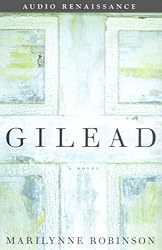
Review: Gilead, Marilynne Robinson

Marilynne Robinson’s novel Gilead won the Pulitzer Prize in 2005. It is the story of a dying preacher, John Ames, who worries about leaving his young wife and son with no money (and in his son’s case, few memories of his father). The novel is written in the form of a letter from Rev. Ames to his son as a means for his son to understand and get to know his father.

At the outset, such a setup seems like it would be a depressing novel, but the result is actually more uplifting. Ames may be a minister well-versed in the gospel, but he is not holier-than-thou—in fact, he’s quite reflective about the ways in which he falls short, and he’s a rather open-minded philosopher. More than anything else, this book winds up being a sort of philosophical memoir. Ames recalls memories of his father and grandfather, both of whom were also ministers and who often clashed with each other. His grandfather was a abolitionist who was connected with John Brown in Kansas.

Obviously this book is well-regarded, and it has received a lot of praise. Though I did like it, I can’t really say I loved it, but I think part of the problem might be that I listened to it instead of read a print version. I think this book needs a slower digestion that is possible with print. Though the narrator, Tim Jerome, did a wonderful job telling the story, I think I missed some things as I listened to it. I can tell it’s well-written and spare in its elegance, but the story didn’t do as much for me as I wanted it to. I thought the prodigal son Jack Boughton was the most interesting character, and the way Ames wrestled with his conscience over Jack Boughton was the most memorable part of the book for me. In the right hands, I think this book could be a wonderful book. I’m just not sure it was really written for me.

Rating: ★★★½☆
Audio Rating: ★★★★½