Review: Hidden in Plain View: A Secret Story of Quilts and the Underground Railroad

Review: Hidden in Plain View: A Secret Story of Quilts and the Underground RailroadHidden in Plain View: A Secret Story of Quilts and the Underground Railroad by Jacqueline L. Tobin, Raymond G. Dobard
Published by Doubleday Books on January 19, 1999
Genres: History
Pages: 224
Format: Hardcover
Source: Library
Buy on AmazonBuy on Bookshop

This post contains affiliate links you can use to purchase the book. If you buy the book using that link, I will receive a small commission from the sale.

Goodreads
two-stars

The fascinating story of a friendship, a lost tradition, and an incredible discovery, revealing how enslaved men and women made encoded quilts and then used them to navigate their escape on the Underground Railroad.

In Hidden in Plain View, historian Jacqueline Tobin and scholar Raymond Dobard offer the first proof that certain quilt patterns, including a prominent one called the Charleston Code, were, in fact, essential tools for escape along the Underground Railroad. In 1993, historian Jacqueline Tobin met African American quilter Ozella Williams amid piles of beautiful handmade quilts in the Old Market Building of Charleston, South Carolina. With the admonition to "write this down," Williams began to describe how slaves made coded quilts and used them to navigate their escape on the Underground Railroad. But just as quickly as she started, Williams stopped, informing Tobin that she would learn the rest when she was "ready." During the three years it took for Williams's narrative to unfold—and as the friendship and trust between the two women grew—Tobin enlisted Raymond Dobard, Ph.D., an art history professor and well-known African American quilter, to help unravel the mystery.

Part adventure and part history, Hidden in Plain View traces the origin of the Charleston Code from Africa to the Carolinas, from the low-country island Gullah peoples to free blacks living in the cities of the North, and shows how three people from completely different backgrounds pieced together one amazing American story.

This book has been on my radar for a while, mainly because many quilters refer to it and ask me if I’ve read it. I decided to read it, even though I had heard rumblings about the lack of evidence for the book’s premise: that quilts served as secret codes for people escaping north to freedom on the Underground Railroad.

It’s one of those stories one wants to be true, and I suspect that’s the case with Jacqueline Tobin, the primary author. There is some basis for using coded language in the form of spirituals. Harriet Tubman, perhaps the most famous conductor on the Underground Railroad, is known to have used two songs as codes, including “Go Down, Moses.” Another popular story is that cornrow hairstyles were used to convey secret messages to enslaved people. According to the Snopes article on this practice, they “found no tangible evidence of slaves in the U.S. actually using cornrows to convey messages. But this doesn’t mean that these stories should be disregarded, or that the practice never existed.” I suggest the same is true of the story Tobin and Dobard tell about quilts serving as coded messages to those escaping slavery.

The first problem is that Tobin seems to have relied on a single person for this story. It beggars belief that no one besides Ozella McDaniel Williams would have told stories about this practice. According to Laurel Horton in her article “Truth and the Quilt Researcher’s Rage: The Roles of Narrative and Belief in the Quilt Code Debate” in Western Folklore, “the eleven patterns named in the Quilt Code are typical of those popular in South Carolina [where Ozella McDaniel Williams lived] in the early twentieth century” (p. 43). However, some of the patterns did not yet exist before the Civil War, while others did not have the names that Ozell McDaniel Williams gave (e.g., the Monkey Wrench) (Horton, 2017). I was also a bit surprised to learn from Horton’s article that block-style quilt patterns were “virtually unknown” in South Carolina until the 1840s, and that it would probably not have been possible for African-American quilters to hide such quilts “in plain view” (p. 43).

As a qualitative researcher myself, I’d be the first to disagree with critiques that dismiss Tobin’s research because she obtained the information she published in this book from a storyteller. However, we can’t take this anecdote, no matter how attractive it is, and extrapolate that quilts served as codes based on one woman’s story, especially since the story is filtered entirely through Tobin—we never really hear much in the way of direct quotes from Williams herself. I am even more skeptical of the book’s claims that some quilt patterns have Masonic connections. I mean, maybe? I don’t know enough to say absolutely not, but it reads sort of like pretty much every other conspiracy theory about Freemasons.

In terms of style, the authors frequently employ questions as a rhetorical device (I also caught some copyediting mistakes). For me, this style undercut the book’s message and made the authors sound unsure of themselves, which I suppose they may have been. There is also quite a bit of repetition, and ideas might have been more tightly organized. The author might repeat biographical details about figures in the book, such as Denmark Vesey. I found myself thinking, “Yes, you already told me that,” a few times as I read.

This story has taken root, and so many people want it to be true that I doubt my critique will amount to much. So why two stars? I found the story compelling, as Horton states in her article as well. I also appreciated the discussion of modern quilters such as Faith Ringgold, Michael Cummings, and Carolyn Mazloomi. I also enjoyed reading about some of the connections between patterns and African art, though I will independently research those claims to verify their accuracy. I probably should give the book fewer stars, but I admit it held my attention. Now I can say I’ve read it when people ask, and I will definitely tell them what I think. In the immortal words of Jake Barnes at the end of The Sun Also Rises, “Isn’t pretty to think so?”

Reference:
Horton, L. (2017). “Truth and the quilt researcher’s rage: The roles of narrative and belief in the quilt code debate.” Western Folklore, 76(1), 41–68. http://www.jstor.org/stable/44790939
two-stars

Review: World War II Quilts, Sue Reich

Review: World War II Quilts, Sue ReichWorld War II Quilts by Sue Reich
Published by Schiffer on May 28, 2010
Genres: Craft, History
Pages: 192
Format: Hardcover
Source: Library
Buy on AmazonBuy on Bookshop

This post contains affiliate links you can use to purchase the book. If you buy the book using that link, I will receive a small commission from the sale.

Goodreads
four-stars

Many American women made warm and attractive quilts to honor and benefit US soldiers during the period 1940-1945, either as outright gifts or as raffle items to raise money for the war effort. This book reflects extensive original research of newspaper and magazine articles of the era, and authenticates the patterns and designs available to quiltmakers, anchoring the quilts historically in time. Color photos and descriptive text identify many patriotic quilts made for donation to the Red Cross and organizations such as Bundles for Britain. When possible, original patterns and designs that inspired the quilts are included. The quilts can now be interpreted from factual and objective perspectives, enhancing their historic and emotional importance.

This book was fascinating and featured many great photographs. Before reading this book, I didn’t know about the Changi Prison, described by Mary Thomas, a British woman imprisoned there and quoted in this book:

At last the grey walls and roofs of the prison appeared on a small hill to our right. We were hot and tired and glad to see them. As we drew near, some of the women felt a gesture of defiance was needed and they began to sing. We had left Katon singing Tipperary and we walked into Changi singing There’ll always be an England… (146).

I loved the story of these spirited women creating a quilt to document their experience. Learning about the patterns and fabrics was also interesting. There was a short piece in the book about the feuding Hatfield and McCoy families uniting for a quilting bee. I loved seeing the creativity of these women on full display in these pages.

On the other hand, I caught a few typos or proofreading errors, and I question whether including any of the truly terrible poetry written by amateur poets during the War added much of anything to the book.

It was a worthwhile read, thanks to the well-researched information and photographs.


four-stars

Related posts:

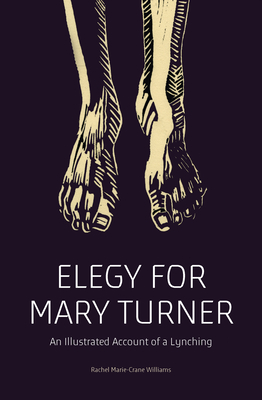
Review: Elegy for Mary Turner: An Illustrated Account of a Lynching, Rachel Marie-Crane Williams

Review: Elegy for Mary Turner: An Illustrated Account of a Lynching, Rachel Marie-Crane WilliamsElegy for Mary Turner: An Illustrated Account of a Lynching by Rachel Marie-Crane Williams
Published by Verso on March 16, 2021
Genres: Biography, History, Nonfiction
Pages: 57
Format: Paperback
Buy on AmazonBuy on Bookshop

This post contains affiliate links you can use to purchase the book. If you buy the book using that link, I will receive a small commission from the sale.

Goodreads
five-stars

A lyrical and haunting depiction of American racial violence and lynching, evoked through stunning full-color artwork.

In late May 1918 in Valdosta, Georgia, ten Black men and one Black woman—Mary Turner, eight months pregnant at the time—were lynched and tortured by mobs of white citizens.

Through hauntingly detailed full-color artwork and collage, Elegy for Mary Turner names those who were killed, identifies the killers, and evokes a landscape in which the NAACP investigated the crimes when the state would not and a time when white citizens baked pies and flocked to see Black corpses while Black people fought to make their lives—and their mourning—matter.

Included are contributions from C. Tyrone Forehand, great-grandnephew of Mary and Hayes Turner, whose family has long campaigned for the deaths to be remembered; abolitionist activist and educator Mariame Kaba, reflecting on the violence visited on Black women’s bodies; and historian Julie Buckner Armstrong, who opens a window onto the broader scale of lynching’s terror in American history.

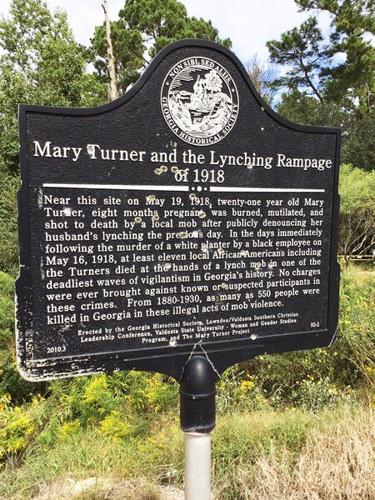
I read this book after one of my students recommended it. I think she may have read it in one of her other classes. This book describes one of the most horrific murders I think I’ve ever read about. And on top of everything that happened to Mary Turner and her family, the end of the book explains that the marker on the site of her lynching had to be removed to storage after being repeatedly defaced.

Mary Turner Memorial, photo published in Valdosta Daily Times

And yet some would have you believe that it’s people who want students to know the truth, the full and real history of slavery, Jim Crow, racial terror lynching, and White supremacy who are racially divisive. We must reckon honestly with our history of racism. This is an important book about a history that people should know. This is not ancient history. My great-grandmother, whom I knew as a child, was born the year after Mary Turner.

NPR: An Author Replies To The Unspeakable In Her ‘Elegy’ For Lynching Victim Mary Turner

Equal Justice Initiative: Mary Turner, Pregnant, Lynched in Georgia for Publicly Criticizing Husband’s Lynching

Black Past: Mary Turner (1899-1918)

five-stars

Related posts:

Review: The Five: The Untold Lives of the Women Killed by Jack the Ripper, Hallie Rubenhold

Review: The Five: The Untold Lives of the Women Killed by Jack the Ripper, Hallie RubenholdThe Five: The Untold Lives of the Women Killed by Jack the Ripper by Hallie Rubenhold
Narrator: Louise Brealey
Published by Highbridge on October 8, 2019
Genres: Biography, History, Nonfiction
Length: 10 hours 19 minutes
Format: Audio, Audiobook
Source: Audible
Buy on AmazonBuy on Bookshop

This post contains affiliate links you can use to purchase the book. If you buy the book using that link, I will receive a small commission from the sale.

Goodreads
five-stars

Five devastating human stories and a dark and moving portrait of Victorian London—the untold lives of the women killed by Jack the Ripper.

Polly, Annie, Elizabeth, Catherine, and Mary-Jane are famous for the same thing, though they never met. They came from Fleet Street, Knightsbridge, Wolverhampton, Sweden, and Wales. They wrote ballads, ran coffee houses, lived on country estates; they breathed ink-dust from printing presses and escaped people-traffickers. What they had in common was the year of their murders: 1888. The person responsible was never identified, but the character created by the press to fill that gap has become far more famous than any of these five women.

For more than a century, newspapers have been keen to tell us that "the Ripper" preyed on prostitutes. Not only is this untrue, as historian Hallie Rubenhold has discovered, but it has prevented the real stories of these fascinating women from being told. Now, in this devastating narrative of five lives, Rubenhold finally sets the record straight, revealing a world not just of Dickens and Queen Victoria, but of poverty, homelessness, and rampant misogyny. They died because they were in the wrong place at the wrong time—but their greatest misfortune was to be born a woman.

This book was very moving. I cried twice: while listening to the Introduction and while listening to the Conclusion/A Life in Objects. What I particularly appreciated about this book is that it focused on what is known about the five canonical victims of Jack the Ripper and not what he did to them. The book also did not focus at all on the killer himself. I appreciated this fresh approach. One problem I have with true crime as a genre is the way it can be overly glib about horrific crimes; people forget that real people were at the center of these crimes. Hallie Rubenhold handled the story of each woman gracefully. She has done a wealth of research into these women’s lives. The great tragedy that seemed to be at the heart of most of their stories was that they were poor and struggled with alcoholism. Rubenhold argues that the women have been dismissed as sex workers, the implication being that perhaps the world was better off after they were killed. However, not only is it untrue that they were all sex workers—as though that even means they deserved what happened to them, which Rubenhold also dismisses—but she also emphasizes their relationships with family members, loved ones, and friends. This book was a refreshing biography and should be the model for other books about famous crimes. It’s a shame that we, as a people, are more fascinated by a psychopathic misogynist than the women he killed.

five-stars

Review: Barracoon: The Story of the Last “Black Cargo,” Zora Neale Hurston

Review: Barracoon: The Story of the Last “Black Cargo,” Zora Neale HurstonBarracoon: The Story of the Last “Black Cargo” by Zora Neale Hurston, Deborah G. Plant
Published by Amistad on May 8, 2018
Genres: History, Nonfiction
Pages: 171
Format: Hardcover
Buy on AmazonBuy on Bookshop

This post contains affiliate links you can use to purchase the book. If you buy the book using that link, I will receive a small commission from the sale.

Goodreads
five-stars

In 1927, Zora Neale Hurston went to Plateau, Alabama, just outside Mobile, to interview eighty-six-year-old Cudjo Lewis. Of the millions of men, women, and children transported from Africa to America as slaves, Cudjo was then the only person alive to tell the story of this integral part of the nation’s history. Hurston was there to record Cudjo’s firsthand account of the raid that led to his capture and bondage fifty years after the Atlantic slave trade was outlawed in the United States.

In 1931, Hurston returned to Plateau, the African-centric community three miles from Mobile founded by Cudjo and other former slaves from his ship. Spending more than three months there, she talked in depth with Cudjo about the details of his life. During those weeks, the young writer and the elderly formerly enslaved man ate peaches and watermelon that grew in the backyard and talked about Cudjo’s past—memories from his childhood in Africa, the horrors of being captured and held in a barracoon for selection by American slavers, the harrowing experience of the Middle Passage packed with more than 100 other souls aboard the Clotilda, and the years he spent in slavery until the end of the Civil War.

Offering insight into the pernicious legacy that continues to haunt us all, black and white, this work is an invaluable contribution to our shared history and culture.

This book is such a valuable record. It’s wonderful that it has come to light at long last, and I’m so glad it exists. I first heard about the Clotilda on an episode of Finding Your Roots, hosted by Dr. Henry Louis Gates, Jr. The show’s genealogists uncovered that Questlove descended from Charles Lewis, one of the 125 people captured, enslaved, and brought to the United States on the Clotilda. This ship was the last ship to bring enslaved Africans to the United States in 1860. While the slave trade had been abolished, it didn’t stop the illegal trafficking of enslaved people, and of course, slavery had not yet ended in the United States. The men responsible for trafficking the people brought to the United States aboard the Clotilda were never punished for the crime.

Netflix currently has a documentary, Descendant, about the Clotilda descendants in Africatown, Alabama.

We now know that two other survivors of the Clotilda outlived Cudjo Lewis, but when Hurston interviewed him, he was believed to be the last person alive to have survived the Middle Passage. She captured video footage of Cudjo Lewis, a powerful documentation of the legacy of slavery.

I appreciated the opportunity to read this first-hand account of Cudjo Lewis’s story and am grateful to all those who brought his story to light.

five-stars

Related posts:

Review: We Don’t Know Ourselves: A Personal History of Modern Ireland, Fintan O’Toole

Review: We Don’t Know Ourselves: A Personal History of Modern Ireland, Fintan O’TooleWe Don't Know Ourselves: A Personal History of Modern Ireland by Fintan O'Toole
Published by Liveright on March 15, 2022
Genres: History, Memoir, Nonfiction
Pages: 624
Format: E-Book, eBook
Buy on AmazonBuy on Bookshop

This post contains affiliate links you can use to purchase the book. If you buy the book using that link, I will receive a small commission from the sale.

Goodreads
five-stars

A quarter-century after Frank McCourt’s extraordinary bestseller, Angela’s Ashes, Fintan O’Toole, one of the Anglophone world’s most consummate stylists, continues the narrative of modern Ireland into our own time. O’Toole was born in the year the revolution began. It was 1958, and the Irish government—in despair, because all the young people were leaving—opened the country to foreign investment. So began a decades-long, ongoing experiment with Irish national identity. Weaving his own experiences into this account of Irish social, cultural, and economic change, O’Toole shows how Ireland, in just one lifetime, has gone from a Catholic “backwater” to an almost totally open society. A sympathetic-yet-exacting observer, O’Toole shrewdly weighs more than sixty years of globalization, delving into the violence of the Troubles and depicting, in biting detail, the astonishing collapse of the once-supreme Irish Catholic Church. The result is a stunning work of memoir and national history that reveals how the two modes are inextricable for all of us.

I thoroughly enjoyed this book and learned a great deal. As O’Toole argues in the Acknowledgments (and also in speaking engagements), his “life is too boring for a memoir and there is no shortage of modern Irish history” (587). So he combined the two and described the changes Ireland has undergone while sharing his personal stories and anecdotes as well as connections to and recollections of those events. The result is a thoroughly engaging read.

I appreciated O’Toole’s facility with a turn of phrase as much as his skill with organizing his ideas. I was glad I read the book on Kindle, as it’s a hefty tome at more than 600 pages, but I also felt freer to highlight and otherwise markup the text. O’Toole’s central argument is that Ireland has attempted to operate under a “doubleness… [a] permanent state of contradiction” (33) that O’Toole describes throughout the book as “a society that had developed an extraordinary capacity for cognitive disjunction, a genius for knowing and not knowing at the same time” (168). This capacity, O’Toole argues, prevented Ireland from progressing socially until the 1990s and from progressing economically until roughly the same time. The abuses of the Irish Catholic Church came to light in the 1990s, and O’Toole sees this as no coincidence. As I read, I kept thinking of how Sinéad O’Connor tried to cast light on these abuses and was ostracized and criticized for telling the truth. Ireland’s capacity to both know abuses were happening and pretend they were not resulted in mass emigration and trauma, but O’Toole believes Ireland may have “reached the point of accepting that half-knowledge—the ability to see clearly what is, while also acknowledging what is dark—is better than the swinging between the pretence of knowing everything and the denial of what you really do know” (569).

O’Toole thoroughly covers many major events in Irish history over the last 60 or so years, and I was especially interested in reading about the Troubles. One of my earliest memories of a news story that captured my attention was the hunger strikes in the early 1980s. I just couldn’t fathom how someone might stop eating to protest. I had a very simplistic understanding of the Troubles until recently. O’Toole argues that at least in part, admiration for martyrdom prolonged the Troubles. O’Toole explains that the hunger strikes were a part of this mindset: “We sacrifice ourselves. By doing so we show that life itself—including your life—is not the ultimate value” (325).  Thatcher’s Britain doesn’t get a pass. O’Toole criticizes the UK’s lack of understanding and treatment of the prisoners during the hunger strike. O’Toole says if the British government had allowed the IRA prisoners to wear their own clothes “a year earlier, dozens of people, inside and outside the prison, would not have died” (335).

I first heard about this book from a book review by Cullen Murphy in The Atlantic. The review intrigued me, so I purchased the book for my Kindle. I had a feeling I’d want to own this one and mark it up well. I have been on spring break for the last two weeks, and I wanted to go into Boston and get a library card from the Boston Public Library, so I visited their website to find out the requirements. The website advertised that Fintan O’Toole would be giving a talk about his new book at the library on Friday, March 18. It seemed like kismet. My son and I rode the train into Boston and enjoyed a great day wandering around the city, culminating our visit with a library visit to hear O’Toole speak. I was fascinated to hear him discuss his frustration with Brexit. He said that no consideration had been given to Northern Ireland in Brexit at all, but as he explained it, citizens of Northern Ireland are free to define themselves as Irish, English, or both. I didn’t know that. I also didn’t know that they can rejoin the Republic of Ireland any time a majority of the citizens of Northern Ireland decide they want to. I think it will be very interesting to watch how Ireland’s future unfolds, especially now that Brexit means the border between Ireland and Northern Ireland is an EU border as well.

five-stars

Related posts:

Review: Crazy Horse and Custer: Born Enemies, S. D. Nelson

Review: Crazy Horse and Custer: Born Enemies, S. D. NelsonCrazy Horse and Custer: Born Enemies by S.D. Nelson
Published by Harry N. Abrams on November 9, 2021
Genres: Biography, Childrens, History, Nonfiction, Young Adult
Pages: 144
Format: Hardcover
Source: Library
Buy on AmazonBuy on Bookshop

This post contains affiliate links you can use to purchase the book. If you buy the book using that link, I will receive a small commission from the sale.

Goodreads
four-stars

With photographs and stunning illustrations from acclaimed author-artist S.D. Nelson, this thrilling double biography juxtaposes the lives of two enemies whose conflict changed American history: Crazy Horse and George Custer.

In 1876, Lakota chief Crazy Horse helped lead his people’s resistance against the white man’s invasion of the northern Great Plains. One of the leaders of the US military forces was Army Lt. Col. George Armstrong Custer. The men had long been enemies. At the height of the war, when tribalism had reached its peak, they crossed paths for the last time.

In this action-packed double biography, S. D. Nelson draws fascinating parallels between Crazy Horse and Custer, whose lives were intertwined. These warriors were alike in many ways, yet they often collided in deadly rivalry. Witness reports and reflections by their peers and enemies accompany side-by-side storytelling that offers very different perspectives on the same historical events. The two men’s opposing destinies culminated in the infamous Battle of the Greasy Grass, as the Lakota called it, or the Battle of the Little Bighorn, as it was called by the Euro-Americans.

In Crazy Horse and Custer, Nelson’s gripping narrative and signature illustration style based on Plains Indians ledger art, along with a mix of period photographs and paintings, shines light on two men whose conflict forever changed Lakota and US history. The book includes an author’s note, timeline, endnotes, and bibliography.

This book approaches the biographies of Crazy Horse and George Armstrong Custer by drawing parallels between their lives. It is striking that the two men who would face each other at the Battle of Little Bighorn were born a year apart and died a year apart. I appreciated that Nelson did not engage in the hagiography of either man but instead demonstrated their humanity, flaws and all. Truthfully, though, it’s hard for Custer to come across well to a modern reader, revered as he might have been at the time of his death. The author even points out that in our current time, Crazy Horse is largely admired while Custer is reviled.

I first became interested in this history when I saw the film Little Big Man as a middle schooler. It’s a great film and one of the first (if not the very first) revisionist Western. Though the main character is a White man who is kidnapped by Cheyenne as a child and assimilated into the tribe, some (though admittedly not all) of the Cheyenne characters are played by Native actors, and indigenous people are shown in a more sympathetic light than Hollywood had traditionally depicted them. After seeing this film, I started to read about what happened with Custer, who is a character in the movie.

This book seems to be pitched to late middle-grade readers. I admit I learned a lot I didn’t know about both men. I had no idea Custer and his father were pro-slavery, for example. I knew next to nothing of Crazy Horse’s biography. The book is organized into short chapters that alternate between the biographies of both men. The author explains that he feels uniquely qualified to tell this story as the descendant of a Lakota woman who married a White man who had served under Custer in the Army until being honorably discharged before the Battle of Little Bighorn.

Though the intended audience for this book is probably middle schoolers, anyone with a passing interest in the history of the so-called Indian Wars might enjoy reading this book. I appreciated the author’s artwork as part of the storytelling as well. Crazy Horse and George Armstrong Custer both come alive in the pages of this book.

four-stars

Review: Never a Dull Moment: 1971—The Year that Rock Exploded

Review: Never a Dull Moment: 1971—The Year that Rock ExplodedNever a Dull Moment: 1971—The Year That Rock Exploded by David Hepworth
Published by Recorded Books on June 9, 2016
Genres: History, Nonfiction
Length: 11 hours 39 minutes
Format: Audio, Audiobook
Source: Library
Buy on AmazonBuy on Bookshop

This post contains affiliate links you can use to purchase the book. If you buy the book using that link, I will receive a small commission from the sale.

Goodreads
four-half-stars

A rollicking look at 1971—the busiest, most innovative, and resonant year of the 70s, defined by the musical arrival of such stars as David Bowie, Pink Floyd, Led Zeppelin, and Joni Mitchell

On New Year's Eve, 1970, Paul McCartney told his lawyers to issue the writ at the High Court in London, effectively ending The Beatles. You might say this was the last day of the pop era. The following day, which was a Friday, was 1971. You might say this was the first day of the rock era. And within the remaining 364 days of this monumental year, the world would hear Don McLean's "American Pie," The Rolling Stones' "Brown Sugar," The Who's "Baba O'Riley," Zeppelin's "Stairway to Heaven," Rod Stewart's "Maggie May," Marvin Gaye's "What's Going On," and more.

David Hepworth, an ardent music fan and well-regarded critic, was twenty-one in '71, the same age as many of the legendary artists who arrived on the scene. Taking us on a tour of the major moments, the events, and songs of this remarkable year, he shows how musicians came together to form the perfect storm of rock and roll greatness, starting a musical era that would last longer than anyone predicted. Those who joined bands to escape things that lasted found themselves in a new age, its colossal start being part of the genre's staying power.

Never a Dull Moment is more than a love song to the music of 1971. It's also an homage to the things that inspired art and artists alike. From Soul Train to The Godfather, hot pants to table tennis, Hepworth explores both the music and its landscapes, culminating in an epic story of rock and roll's best year.

I wanted to read this book for a long time for many reasons, chief of which is that 1971 is the year I was born but also because I knew it was such a great year for music. Hepworth’s thesis is that 1971 was the greatest year for rock music, and given the evidence he provides, he makes a fairly strong case. I don’t necessarily agree with all of his arguments, but I think he makes a great case, and he clearly has done his research. I was impressed by the breadth of music Hepworth covered, too; I think many rock writers tend to be kind of niche. The book was entertaining, and each chapter ends with a playlist (my version is embedded below). On the other hand, reviews I’ve read critique the author because he picked the year he turned 20, and most of us wax nostalgic for the music we heard when we came of age, no matter how good or bad it was. I think there is also something to this argument. Hepworth reasons that 1971 was the year rock turned 17, so it arguably was also coming of age that year.

One of the more fun arguments Hepworth makes is that if you put together the biggest solo songs by each of the four Beatles, you’d have one of the best Beatles albums ever made: George Harrison’s “My Sweet Lord” and “Isn’t it a Pity?,” John Lennon’s “Jealous Guy” and “Imagine,” Paul McCartney’s “Another Day,” “The Back Seat of My Car,” and “Uncle Albert/Admiral Halsey,” and Ringo Starr’s “It Don’t Come Easy.” Another Spotify user put together an imagined album, and I have to admit it’s compelling:

I listened to the audiobook, and this is one I’d recommend reading in print. You might spend less time looking up things later on. I found it challenging to look up all the songs for the playlist. There was one song I couldn’t find on Spotify, so it doesn’t appear in the playlist below, but I honestly can’t remember what the song was anymore (I’d never heard of it before, and it went right out of my head). If I have another quibble, I’d argue Hepworth devotes a lot of space in the playlist to songs that really haven’t stood the test of time and are not in the same league as the more well-known songs on the list. Of course, that’s just my opinion, and I’m also speaking from the vantage point of someone who doesn’t remember the songs when they came out. Ask me about the late 1980s and early 1990s, and I might have a playlist with as many idiosyncracies as Hepworth’s. He had “Anticipation” by Carly Simon on the list twice, too (eh, I just left it like that). I was a bit surprised by Hepworth’s selection for the best song on the best album of the year. I don’t exactly think he’s out of the left-field with the choice. It makes a ton of sense. I might have argued for another song released, ironically enough, the same month—November. I don’t know if it’s spoiler-y of me to share the song title, but if you want to know it, let me know. Both the song he argued for the one I argued for are in the playlist below. One final point: near the end of the book, Hepworth argues that rock’s future was embodied in Elvis Presley’s career turn that year: becoming a nostalgia act and playing his hits for Vegas crowds rather than making new music. He argues that most rock acts end up that way—playing their earlier songs as their creative output diminishes. It’s a bit hard to argue with as there are few rock bands I can think of who are making music as compelling as the music they made when they were young. I have to say that part of the book made me feel a bit sad. In all, I would recommend this book for anyone who likes classic rock and wants to zoom in on a particularly significant year.

four-half-stars

Review: Sourdough Culture: A History of Bread Making from Ancient to Modern Bakers, Eric Pallant

Review: Sourdough Culture: A History of Bread Making from Ancient to Modern Bakers, Eric PallantSourdough Culture: A History of Bread Making from Ancient to Modern Bakers by Eric Pallant
Published by Agate Surrey on September 14, 2021
Genres: Cooking, History, Nonfiction
Pages: 280
Format: Hardcover
Buy on Amazon
Goodreads
four-stars

Sourdough bread fueled the labor that built the Egyptian pyramids. The Roman Empire distributed free sourdough loaves to its citizens to maintain political stability. More recently, amidst the Covid-19 pandemic, sourdough bread baking became a global phenomenon as people contended with being confined to their homes and sought distractions from their fear, uncertainty, and grief. In Sourdough Culture, environmental science professor Eric Pallant shows how throughout history, sourdough bread baking has always been about survival.

Sourdough Culture presents the history and rudimentary science of sourdough bread baking from its discovery more than six thousand years ago to its still-recent displacement by the innovation of dough-mixing machines and fast-acting yeast. Pallant traces the tradition of sourdough across continents, from its origins in the Middle East's Fertile Crescent to Europe and then around the world. Pallant also explains how sourdough fed some of history's most significant figures, such as Plato, Pliny the Elder, Louis Pasteur, Marie Antoinette, Martin Luther, and Antonie van Leeuwenhoek, and introduces the lesser-known—but equally important—individuals who relied on sourdough bread for sustenance: ancient Roman bakers, medieval housewives, Gold Rush miners, and the many, many others who have produced daily sourdough bread in anonymity.

Each chapter of Sourdough Culture is accompanied by a selection from Pallant's own favorite recipes, which span millennia and traverse continents, and highlight an array of approaches, traditions, and methods to sourdough bread baking. Sourdough Culture is a rich, informative, engaging read, especially for bakers—whether skilled or just beginners. More importantly, it tells the important and dynamic story of the bread that has fed the world.

I bought this book for myself as a birthday present. I learned some interesting things about how sourdough culture works as well as its use in historical bread baking. Pallant begins his history of sourdough with the conceit of tracing the origin of his own sourdough starter. He was told that its provenance was in the mining town of Cripple Creek, CO. in 1893; however, proving it turns out to be an impossible task. Pallant makes a case that sourdough’s survival is miraculous in the age of commercial yeast. He also addresses the boom in home-baked sourdough in response to the Covid-19 pandemic. (I personally know several people who never baked sourdough before the pandemic, and now they’re more expert than I am! Disclosure: I am not an expert.)

The historical aspects of the book are certainly interesting, though, at times, Pallant veers off-topic a bit. I found the scientific discussion of yeasts and bacteria really fascinating. Honestly, one of the first things I wanted to do was have my sourdough starter tested to see what sorts of yeasts and bacteria it contains. Can one do this? I feel like I found a website for a place where you could send your starter for testing, but now that I’m trying to find it again, I wonder if I dreamed it—sort of a 23 and Me for sourdough starter. I wouldn’t expect to find anything particularly odd about my starter, but it would be interesting to see what the dominant strains of yeast and bacteria are.

I found the chapter about the mass production of bread to be interesting, mainly because it helps explain why home-baked bread, even bread made with commercial yeast, tastes so much better than mass-produced bread. Honestly, his description of the Chorleywood Bread Process that is used to make commercial bread is kind of gross. It definitely did not make me want to go back to commercial bread, though, to be fair, I’m not sure if that process is used in the USA.

Pallant understands that making bread connects us to humanity’s history. I always feel connected to the past when I make a loaf of bread, and I feel even more connected when I make a loaf of sourdough. Sourdough demands time and patience, both of which are hard to come by in the 21st century.

Pallant also includes quite a few recipes, but frankly, there isn’t much that’s new. One recipe, for example, is Chad Robertson’s sourdough recipe. If you are looking for recipes, you’d do better to buy a bread recipe book. In fact, buy Chad Robertson’s Tartine Bread. Because Pallant spoke so highly of it, I bought Daniel Leader’s Living Bread: Tradition and Innovation in Artisan Bread Making (paid link), and I’m looking forward to reading that book and trying some of the recipes.

I would probably recommend this book only to true bread freaks. I’m not sure people who don’t bake would enjoy it. On the other hand, if you are interested in food history or microhistory (history focusing on a narrow subject), then you might still enjoy this book even if you don’t bake.

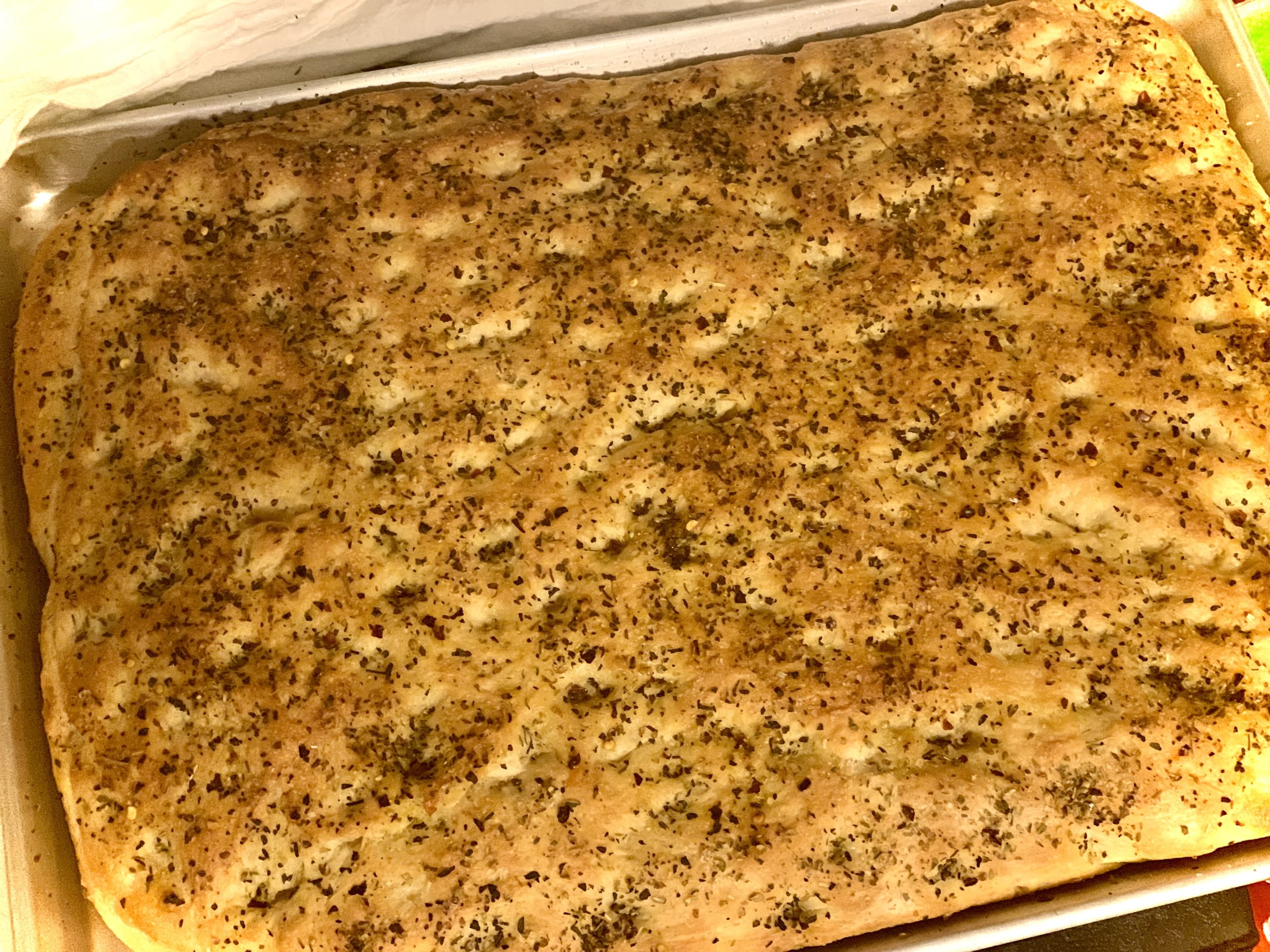
Sourdough Foccacia made with my starter. Recipe link.
four-stars

Review: A Brief History of Nearly Everything, Bill Bryson

Review: A Brief History of Nearly Everything, Bill BrysonA Short History of Nearly Everything by Bill Bryson
Narrator: Richard Matthews
Published by Books on Tape on October 17, 2003
Genres: History, Nonfiction, Science
Length: 17 hours 47 minutes
Format: Audio, Audiobook
Buy on Amazon
Goodreads
four-half-stars

Bill Bryson has been an enormously popular author both for his travel books and for his books on the English language. Now, this beloved comic genius turns his attention to science. Although he doesn't know anything about the subject (at first), he is eager to learn and takes information that he gets from the world's leading experts and explains it to us in a way that makes it exciting and relevant. Even the most pointy-headed, obscure scientist succumbs to the affable Bryson's good nature and reveals how he or she figures things out. Showing us how scientists get from observations to ideas and theories is Bryson's aim, and he succeeds brilliantly. It is an adventure of the mind, as exciting as any of Bryson's terrestrial journeys.

I have read quite a few Bill Bryson books this year. I enjoy his comic voice, which is evident in this book, though not as strong as in the other books I read. Partly, it’s the subject matter. Still, he manages to explain some complex topics in an accessible way and be entertaining at the same time. I was reminded in particular of my courses in anthropology, astronomy, and weather and climate from college as I listened. I was surprised I remembered so much.

The book might be a little out of date. I think it was originally published in 2003, and I have a whole grown-up son living in my house who was published the same year. As such, given the scientific nature of the book’s topics, I believe some of the information to be out of date. For example, Bryson asserts in the books that Neanderthals and Homo sapiens did not breed and even argued that the results might be similar to a mule (!). Well, I’m not sure when scientists discovered that’s not true, but the current prevailing thought is that they did, and not only did they, but many people the world over carry Neanderthal DNA. That was one example that I caught. It’s tricky because what we understand and the science behind it changes all the time.

Still, this was an enjoyable read, and I highly recommend the audiobook. The narrator is not Bryson, but he’s great.

four-half-stars

Related posts: